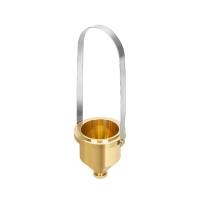
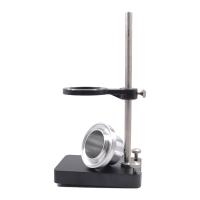
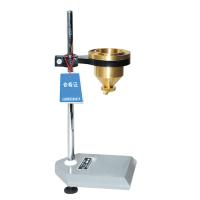
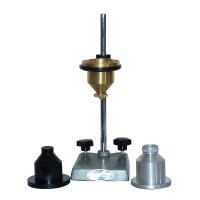
(1) Kinematic viscosity method This method is based on the national standard GB/T 265-1988, using a capillary viscometer to measure the kinematic viscosity of various standard oils. Then under the specified temperature conditions [such as (23 ± 0.2) ℃ or (25 ± 0.2) ℃], use various standard oils with known kinematic viscosities, and measure the Calibrate the outflow time t of the viscometer. According to the kinematic viscosity of the standard oil, the standard outflow time T of the Tu-4 cup is calculated by the formula.
T = 0. 2231v+6 (23s≤T<l50s)
In the formula, T——standard outflow time, S:
v—kinematic viscosity, mm²/s.

Under the same conditions, the ratio of the standard outflow time T of the viscometer being calibrated to the measured outflow time t is the correction coefficient K of the Viscosity Cup. The formula is:
K = T/t
In the formula, K——Viscometer correction coefficient;
T——Standard outflow time, s;
t is the outflow time measured one by one, s.
Obtain a series of correction coefficients K1, K2, K3, etc. according to the above formula, and take the arithmetic mean value, which is the correction coefficient K of the Viscosity Cup. If K is within the range of 0.95-1.05, the Viscosity Cup is qualified and can still be used, but the test data should be multiplied by the correction coefficient K to obtain the real measured viscosity.
(2) Standard viscosity meter method The standard Viscosity Cup is commonly known as the K value cup, and the Tu-4 cup used is regularly checked with the standard Viscosity Cup.
(3) Ngualla condition degree The Ngualla condition degree refers to the time in seconds (s) between the time required for the sample to flow out of 200mL from the Engel viscometer at a certain temperature and the time required for distilled water to flow out of the same volume at 20°C Compare. The standard value of Engua viscometer should be (51 ± 1) s. Use the Engua viscometer to find the conditional degree (°E) of each standard oil, check the kinematic viscosity according to the corresponding table, and use the formula (1-1) or formula (1-2) to calculate it, which is the same as that measured by the calibrated Viscosity Cup The ratio of outflow time t is the correction coefficient K. Since the data deviation of this method gradually increases with the increase of standard oil viscosity, it is rarely used at present.