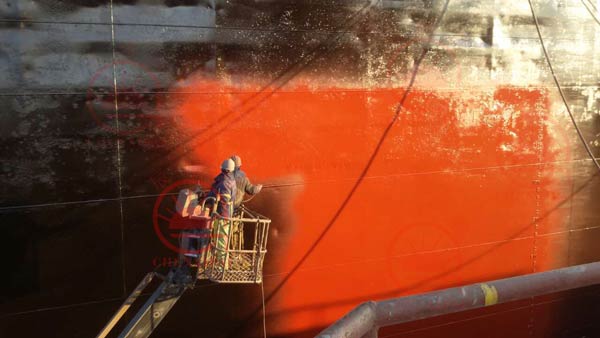
(1) Before painting, the pre-treatment of the steel plate strictly meets the relevant standards for secondary derusting, degreasing, decontaminating , wiping the surface with a solvent, and painting should be done as soon as possible to avoid re-oxidation and rusting of steel.
(2) According to different parts of the ship and different use requirements, choose reasonable coating varieties and supporting schemes . Each coating should be constructed in accordance with the requirements of the product instruction manual. Before painting, check whether the type, color, specification and model of the paint meet the technical requirements of painting, and check the quality and storage period of the paint. The paint that exceeds the storage period needs to be re-inspected by a unit with inspection qualifications, and can only be used after passing the test .
(3) Thinner should be used as required, generally no more than 5% of the paint dosage. Harmful solvents or pigments are not allowed mixed evenly before use and filtered according to the requirements of the coating method. For two-component coatings, the curing agent should be added in proportion and stirred evenly. It should have a certain pot life and be used up within a certain period of time.
(4) The construction unit can adopt suitable generally brush coating, roller coating, air spray coating, airless spray coating and scraping coating and other construction methods. In order to improve the effectiveness and obtain a beautiful coating film, high-pressure airless spraying is generally used. However, roller coating or manual brushing is still used for the coating of small cabins . Use a brush , elbow brush, etc. to pre-paint the water hole, the back of the angle iron, and the parts that are not easy to spray . For dissimilar metal contact parts and rivets, welds and edges and corners should be brushed once, and then sprayed.
(5) The coating film should reach the specified dry film thickness. During the coating process, the wet film thickness should be continuously measured to estimate how many coats can be sprayed to reach the specified dry film thickness. Before spraying and painting, it is necessary to carry out trial spraying, select the appropriate nozzle, and adjust the appropriate pressure.
(6) When applying anti-rust paint, it is better to use the same type of paint with different colors for each coat to prevent missing coating and facilitate quality inspection. After the coating is completed, the total dry film thickness shall be inspected and the coating leak test shall be carried out .
(7) It is forbidden to paint on sacrificial anodes, insoluble auxiliary anodes, reference electrodes, receiver and transmitter threads of depth sounders, signs, rubber seals, valves, steel cables, movable friction surfaces, etc. that are not suitable for painting . Cover with adhesive tape when spraying or applying by other methods.
(8) It is strictly forbidden to apply antifouling paint and waterline paint directly on the bare metal surface or the inner wall of the cabin.
(9) When painting in sections, it is strictly forbidden to work with open flames. High-pressure airless spraying needs to strictly abide by the operating procedures and prevent the spray from polluting the environment. Install appropriate ventilation equipment to avoid the poisoning of the human body and possible fires caused by solvent evaporation, while ensuring the construction quality. Coating small cabins requires artificial ventilation, and construction personnel should wear gas masks and work continuously for no more than half an hour.
(10) Coating construction is generally carried out in an environment with a temperature of 5~30°C and a relative humidity of less than 85% . It should not be painted outdoors when it is raining, foggy or the hull is covered with water vapor, frost and snow. It is not suitable to paint when there is a lot of wind and dust . The temperature of the steel plate should be 3°C higher than the dew point, and the air temperature should not be lower than the minimum temperature specified for the drying of the paint.
(11) Aluminum, galvanized surfaces or other special material surfaces should use special paints, such as zinc yellow primers , and primers containing copper, mercury, and lead pigments are not allowed.
(!2) Before the watertight test, the welds and rivets of the hull part shall not be painted within 10mm around; before welding no paint shall be painted within 50mm of the weld edge. When painting, it should be covered with paper or plastic film, and it should be removed in time .
(13) In order to ensure the quality of the coating, the segment can only be moved after the coating film is fully dried. Avoid scratching and abrading the coating film when moving .
(14) Before the coating is applied, the construction unit shall calculate the required amount of coating and formulate detailed construction plan according to the actual situation of each part of the ship such as the coating area, construction method, and substrate, as well as referring to past construction data and other factors.
