1. Selection background
Background: Field/Outdoor Flaw Detection
Working conditions: Weld seam flaw detection is the main focus, mainly considering the butt welding, lap welding and fillet welding of the plate; the surface is usually painted and not smooth; the thickness of the plate is mostly below 25mm; most of them are assemblies, that is, they have been assembled, Without disassembling the detection, it may only be detected on one side.
It is difficult to use the eddy current method: the surface has paint, rust stains, is not smooth, and has burrs;
Difficult to use X-ray method: need to consider protective equipment, film processing equipment, unable to judge at the time; (except industrial CT)
Difficult to use magnetic particle method: no grinding of weld reinforcement, deep cracks cannot be detected,
There may be non-magnetic parts (such as aluminum alloy parts);
Difficult to use penetration method: Defects not opened to the surface cannot be detected.
2. Solutions
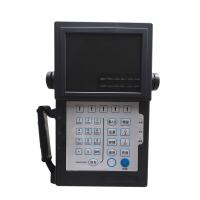
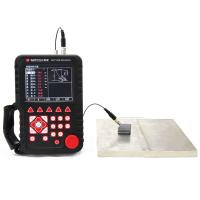
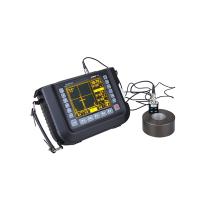
Based on the above circumstances, it is recommended to use an ultrasonic flaw Detector. For flaw detection in various working conditions, refer to the following two pictures (typical pictures, for reference only):
Figure 1, butt welding, the weld reinforcement has not been ground and can only be detected on one side. An angle probe can be used to observe primary or secondary echoes, and scan and detect flaws on both sides of the weld.
Figure 2, fillet weld. Comprehensive use of oblique probes, straight probes, multi-faceted and multiple detections.
Ultrasonic flaw detection is used for three purposes:
Positioning: whether there is a defect, roughly where it is;
Quantitative: Whether the size of the defect exceeds the standard - the existence of defects is often inevitable, the key is whether the size is within the safe range;
Qualitative: What kind of defects, pores, slag inclusions, cracks? - This is completely based on the familiarity with the structure and material of the tested part, and after rich detection experience, self-summarization.
The working process of ultrasonic measurement:
The probe emits or receives ultrasonic signals, causing the probe crystal plate to vibrate. The mechanical vibration is converted into electrical energy and manifested as a change in voltage. The instrument monitors this change in voltage and converts this change into an oscillometric signal on the screen. show.
The change of the voltage is the data (sampling) collected by the instrument. According to this change, the calculation is carried out, so as to obtain the position where the signal comes back, the strength and weakness, and then according to the formula (or various standards) Refer to the curve) to further deduce whether this signal is an over-standard signal.
It can be seen that the accuracy of sampling is fundamental, and it is affected by three major aspects: the material/structure of the tested part, the probe (frequency/structure), and the instrument.
We cannot control and choose the tested part; the probe can be replaced continuously, and finally a suitable matching probe can be selected according to the actual situation (so, the probe is a vulnerable and consumable part).