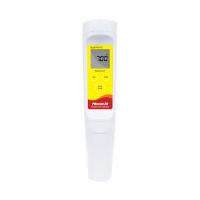
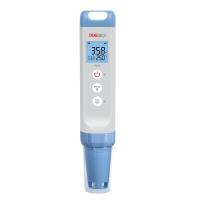
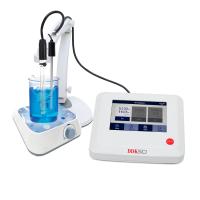
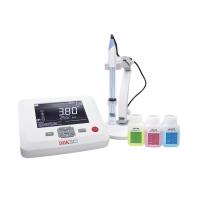
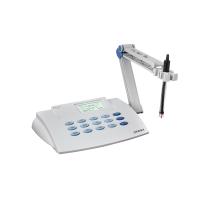
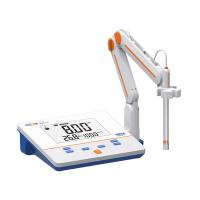
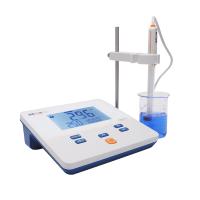
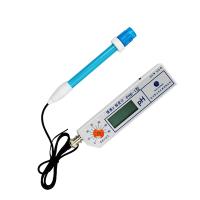
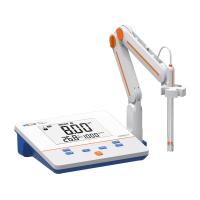
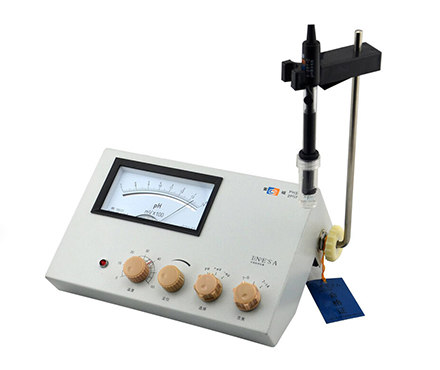
In beer enterprises, the PH meter is one of the longest-used testing instruments. In addition to measuring the PH value and total acid of beer, the PH meter is also used for the pH of wort and fermented liquid to achieve effective production guidance. This article will introduce the working principle of pH meter in detail.
1 Principle of pH meter
1.1 Measuring principle
The measurement of the pH of the solution generally uses a glass electrode as the measuring electrode, and a Gancheng electrode or a silver-silver chloride electrode as the reference electrode. When the hydrogen ion activity changes, the electromotive force between the electric glass electrode and the reference electrode will change accordingly. .
The pH value is the unit for measuring the acidity and alkalinity of a certain solution. It is expressed as the negative logarithm value of the hydrogen ion concentration.
Measuring pH requires a sensing electrode and a reference electrode. Combination electrodes (a combination of sensing and reference electrodes) are often used in routine pH measurementsc
The sensing (pH) electrode (or the sensing element in a combination electrode) has some sort of internal buffer that stabilizes the pH. And generate a potential (difference in internal and external ionic charge) in the measured solution. This depends on the H+ activity (concentration) in the ficus solution. c The reference electrode (or the reference element in the composite electrode) has a defined, stable. Potential c independent of sample H+ activity
The response (or slope) of a pH electrode is calculated using the Nernst equation.

F: Faraday's constant (that is, Faraday's constant 96495 coulombs/gram equivalent)
T: absolute temperature (273 + t°C)
pH: Indicates the measured content: the difference between the night pH value and the pH value of the inner solution
1.2 Electrode system
Combination electrodes are generally molded case rechargeable composite electrodes that are composed of a glass electrode (measuring electrode) and silver-silver chloride (reference electrode). The glass electrode head bulb is made of a specially formulated glass film. It is only sensitive to hydrogen ions. When it is immersed in the measured solution, the hydrogen ions in the measured solution exchange with the hydration layer on the surface of the electrode bulb to form a potential, and the inner layer of the bulb also has potential. Therefore, a potential difference is generated inside and outside the bulb. This potential difference varies with the concentration of hydrogen ions in the outer layer. Since the hydrogen ions of the solution inside the electrode are constant, the pH value of the solution to be measured can be known as long as the potential difference is measured.
The glass electrode bulb is composed of a silver-silver chloride electrode to form a half-cell, and a silver-silver chloride reference electrode is passed outside the bulb to form another half-cell. The two half-cells form a complete chemical primary cell, and its potential is only It is related to the hydrogen ion concentration of the measured solution.
When the potential difference formed by a pair of electrodes is equal to zero, the pH value of the measured solution is the zero potential pH value. It is related to the liquid in the glass electrode c,
1. 3 Slope
That is, the electrode conversion coefficient. Because the actual electrode system cannot reach the theoretical conversion factor (100%). Therefore, the pH needs to be corrected, and the two-point calibration method is commonly used.
This article mainly excerpts Tian Jiyuan's "Principle and Effective Operation of PH Meter"