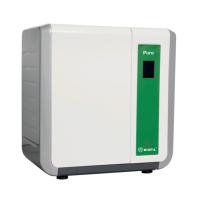
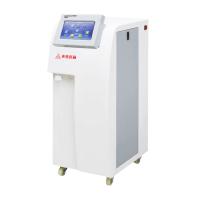
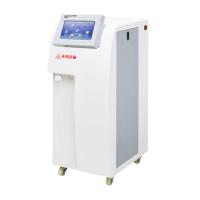
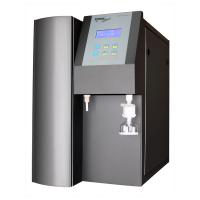
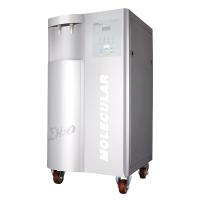
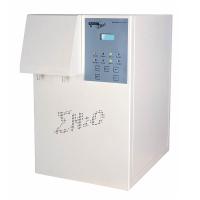
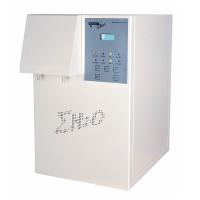
First of all, let’s briefly understand the ultra-pure water machine in the laboratory. The tap water is pretreated by a precision filter element and an activated carbon filter element to filter particulate matter such as sediment and absorb odors, etc., so that the tap water becomes cleaner, and then the water quality is purified and desalinated through a reverse osmosis device. The purified water is stored in the water storage tank, and its water quality can reach the national third-grade water standard. At the same time, the wastewater produced by the reverse osmosis device (also known as "concentrated water") is discharged.
Reverse osmosis pure water is desalinated through the purification column to obtain first-grade water or ultrapure water. Finally, if the user has special requirements, ultraviolet sterilization or microfiltration, ultrafiltration and other devices are added behind the ultrapure water to remove residual water. Bacteria, particles, heat sources, etc.

maintenance
Precision filter elements, activated carbon filter elements, reverse osmosis membranes, and purification columns are all materials with relatively long lifespans. Precision filter elements and activated carbon filter elements are actually protection for the reverse osmosis membrane. Short, if you continue to turn on the machine, the quality of the pure water produced will decrease, and then the burden on the purification column will be increased, and the life of the purification column will be shortened. The end result is to increase the cost of using the ultrapure water machine.
The ultra-pure water machine with tap water as the water source generally has two water outlets, namely the third-grade water and the first-grade water. Take it immediately, don't store it. The third-grade water does not pass through the purification column, the first-grade water passes through the purification column, and the cost of the first-grade water is higher than that of the third-grade water. Therefore, in daily use, water should be drawn according to the water quality requirements. When the third-grade water can be used, the first-grade water should not be used as much as possible to avoid the increase in use costs.
The specific steps of the long-term shutdown maintenance measures of the pure water machine are as follows:
1. First, clean the membrane elements in the reverse osmosis system;
2. Use the water produced by reverse osmosis to prepare a sterilizing solution, and use the sterilizing solution to flush the reverse osmosis system;
3. After filling the reverse osmosis system with the sterilizing solution, close the relevant valves to keep the sterilizing solution in the system. At this time, confirm that the system is completely filled;
4. If the system temperature is lower than 27°C, the first two steps should be performed with a new sterilizing solution every other month. If the system temperature is higher than 27°C, the sterilizing solution should be replaced every half a month;
5. Before the single-stage reverse osmosis pure water system is put into use again, flush the system with low-pressure water supply for one hour, and then flush the system with high-pressure water supply for 5 minutes. Regardless of low-pressure flushing or high-pressure flushing, the water discharge valve of the system should be All open. Before resuming normal operation of the system, check that the product water is free of any biocide.