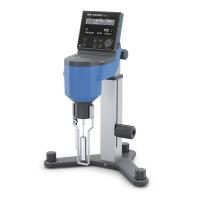
Standard viscometers and rheometers measure viscosity using a rotating rotor submerged in a fluid, see Figure 1 . The resistance measured at different speeds is reflected as a torque value, and the value in the unit of " centipoise " is obtained through mathematical calculation . The resulting graph from the test is similar to the graph shown in Figure 1 on the instrument. Viscosity value on the Y-axis vs. RPM on the X-axis. Non-Newtonian fluid materials usually exhibit a decrease in viscosity as the rotational speed increases. This type of flow behavior is known as "pseudoplasticity" or "shear thinning".

Non-flowing materials are more challenging to test for viscosity because the rotor will form a void where it rotates. Once the material is far away from the rotor, the material cannot recover in time, and a void will be generated near the rotor. At this time, the viscosity value will drop rapidly, and accurate data cannot be recorded. Choosing a rotor with a different shape can solve this problem.
The paddle rotor used in the instrument in Figure 2 has several advantages: the paddle rotor can be directly inserted into the sample without destroying the structure of the sample; the sample between the rotor blades is fresh and can be tested directly without pre-shear history .

The instrument shown in Figure 2 is a controlled stress rheometer. The instrument has two modes to choose from: run the rotor at a specified torque, or run the rotor at a specified speed. The former is used to determine the force to initiate flow, and the latter can characterize both the force to initiate flow and the viscosity or resistance to motion after flow begins. Using the latter method can provide two-part comparative data in a rapid test for monitoring a product.

Control the low speed, such as 0.5rpm to test, as the rotation starts, the resistance to the rotor increases. The recorded stress will reach a peak, known as the "yield stress", which indicates the onset of material flow behavior. Figure 3 shows the yield stress test curves for conventional butter and spreadable butter. Because the rotors rotate at the same speed with different resistances, the slope of the curve after flow initiation can represent the respective viscosity of the samples.
相同的测试可以用于比较黄油和人造黄油的延展性。图 4 用同样的方法测试三种不同产品。黄油的行为表现为在屈服应力点附近为渐进式的变化,而人造黄油在开始流动后应力值急剧下降。这反映了人造黄油的结构更脆弱,一旦开始流动,人造黄油的涂抹阻力更小。1 号黄油比 2号黄油的屈服应力和粘度值高,表示其品牌可能更优。

如果使用流变仪的控制扭矩模式,并保持一个接近材料屈服应力的恒定值,可以测试材料的蠕变行为。有这种特性的材料(例如果酱和糖衣)要在恒定负荷(如重力)下保持它们的形状。当材料的外观对用户有影响时,此类测试是很重要。另一个例子是需要保持作为糕点填料的果酱和糖衣的结构完整性,以便不发生渗出的情况。所有情况下,保持形状都是材料需要的特性。
进行此类测试的另一种方法是使用图 5 所示的质构仪。仪器驱动探头以指定的穿透速率刺入样品。延展性的测量可以使用图 6 的夹具配合锥形探头以 1mm/sec 的速率进入测试材料的容器来完成。仪器According to时间和位移,以力值的形式记录穿透阻力,单位为克。探头刺入样品的距离由用户决定。


这种测试方法有几个优点:
1) 如果需要,样品可以放置于原始包装或容器;
2) 测试前,材料无破坏;
3) 穿刺或挤出样品的消耗可量化;
4) 移开探头可以测量材料的粘性特性,即探头收回时材料对探头的粘滞力。
图 7 展示了一个典型的黄油和人造黄油延展性测试数据图。峰值表示样品的硬度。上升到峰值的曲线斜率为一个“刚性”测量,并且会随着探头穿透的速度调整而发生变化。上升到峰值的曲线下方区域是测量穿透样品所做的功。比较测试结果,可以看出人造黄油比黄油更软。

测量高度粘稠、不流动的物料有两种可选用的方法:带(锥)桨式转子的流变仪和带锥形探头的质构分析仪,哪个更好?在两种方法都可接受、易执行,且准备和清洁过程相似的情况下,两种测试的数据都是有效的,可以测量硬度、坚固性和延展性。质构分析仪可计算所做的功提供额外的信息。任一方法都可以用于比较重现性,通过测试问题物料是很好的证实。
The investment of laboratory managers is mainly in the purchase of equipment and training of personnel. Both instruments have been available and used in general industry for many years. R&D can cooperate with the software to characterize the initial material, and the QC laboratory can perform stand-alone operation of the instrument, and can report the yield stress or hardness of the material separately.
When the laboratory has sufficient resources, you can find that the test method is similar to the above two instruments. Perhaps now is the time to apply these testing techniques and improve QC testing of your "soft solid" products.