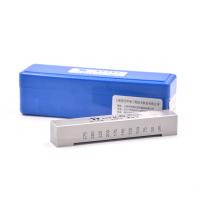
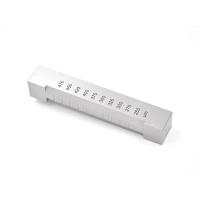
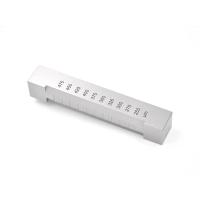
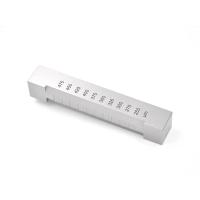
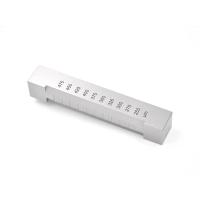
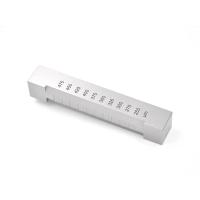
A.Equipment
anti-dragging watch Straightening Edges, Item SE-1 Descending plate fixation, item 1 Extract Form 7b black and white, light paint. Form WB pure white, dark paint. Fixed Paper, Form CP-1 Pre-shear equipment with low sag resistance, flat glass surfaces are preferred.
B. Preparation of Coatings
Stir well and adjust to 23°C (73.5°F) pre-cut as described in a With pre-cut method Testing follows.
C. Application of paint
Put the straight-edged drop board in place. Clip the test chart downsizing board. Place adjacent clips on the anti-drain gauge chart, with their operators shoulder-side apart from the ruler. The location catches the paper. Apply an appropriate amount (8-10 ml) of pre-shear directly in front of the blade, and rain evenly at about 6 inches (150 mm) per second. In time place the landing onto a vertical surface, with a horizontal stripe like a standing ladder rung, on top of the left edge (thin stripe), and allow to dry in that position.
D. Rating down
Note the number of incisions marked on the anti-sag sheet and identify the corresponding stripes, accordingly. Ignore the leading and trailing edges, and observe only the central 5/2" (150 mm) of the blade channel, which corresponds to the black area of the Form 7B. The lowest (thickest) streak, untouched, is itself called the index stripe, and its notch number is the inverse of the paint sag index. For a more accurate anti-sag index, add to the degree of the index gap step product and fraction after the number of index entries it fails to merge with the next entry

E. Interpretation of Rating Practices
This is experience and strongly subjective. It should be emphasized that the anti-sag index is not the wet film thickness which is expressed by the MILS index of the groove gap, so that approximately twice the emphasis is approximately twice the wet film thickness of the approximate index fringe. Both the anti-sag index and the estimated corresponding wet film thickness are interpreted as requiring specific thicknesses in practice. This is only a numerical comparator and the actual meaning obtained is based on experience only. When a coating is considered to have good sag resistance by practical application, the anti-sag index is measured and thereafter becomes the sag control value for a particular formulation.