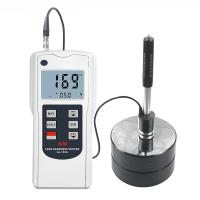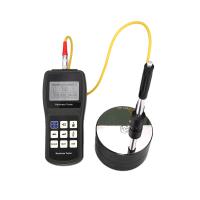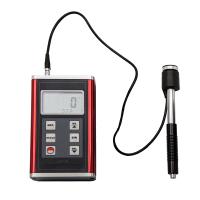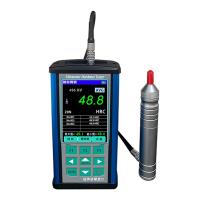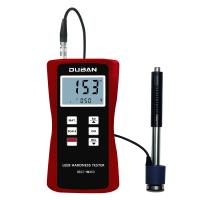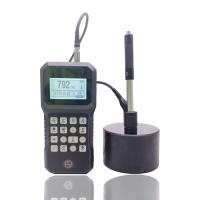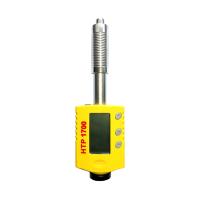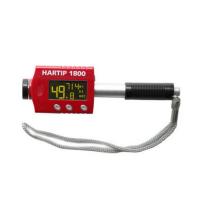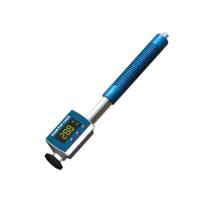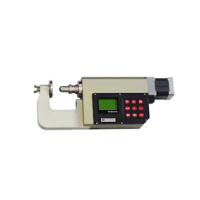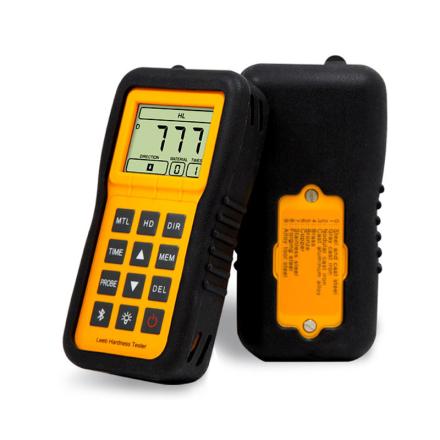
The Leeb Hardness Tester has 7 hardness systems: Leeb (HL), Shore (HS), Brinell (HB), Rockwell A (HRA), Rockwell B (HRB), Rockwell C (HRC), Vickers Shi (HV). The Leeb Hardness Tester can realize the mutual conversion between seven kinds of hardness (HL, HRA, HRB, HRC, HB, HV, HS) and the mutual conversion between hardness and tensile strength (according to the standard GB/T 1172-1999).
When testing at the engineering site, the Leeb Hardness Tester is used to test the hardness of the metal surface in order to infer the material of the steel. Therefore, during on-site testing, it is better to choose the two hardness systems of Rockwell B (HRB) and Vickers (HV). According to the test results, the tensile strength value of the steel can be directly converted, and then according to the current Standard "Carbon Structural Steel" GB/T 700 and "Low Alloy High Strength Structural Steel" GB/T 1591, check the tensile strength values corresponding to various materials, such as the tensile strength of Q235 steel is 370MPa-500MPa. Combined with the test results, the material of the steel can be inferred. If it is necessary to further and more accurately grasp the material of the steel, it is necessary to make a judgment based on the method of chemical element analysis of the steel in accordance with the provisions of the "Technical Standards for On-Site Inspection of Steel Structures" GB/T 50621-2010.
The Leeb Hardness Tester is a more professional hand-held hardness testing instrument. The Leeb Hardness Tester has the characteristics of easy portability, wide measurement range, and convenient operation. It is especially useful for parts that are not easy to move or require retesting of hardness after finishing. However, in the actual hardness measurement, it is found that the hardness value measured by the Leeb Hardness Tester is generally lower than the hardness value measured by the bench-type Hardness Tester (Brinell Hardness Tester, Rockwell Hardness Tester), which to a certain extent provides a basis for determining the quality of the part. The actual situation created difficulties.
To use the Leeb Hardness Tester to accurately measure the Brinell hardness or Rockwell hardness of the part and judge it, the following issues need to be paid attention to:
(1) First of all, it is necessary to determine whether the accuracy of the Leeb Hardness Tester used meets the measurement requirements;
(2) Be familiar with the measurement principle of the Leeb Hardness Tester to ensure the correctness of the surface state of the tested part and its support;
(3) Before the measurement, the Hardness Tester must be calibrated on the standard test block and the test parameters of the Hardness Tester should be correctly set, such as the impact direction, hardness scale, strength and the code of the material to be tested, etc.;
(4) If the tested part (or hardness block) is formed by forging process, and the tested Brinell hardness value is within a certain range, the Leeb hardness test should be selected, and finally the value can be obtained by looking up the HLD average value displayed by the Hardness Tester. Brinell hardness value of the part;
(5) According to the actual situation of product manufacturing, a series of commonly used materials and hardness test blocks with different process parameters shall be made, and the Rockwell hardness measured by Leeb Hardness Tester, Rockwell Hardness Tester or Brinell Hardness Tester shall be marked respectively Value or Brinell hardness value, so that necessary corrections can be made when the bench Hardness Tester cannot be used or the hardness of the part needs to be re-measured after finishing.
In short, when using a Leeb Hardness Tester to measure the Brinell or Rockwell hardness of a part, in addition to operating correctly according to the operating procedures, a certain amount of correction should be made so as to accurately reflect the hardness value of the tested part.