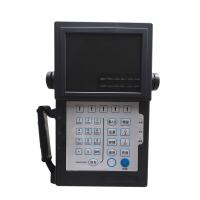
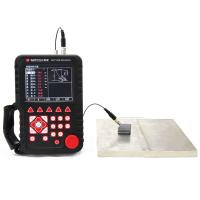
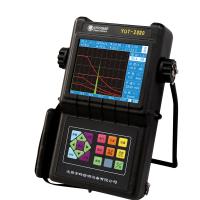
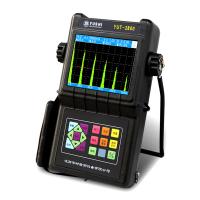
The application of ultrasonic non-destructive testing in the identification and testing of steel structures, combined with relevant specifications, is discussed as follows:
1. Types of test data and test reports
In the case that the house has relevant information, we should conduct a comprehensive evaluation based on relevant information and inspection data when we carry out identification and testing. The relevant information provided by the entrusting unit often includes self-inspection by the construction unit, witness inspection and third-party inspection. For the above three materials, the corresponding requirements can usually be summarized as listed in Table 1:
If the following inspection data fails to pass the review or the on-site sampling inspection fails to meet the standards, the project should be further tested in combination with relevant national regulations such as reliability appraisal standards and steel structure engineering construction quality acceptance specifications.
2. Inspection level of non-destructive testing of welds:
According to the provisions of GB11345-89 "Manual Ultrasonic Flaw Detection Methods and Flaw Detection Results Classification of Steel Welds", the ultrasonic inspection grades are divided into three grades: A, B, and C:
A-level inspection uses a probe with an angle to inspect one side of the weld, and only detects the section of the weld that is allowed to be scanned. Inspection for transverse flaws is generally not required. When the base metal thickness is >50mm, Class A inspection shall not be adopted.
In principle, level B inspection uses an angle probe to inspect one side and both sides of the weld to detect the entire weld section. When the base metal thickness is >100mm, double-sided and double-sided inspection shall be adopted. Restricted by geometrical conditions, probes with two angles can be used for flaw detection on both sides and one side of the weld. When conditions permit, inspection for transverse defects shall be carried out.
C level inspection shall use at least two kinds of angle probes for inspection on one side and both sides of the weld. At the same time, two scanning directions and two kinds of probe angles are to be inspected for transverse defects. When the base metal thickness is >100mm, double-sided and double-sided inspection shall be adopted. Other additional requirements are: 1. The reinforcement of the butt weld should be ground flat so that the probe can scan in parallel on the weld; 2. The part of the parent metal passed by the oblique probe on both sides of the weld should be inspected with a straight probe; 3 .When the base metal thickness of the weld is ≥100mm, and the thickness of the base metal of the narrow gap weld is ≥40mm, it is generally necessary to increase the tandem scanning.
3. Specific requirements for non-destructive testing of building structure welds:
1. The design requires full penetration welds, and the inspection of internal defects shall meet the following requirements:
1) 100% inspection shall be carried out for the first-grade welds, and the qualified grade shall be Grade II and above of Grade B inspection in GB11345-89 of Manual Ultrasonic Flaw Detection Method and Flaw Detection Results Classification of Steel Welds;
2) Second-level welds should be subject to random inspection, with a sampling ratio of 20%, and their qualified grades should be Grade III and above for Class B inspection in GB11345-89 of Manual Ultrasonic Flaw Detection Methods and Flaw Detection Results for Steel Welds;
3) Non-destructive testing is not required for full penetration tertiary welds.
2. The ultrasonic flaw detection and defect classification of welded ball joint grid frame welds shall comply with the provisions of JG/T3034.1-1996 "Ultrasonic flaw detection and quality classification method for welded ball joint steel grid frame welds".
3. Ultrasonic flaw detection and defect classification of bolted ball joint grid welds shall comply with the provisions of JG/T3034.2-1996 "Method for Ultrasonic Flaw Detection and Quality Classification of Bolted Ball Joint Steel Grid Frame Welds".
4. The ultrasonic flaw detection method and defect classification of T, K, Y joint welds of round pipes shall comply with the provisions of JGJ81-2002 of "Technical Regulations for Welding of Construction Steel Structures".
4. Evaluation grade of weld defects
After the size of the defect is determined, the quality level of the weld should be evaluated according to the nature of the defect and the indicated length combined with the provisions of the relevant standards.
The assessment grades of ultrasonic inspection of internal defects of welds are divided into grades I, II, III and IV, of which grade I is the highest quality and grade IV is the lowest.
According to the distance-amplitude curve drawn on the standard test block, compare the position of the highest echo of the defect in the weld and the nature of the defect to judge the weld grade. For defects whose maximum reflection amplitude does not exceed the evaluation line in the distance-amplitude curve, they are all evaluated as Class I; when the defect inspector judges that the maximum reflection amplitude exceeds the evaluation line as a crack or other harmful defect, regardless of its amplitude and size, it is evaluated as Class I. Grade IV; non-crack defects with reflection amplitude in zone I are rated as grade I; defects with reflection amplitude in zone III are rated as grade IV regardless of their indicated length. The defect whose maximum reflection amplitude is located in zone II is followed by the indicated length of the defect:
5. Weld inspection counting rules and conformity assessment
1. Non-destructive testing counting rules for internal defects of welds The proportion of first-level weld flaw detection is 100%, that is, all flaw detection; the proportion of second-level weld flaw detection is 20%. For factory-made welds, the proportion should be calculated according to the length of each weld, and The flaw detection length is ≥ 200mm. When the weld length is ≤ 200mm, flaw detection should be carried out on the entire weld; for field installation welds, the ratio should be calculated according to the number of welds of the same type and the same welding conditions, and the flaw detection length should be ≥ 200mm. And there should be no less than one weld; non-destructive testing of internal defects is not required for third-level welds.
2. The counting method of the number of welds. When the length of the weld made by the factory is ≤ 1000mm, each weld is 1 place. When the length is > 1000mm, it is divided into 1 place every 300mm. for 1 place.
3. Qualification judgment of sampling inspection If the number of welds in the sampling inspection is less than 2%, the acceptance of this batch should be determined as qualified; If the unqualified rate of all welds in random inspection is ≤3%, the acceptance of this batch shall be regarded as qualified, and when it is >3%, the acceptance of this batch shall be regarded as unqualified. When the batch acceptance fails, all remaining welds in the batch shall be inspected.
6. Types of common defects in welds and their identification in ultrasonic flaw detection
Common defects in welds mainly include pores, slag inclusions, incomplete penetration, incomplete fusion and cracks, and their respective echoes have their own characteristics.
1. Stomata
Pores are cavities formed in the weld metal that absorb excess gas or gas produced by metallurgical reactions when the weld pool is at a high temperature during the welding process. They have no time to escape before cooling and solidification, and remain in the weld metal. Stomata can be divided into single stomata and dense stomata. The echo height of a single stomata is low, and the waveform is relatively stable. Probing from all directions, the reflected wave height is roughly the same, but it disappears when the probe is moved slightly. Dense stomata are a cluster of reflected waves, and the wave height varies with the size of the stomata. When the probe is rotated at a fixed point, there will be a phenomenon of rising and falling.
2. Slag inclusion
Slag inclusion refers to the slag or non-metallic inclusions remaining in the weld metal after welding, and the surface of the slag inclusion is irregular. The slag inclusions are divided into point slag inclusions and strip slag inclusions. The echo signal of point-shaped slag inclusions is similar to that of point-shaped pores. Strip slag echo signals are mostly jagged. Its reflectivity is low, generally the amplitude is not high, the waveform is often dendritic, and there are small peaks beside the main peak. When the probe is translated, the wave amplitude changes, and the reflection wave amplitude is different when detecting from all directions.
3. Incomplete penetration
Incomplete penetration refers to the phenomenon that the metal in the welded joint is not completely penetrated. It is generally located on the centerline of the weld and has a certain length. When the probe moves in translation during flaw detection, the non-penetration waveform is relatively stable, and when flaw detection is performed on both sides of the weld, roughly the same reflection amplitude can be obtained.
4. Not fused
Unfused mainly means that the filler metal and the base metal are not fused together or the filler metal layers are not fused together. The characteristic of the unfused reflected wave is that when the probe is translated, the waveform is relatively stable. When detecting on both sides, the reflection amplitude is different, and sometimes it can only be detected from one side.
5. Crack
Cracks refer to cracks that are partially broken in the heat-affected zone of the weld or base metal during or after welding. Generally speaking, the echo height of the crack is large, the wave amplitude is wide, and there will be multiple peaks. When the probe is moved in translation, the reflected wave appears continuously and the amplitude changes; when the probe is rotated, the wave peaks are shifted up and down.