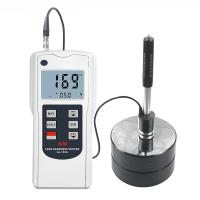
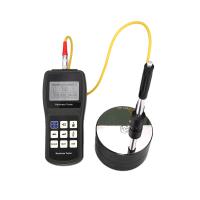
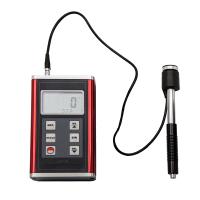
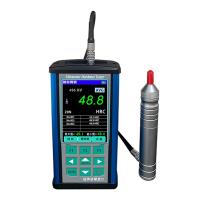
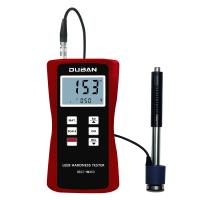
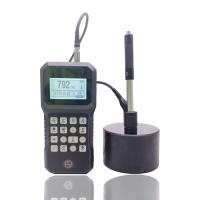
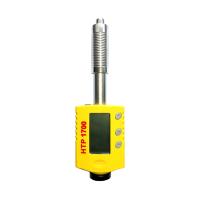
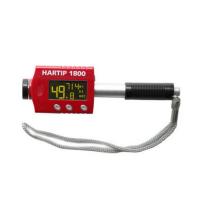
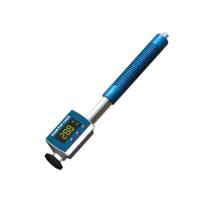
The Leeb Hardness Tester is a measuring and testing instrument, which plays an important role in ensuring product quality and performing failure analysis. Therefore, choosing a good Leeb Hardness Tester is a key issue for users. I personally think that the choice of Leeb Hardness Tester cannot be determined solely by the price, only the one that is suitable for the actual use can be called suitable. The selection of Leeb Hardness Tester can be said to be an important problem for engineers to solve practical applications. A good selection scheme of Leeb Hardness Tester can not only save product costs, save money for customers, but also save the time of users , Make the measurement in the laboratory and industrial field convenient and fast. Choosing the correct Leeb Hardness Tester can get the most matching and accurate data, which provides a solid data foundation for practical applications. Now, combining my project experience and what I have learned, I would like to discuss with friends and colleagues the knowledge and problems that should be paid attention to in the selection of Leeb Hardness Testers.
The issues that need to be concerned about when selecting the type of Leeb Hardness Tester mainly include the following aspects:
(1) performance; (2) cost; (3) whether the typical application is convenient; (4) whether it has perfect after-sales service;
(1) Performance
The reason why we put performance in the first place is because the performance of the Leeb Hardness Tester determines the failure rate and service life of the product when we use it. The failure rate and service life of the product will eventually affect the working quality. Efficiency and data reliability, so when selecting a model, it is necessary to ensure that the selected Leeb Hardness Tester has no problems in performance, at least within the foreseeable time frame or within the scope of the warranty period, the probability of failure and damage is very low .
The performance of the Leeb Hardness Tester mainly includes function, working temperature, measurement range, reading accuracy, measurement parameters, data conversion, etc. It is necessary to ensure that these points meet the application requirements of the product when selecting the model. For example, if it is mainly used in the industrial field, then the durability of the instrument should be high, and it is required to have the characteristics of easy operation when used.
Now many industrial customers will consider imported Leeb Hardness Testers when choosing high-performance Leeb Hardness Testers. The mainstream foreign Leeb Hardness Testers on the market mainly include:
1, Equotip series Leeb Hardness Tester from Swiss proceq company
2. PhysiTest series Leeb Hardness Tester from German company,
Some of the above-mentioned Leeb Hardness Testers have their own characteristics. After a series of actual measurements and comparisons, the author found that there is not much difference between these instruments when measuring the hardness of various steels and cast steels. Repeatability is also relatively close.
(2) cost
Many people know the principle that you get what you pay for, and many customers often don’t choose the cheapest and most expensive ones when choosing products, and the cost-effective ones are relatively high. Therefore, we should mainly consider when choosing a Leeb Hardness Tester. Whether the performance and price of the instrument are more suitable. It can be said that the cost of the Leeb Hardness Tester will affect the customer's choice and use to a certain extent, so the cost issue needs to be considered when selecting the model. Generally speaking, the price of the domestic Leeb Hardness Tester is relatively low, ranging from thousands to tens of thousands , There are various price points, but the market for domestically produced Leeb Hardness Testers is also very chaotic, and products of various qualities are flooding the market at the same time, so that customers do not know which products can really meet their needs. Many times we will find that the more expensive the price, the better its function and performance, and the cheap Leeb Hardness Tester is often not as good as the more expensive one in terms of function and performance, so we need to learn to compromise. So how to compromise?
(3) Whether the typical application is convenient
Typical application actually refers to whether the typical use of the Leeb Hardness Tester in a specific working environment is appropriate. If the thickness of the sample to be measured is only a few mm, or thinner, if you choose an ordinary Leeb Hardness Tester for measurement, it will be Correct data may not be measured. When selecting a model, it is necessary to fully consider the particularity of various use environments, such as the measurement range, the material of the object to be measured, whether it has data conversion function, whether it can measure the thickness of ultra-thin samples, the measurement environment and so on. Yushi Pioneer Leeb Hardness Tester is a typical tool-type measuring instrument, suitable for various harsh working environments.
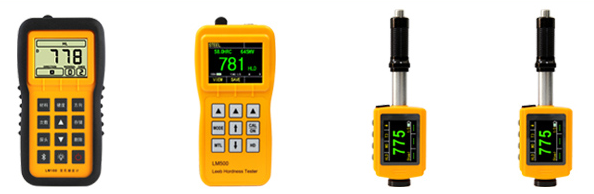
How to choose a suitable Leeb Hardness Tester
1. Understand the specifications of the workpiece you need to test, and the physical properties of the workpiece such as size, thickness, and surface roughness.
2. The material of the workpiece will also have different effects on the test results, such as aluminum, copper, tool steel and other special materials, different materials have different rebound modulus, and the choice of impact device is extremely important to the test results.
3. The purpose of purchasing Leeb Hardness Testers is the hardness system that needs to be tested, HL, HB, HRC, HRB, HV, HS. If you meet the above conditions, you can purchase imported Leeb Hardness Testers that can improve your work efficiency.
The scope of application of the Leeb Hardness Tester is attached
1. Steel and cast steel Rockwell hardness HRC 17-69 Rockwell hardness HRB 13-101.7 Brinell hardness HB 20-655 Vickers hardness HV 80-940 Shore hardness HS 32-99.5 Tensile strength N/mm2 255-2180
2. Alloy tool steel Rockwell hardness HRC 21-67 Vickers hardness HV 80-900
3. Stainless steel Rockwell hardness HRC 20-62 Rockwell hardness HRB 46-102 Brinell hardness HB 85-655 Vickers hardness HV 85-802
4. Gray cast iron Rockwell hardness HRC 21-59 Brinell hardness HB 90-664 Vickers hardness HV 90-698
5. Ductile iron Rockwell hardness HRC 21-60 Brinell hardness HB 95-686 Vickers hardness HV 96-724
6. Cast aluminum alloy Rockwell hardness HRB 24-85 Brinell hardness HB 19-164 Vickers hardness HV 22-193
7. Copper-zinc alloy (brass) Rockwell hardness HRB 14-95 Brinell hardness HB 40-173
8. Copper-aluminum/copper-tin alloy (bronze) Brinell hardness HB 60-290
9. Wrought copper alloy (pure copper), Brinell hardness HB 45-315
10. Forged steel Rockwell hardness HB 20-650