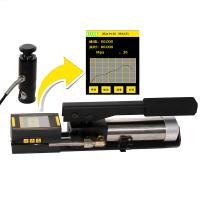
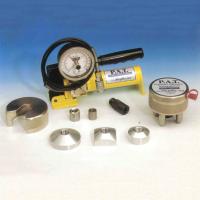
Several reasons may be helpful in determining the bond strength of a coating to a substrate or other coatings. One option is tensile adhesion testing, and you have a variety of test units to choose from. The final chapter of the Paint Inspector's Handbook discusses this form of testing, and which Tester types have high pull levels.
ASTM D4541 defines 6 types of adhesion Testers. All six categories are pulled by different mechanisms, which can cause Testers to measure the same coating system differently. Operator knowledge may also affect the effectiveness of these tests.
These devices can be used in accordance with ASTM D4541 "Standard Method for Pull-Off Strength of Coatings Using Portable Adhesion Testers," which uses the term Method BF (Method A or {Type 1} was previously used but retired).
Type 2
These are manually operated mechanical Testers where the user turns the screw wheel with a wrench or by hand. These Testers are suitable for field use. Depending on the type of substrate, different size trolleys may be required.
The advantages of this Tester are portability, relative ease of use, and being one of the cheapest adhesion Testers on the market. Unfortunately, it's also very inaccurate and will be lower than every other unit on the market. Operators can easily operate.
"Each Tester will produce a wildly different result. That's all the more reason to be cautious."
Type 3
These are hydraulic adhesion Testers. These are the HATE and 108 Testers. They provide a focused application of force within the dolly, resulting in a smoother, better pull. Unlike other adhesion Testers, it uses a piston to push the trolley off the surface.
This is usually required for specifications originating in Europe. It was taller than the Type 2 Tester, but the pull was inconsistent due to manually pushing the dolly. Due to its length, it can be a bit unwieldy to use. It is a Tester that provides a bending trolley.
Type 4
These are PATTI flow meters, an automatic system that operates on gas pressure. If you're used to manual options, switching to this can be a major change. While not as portable as the aforementioned Testers, it can be used in a PSI range up to 17,400.
Its main advantage is repeatability: PATTI is the most accurate Tester on the market and has a very good pull. Most meters where you change the size of the trolley to increase pull, PATTI, Ii is the piston size you change. Depending on what you're testing, you may need to have multiple sizes of pistons, which can be a bit expensive. Many paint manufacturers use this gauge to obtain coating adhesion readings for their product data sheets, as this gauge typically gives the highest pull of any adhesion Tester.
The DeFelsko Adhesion Tester Model 5
comes with various sizes of carts and gives accurate measurements. It can provide a stable pulling force while providing a high degree of accuracy. It has a PSI range up to 10,000 PSI with a 10mm trolley. For substrates such as concrete it offers a 50 mm trolley. In terms of cost, ease of use, portability, and accuracy, the DeFelsko AT Automatic is usually my preferred product of choice. For curved surfaces, DeFelsko offers 10mm, 14mm and 20mm trolleys.
The Type 6
DFD Adhesion Tester is self-adjusting and is the best line of this kind on the market. While they have great functionality, they are manual and have inconsistencies due to Manuel manipulation. Also, they are very expensive, but do have a niche in the market. It is a commercial Tester that meets ASTM C-633 "Standard Test Method for Adhesion or Cohesive Strength of Thermal Spray Coatings." This option is around $10,000.
Now that you know which Tester you need, the next step is to glue the cart on. Different manufacturers recommend different adhesives I have been using Ardalite 2011 epoxy for years and have always had good results. After several tests, DeFelsko suggested ResinLab EP11HT 2-Part Epoxy. Loctite 907 has been tested by at least one manufacturer of adhesion Testers and found to work very well. Tests in the coating lab of a major petrochemical company found that 3M DP420 worked well for them. Large DOTs like to use 3M DP 8005 and DP 8010. Most of these require 24 hours to pull.
If you're in a hurry, and if you don't need tensile strength over 1000 psi, cyanoacrylate (super glue) will usually work fine for most paints. Wait at least 3 hours before pulling.
We generally do not recommend testing new coating systems unless there is reason to suspect a problem, as these are destructive tests.