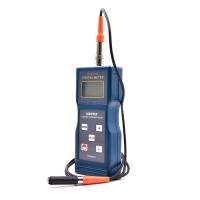
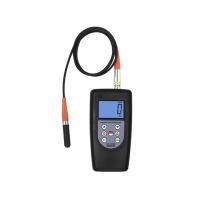
Choosing a good solution depends on:
Substrate material under conformal coating (fiberglass only, fiberglass with copper ground plane or fiberglass with copper traces), area of clear space, specified thickness range of conformal coating.
Solution #1: For PCBs with copper ground planes
Solution #2: For PCBs without copper ground planes
Solution #3: For PCBs without surface contact
Solution #1: For PCBs with copper ground planes
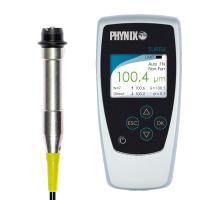
The PosiTector 6000 Eddy Flow Gauge provides a low cost and simple solution for printed circuit boards with copper ground planes. Probe selection depends on the size of the unfilled area, the expected thickness of the conformal coating, and the desired resolution of the probe (see Table 1).
Measurements need to be made directly on the copper ground plane in the unpopulated area of the PCB (see Figure 1). For good accuracy, these strain gages need to be zeroed on the solder mask prior to measuring the conformal coating thickness.
The PosiTector 6000 NS1 is the simple, cost-effective solution. At a slightly higher cost, the PosiTector 6000 NAS1 has a higher measurement resolution. For hard-to-reach areas, the PosiTector 6000 N0S1 has the smallest diameter probe tip for measuring small unpopulated areas of PCBs. To reduce operator influence, an optional probe holder holder is available.

Table 1: PosiTector 6000 Standard Eddy Current Models. Premium models are also available.

Figure 1: PosiTector 6000 NS1 measuring an acrylic-coated PCB with a solid copper ground plane
Solution #2: For PCBs without copper ground planes
Our ultrasonic PosiTector 200 B Thickness Gauge measures conformal coating thickness on certain printed circuit boards without copper ground planes. The application of ultrasonic measurements on PCBs is limited because the probe cannot be zeroed on the solder mask and because of the layered structure of most PCBs which occasionally produces erroneous thickness values. Some applications work well, such as thick silicone measurements or 2-layer board measurements. Please contact our technical support staff to ensure that the ultrasonic solution is right for your application.
The PosiTector 200 B has a measurement range of 13 to 1000 microns (0.5-40 mils) with a resolution of 2 µm (0.1 mils). A probe with a diameter of 30 mm (1.2") requires a relatively large no-man's field (see Figure 2), but the actual measurement area is only 8 mm (0.3"). A drop of water is used as a couplant during the measurement.

Figure 2: Positector 200 B measures on a silicone-coated printed circuit board.
Solution #3: For PCBs with no surface contact
Some PCBs are so densely populated that probes cannot get close to the surface. We recommend an "alternative method" where a metal coupon is inserted into the coating process and coated next to the plate.
The conventional eddy current PosiTector 6000 NS1 can be used to measure the thickness of conformal coatings on non-ferrous metal samples such as aluminum. For ferrous metal specimens, the magnetic PosiTector 6000 FS1 is required.
Conformal Coating Background
Conformal coatings are applied to printed circuit boards to protect mounted electronic components from contaminants such as dust, sand, moisture, salt spray, and conductive particles. They provide environmental and mechanical protection and can significantly extend the life of components and circuits. Conformal coatings, typically only a few mils thick, also provide resistance to several stresses, including abrasion, impact, temperature, ozone, and UV degradation. They improve performance and allow for greater component density due to the increased dielectric strength between conductors.
Conformal coatings used on printed circuit boards are usually acrylic or silicone, but can also include epoxy, polyurethane, paraxylene (parylene), and UV-cured coatings. They are traditionally applied by dipping, spraying or simple flow coating and increasingly by selective coating or robotic dispensing.
The original military specification for conformal coatings dates back to 1966. Since then, they have evolved from solvent-based coatings (which cure in hours) to non-solvent-based coatings, which can be quickly cured in minutes using low heat.
Why measure?
Printed circuit board manufacturers are primarily interested in controlling the cost of conformal coating application while ensuring adequate coverage.
Printed circuit board customers are primarily interested in measuring conformal coating thickness as part of incoming inspection procedures. The quality of the conformal coating can be self-evident in preventing long-term product reliability issues after assembly.