DeFelsko offers many models of the PosiTector 6000 Thickness Gauge, ideal for measuring the total thickness of intumescent fire protection coatings. The choice depends primarily on the expected coating thickness.
background
Intumescent fire retardant coatings are applied to steel structural supports such as beams, channels, pipes and pipe columns to protect their structural integrity during a fire. DeFelsko makes handheld  non-destructive testing instruments that are ideal for measuring the dry film thickness of these coatings and ensuring they are used in satisfactory conditions.
Although steel does not burn, prolonged exposure to high temperatures, such as a building fire, can severely degrade its properties. This damage is believed to have contributed to the collapse of the World Trade Center towers. Since 9/11, more attention has been focused on developing and applying better and more durable intumescent coatings.
When exposed to fire, intumescent coatings typically expand 15 to 30 times in standard tests, forming a thick layer of foam that protects the steel by insulating it from heat. Some manufacturers report expansion of up to 100 times under unspecified conditions. As part of the expansion process, most paints develop an outer ash-char layer. As the fire continues, the ash layer erodes, exposing the remaining intumescent coating and forming more coke. Depending on the thickness of the coating, the process is repeated several times.
Intumescent fire retardant coatings generally require a primer for adhesion. A decorative/protective finish may also be necessary - especially in wet environments. Reinforced mesh can be used to better hold char layers in certain shapes.
Measurement is the key to quality assurance
The effectiveness of intumescent fire retardant coatings depends on the thickness of the coating and its ability to retain the dust layer. Coating thicknesses typically range from 30 to 500 mils (0.8 to 13 mm). Applied thickness needs to comply with product specifications for the type of structure being coated and applicable building code requirements (for example, to withstand fires of specific temperatures and durations).
Since intumescent fire protection coatings can be quite expensive ($4 to $12 per square foot, depending on the application and desired rating), measuring coating thickness can play an important role in controlling application costs.
Proper adhesion is also of paramount importance to the effectiveness of these coatings. Since adhesion is strongly influenced by climatic conditions at the time of application, manufacturers often specify the range of environments in which their products may be applied - such as relative humidity, air temperature, and the difference between surface and dew point temperatures.3 4 Therefore, when using intumescent It is very important to carefully monitor climate conditions when painting.
Gauges from DeFelsko are ideal for measuring the thickness of intumescent fire protection coatings and can be used to monitor humidity and temperature at the time of application.
DeFelsko's Dry Film Thickness Measurement Solutions
DeFelsko offers many models of the PosiTector 6000 Thickness Gauge, ideal for measuring the total thickness of intumescent fire protection coatings. The choice depends primarily on the expected  coating thickness.
The PosiTector 6000 FT Series is an excellent choice for measuring coating thicknesses up to 250 mils (6.4 mm). For measurements less than 100mil (2.5mm), these gauges provide results with a maximum accuracy of ±0.5mil (0.01mm) + 1% of reading. For readings over 100 mil (2.5 mm), the accuracy is ±0.5 mil (0.01 mm) + 3% of reading.
The PosiTector 6000 FKS Series is recommended for thicker applications up to 500 mils (13 mm) and measures results with an accuracy of ±1 mil (0.02 mm) + 3% of reading.
The PosiTector 6000 FLS Series is suitable for very thick applications up to 1.5 inches (38 mm) with an accuracy of +0.01 inches (0.2 mm) + 3% of reading.
Downloading measurements from the PosiTector 6000 is as seamless as storing them to a USB data card or connecting a USB cable to a computer. These functions allow for convenient printing and further analysis on a PC. Data logging and download capabilities allow operators to easily track coating thickness changes through multiple measurements over large areas. Premium models feature wireless WiFi and Bluetooth® connectivity. See our PosiSoft Solutions page for more information.
A detailed brochure can be downloaded here.

FTS probe FKS probe FLS probe
PosiTector 6000 complies with industry best practice
 Measuring intumescent coating thickness using the PosiTector 6000 gage conforms to accepted industry good practice. The National Fire Protection Contractors Association5 publishes a Quality Assurance Procedure for the Application of Intumescent Coatings.6 This procedure requires that "Final Thickness needs to be measured using a Dry Film Thickness Gauge in accordance with AWCI [Wall and Ceiling Industries Association7] Technical Manual 12-B" on site Application of the Standard Practice for Testing and Inspection of Thin Film Intumescent Flame Retardant Materials; Annotated Guide".
While the AWCI guidelines state that coating thickness measurements should be made using gages approved by the building agency having jurisdiction, it lists only two acceptable measurement techniques: magnetic pull gauges and flux-based sensors. The PosiTector 6000 gage uses the latter accepted method.
According to the AWCI guidelines, at least one manufacturer of intumescent coatings (A/D Fire Protection Systems) lists DeFelsko as a manufacturer of dry Film Thickness Gauges suitable for measuring coating thickness.
DeFelsko's Climate Condition Monitoring Solutions
As mentioned above, intumescent fire retardant coatings can only be used within the desired range of relative humidity and temperature.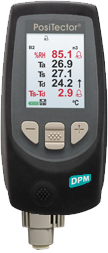
The PosiTector Dew Point Meter (DPM) measures and records climatic conditions including: relative humidity, air temperature, surface temperature, dew point temperature and the difference between surface temperature and dew point temperature.
The graph below shows the DPM along with the following standard measurements on the LCD display: Relative Humidity % (%RH), Ambient Air Temperature (Ta), Surface Temperature (Ts), Dew Point Temperature (Td) and Surface Temperature minus Dew Point Temperature (Ts -Td). All five climate conditions are monitored and calculated simultaneously, and at the push of a button, readings can be stored in memory along with date and time. The DPM also features a unique auto-logging feature that automatically logs a data set containing all 5 climate conditions at user-selected time intervals. This is useful for maintaining a complete record of environmental conditions and trends during, during and after the application of the intumescent coating.

