How is gloss measured?
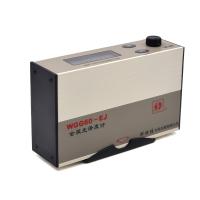
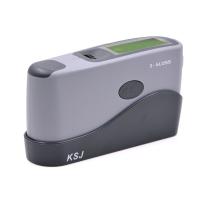
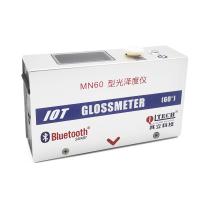
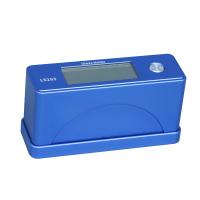
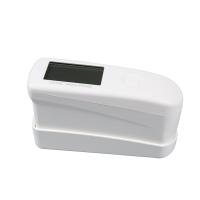
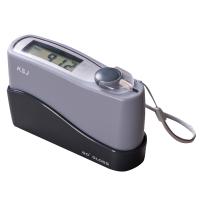
A gloss meter (also called a gloss meter) is an instrument used to measure the specular reflection (gloss) of a surface. Gloss is determined by projecting a beam of light onto a surface at a fixed intensity and angle and measuring the amount of reflected light at an equal but opposite angle.
Gloss meter
There are many different geometries that can be used for gloss measurement, each depending on the type of surface being measured. For non-metals such as coatings and plastics, the amount of reflected light increases with the angle of illumination as some light penetrates the surface material and is either absorbed into it or diffused by it depending on its color scattering. Metals are more reflective and therefore less angularly dependent.
A number of international technical standards are available to define the usage and specifications for different types of gloss meters, including paints, ceramics, paper, metals and plastics. Many industries use gloss meters to measure the gloss of products in their quality control to ensure the consistency of the manufacturing process. The automotive industry is a major user of gloss meters, with applications extending from the factory floor to the repair shop.
history
Of the many internationally documented publications on gloss measurement, the earlier documented studies (perceptual and instrumental) are attributed to Ingersoll 1 who in 1914 developed a means of measuring paper glare. The Ingersoll "Glarimeter" is an earlier known instrument developed for gloss measurement, based on the principle that light is polarized in specular reflection. The instrument takes an incident angle and viewing angle of 57.5° and uses a contrast method to subtract the specular component from the total reflection of the polarizing element. Ingersoll successfully applied for and received a patent for the instrument a few years later in 1917.

In 1922, while studying the glossiness of photographic paper using goniophotometry, Jones 2 based his research on the development of a Glossmeter that provided a closer correlation to the gloss levels assigned by visual assessment. Jones' Glossmeters use a 45°/0°/45° geometry configuration where the surface is illuminated at 45° and two incident reflection angles are measured at 0° (diffuse reflection) and 45° (diffuse plus specular reflection) and compare. Jones was the first to emphasize the importance of using goniophotometry in gloss research.
Pfund 3's early work in 1925 led to the development of a variable angle "gloss meter" to measure specular gloss that was later patented in 1932. Pfund's instrument allowed measurement of angle variations, but maintained the viewing angle with the angle of illumination. Reflected light is measured using a pyrometer lamp as a photometer. The 'Gloss Meter' was the first to use a black glass standard as the basis for reflectance settings. Due to the variable angle, the instrument can also be used to measure gloss or specular gloss at near glancing angles.

During this period, growing interest in the field led to many similar studies by others, each with their own method of measuring gloss, most of which were published as technical articles in the scientific journals of the day. Some of them also resulted in patents.
In 1937, as part of a research project at the National Bureau of Standards, Hunt produced a paper on a method for the determination of gloss. In this article, he discusses the instruments available at the time (including the aforementioned ones) and the classification of the six different types of gloss. In this article, Hunter also details the general requirements for standard gloss meters.
Hunter and ASTM (American Society for Testing and Materials) developed the ASTM D523 standard test method for specular gloss in 1939, which includes a method for measuring gloss at a specular angle of 60°. Later versions of the standard (1951) included 20° (high gloss) and 85° (matt or low gloss) measurements. ASTM has many other gloss-related standards that apply to specific industries.
In the paint industry, the measurement of specular gloss is carried out according to the international standard ISO 2813. This standard is identical to that of ASTM D523, but has a different draft. BS 3900, Part 5, UK; Germany DIN 67530; France NFT 30-064; AS 1580, Australia; Japan's JIS Z8741 are also equivalent.
construction
A typical Glossmeter consists of a fixed mechanical assembly consisting of a standard light source that projects a parallel beam of light onto the test surface to be measured, a filter Detector to receive the light reflected from the surface, Figure 1. The ASTM method states that the illumination should be defined such that the source-Detector combination is spectrally corrected to give the CIE luminous efficiency V(1) vs. the CIE luminous body SC[i].

Figure 1. Parallel beam specular reflectometer.
Many instruments are commercially available with measurement geometries meeting the above criteria. These instruments are calibrated using reference standards, typically made of highly polished flat black glass with a refractive index of 1.567 for the sodium D-line, and for each geometry[ii] they are assigned a gloss value of 100.
Measurement/Angle Selection
The measurement angle is the angle between the incident light and the reflected light. Three measurement angles (20°, 60° and 85°) are specified to cover most industrial coating applications. Choose the angle based on the expected gloss range as shown in the table below.
| Gloss range | 60° value | notes |
| high gloss | > 70 GU | If the measurement exceeds 70 GU, change the test setup to 20° |
| medium gloss | 10 - 70GU | |
| low gloss | <10GU | If the measurement is less than 10 GU, change the test setup to 85° |

For example, if a measurement taken at 60° is greater than 70 GU, the measurement angle should be changed to 20° to optimize measurement accuracy. There are three types of instruments on the market: a 60° single-angle instrument, a combination of 20° and 60°, and an instrument that combines 20°, 60°, and 85°.
The other two angles are for other materials. Measurements for ceramics, films, textiles, and anodized aluminum specify an angle of 45°, while paper specifies 75°.
gloss unit
The gloss meter's measurement scale, Gloss Units (GU), is a scale based on a highly polished reference black glass standard, which has a defined index of refraction and a specular reflectance of 100 GU at a specific angle. This standard is used to establish a 100 point superscript point calibration with the subscript endpoint set to 0 on a good matte surface. This Graduation applies to most non-metallic coatings and materials (paints and plastics) as they generally fall within this range. For other appearance highly reflective materials (mirrors, plated/raw metal parts) up to 2000 gloss units can be achieved. For transparent materials, these values may also increase due to multiple reflections in the material.
standard
| Comparison of Gloss Measurement Standards | |||||
| standard | 20° | 60° | 85° | 45° | 75° |
| high gloss | medium gloss | low gloss | medium gloss | low gloss | |
| Coatings, Plastics and Related Materials | ceramics | Paper | |||
| ASTM C346 | x | ||||
| ASTM D523 | x | x | x | ||
| ASTM C584 | x | ||||
| ASTM D2457 | x | x | x | ||
| BS3900 D5 | x | x | x | ||
| DIN 67530 | x | x | x | ||
| DIN EN ISO 2813 | x | x | x | ||
| EN ISO 7668 | x | x | x | x | |
| Ji Z 8741 | x | x | x | x | x |
| TAPPI T480 | x | ||||
calibration
Each gloss meter is set by the manufacturer to be linear over the entire measurement range by calibrating it to a set of master calibration tiles traceable to BAM Federal Institute for Materials Research or a similar organization such as NIST.
In order to maintain the performance and linearity of the gloss meter, it is recommended to use inspection standard tiles. This standard tile assigns gloss unit values to each angle of measurement, and these values are also traceable to national standards such as BAM Federal Institute for Materials Research or NIST. The instrument is calibrated against check standards commonly referred to as "calibration tabs" or "calibration standards". The interval at which calibration is checked depends on the frequency of use and the operating conditions of the Glossmeter.
It has been seen that standard calibration tiles kept in very good condition can become stained and changed by a few gloss units within a few years. Standard tiles used in working conditions will require periodic calibration or inspection by the instrument manufacturer or a gloss meter calibration professional.
One year between standard tile recalibrations should be considered the minimum time. If at any time the calibration standard becomes permanently scratched or damaged, it needs to be recalibrated or replaced immediately, as the gloss meter may give incorrect readings.
International standards state that tiles are calibrated and traceable artefacts, not gloss meters, but manufacturers often recommend checking the instrument to determine how often it is operating depending on operating conditions.
develop
Gloss meters are useful tools for measuring the glossiness of surfaces. However, it is insensitive to other common effects that reduce appearance quality such as haze and orange peel.
Haze: Caused by tiny surface structures that slightly change the direction of reflected light, causing blooming adjacent to the specular (glossy) corners. The surface has less reflective contrast and a lighter opalescent effect
Orange peel: uneven surface formation caused by large surface structures that distort reflected light.

Surface of orange peel and haze
Two high-gloss surfaces can be measured identically with a standard gloss meter, but can be visually very different. Instruments can quantify orange peel by measuring distinctness of image (DOI) or reflected image quality (RIQ) and haze.
application
Gloss meters are used by manufacturers and users in many industries from paper mills to automotive.
Examples include:
paints and coatings
powder coating
additive
ink
plastic
Wood Coatings
yacht manufacturing
Automobile Manufacturing and Refinishing
aerospace
polished stone and metal
glass manufacturing
Consumer electronics products
anodized metal