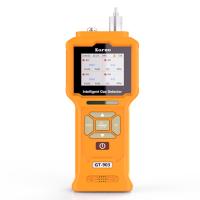
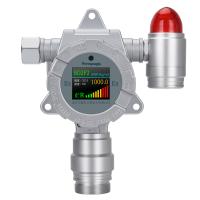
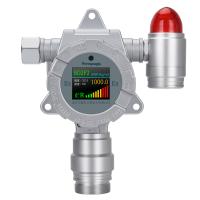
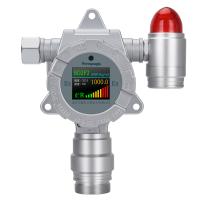
1 有毒有害气体报警器的分类
有毒有害气体报警器是对作业环境中所测气体爆炸下限以内浓度进行报警和测定的仪器。按使用方式可分为便携式、可移动式、固定式等。按工作原理可分为定电位电解型、气敏电极型、半导体型、化学发光型。按检测介质可分为硫化氢报警器、氰化氢报警器、氯气报警器、一氧化碳报警器、丙烯腈报警器、环氧乙烷报警器、氯乙烯报警器等。
2 常见有毒有害气体报警器工作原理
2.1 定电位电解型有毒性气体报警器的工作原理
定电位电解型有毒性气体报警器采用电解分析法工作,被测气体通过渗透膜扩散到测量电极表面,在测量电极上发生氧化(或还原)反应,同时在对电极上发生还原(或氧化)反应,氧化还原反应产生的电流与被测气体的浓度成正比。
2.2 气敏电极型有毒性气体报警器的工作原理
气敏电极型有毒性气体检测器采用电位分析法工作。电位分析法是以测定电池两电极间电位差或电位差的变化为基础的分析方法;气敏电极由憎水性气透膜、内电解液、指示电极和参比电极组成,可测量气体组分的浓度。被测气体通过气透膜与内电解液作用,引起电解液中离子活度的变化,由对该离子敏感的指示电极测出,转而得出被测气体的浓度。
The measuring cell consists of the measured solution, indicating electrode and reference electrode. Most of the indicating electrodes are ion selective electrodes. A certain ion in the measured solution reacts on the surface of the ion-selective electrode, generating a potential (potential) on the electrode, and the value of this potential changes with the change of ion concentration. In order to measure the potential of the ion-selective electrode, a reference electrode with a fixed potential is inserted into the same solution, and the electrolyte (salt solution) in the reference electrode is in contact with the measured solution through a microporous membrane . In a closed loop, the potential of the ion-selective electrode can be calculated from the electromotive force of the battery.
2.3 Working principle of semiconductor toxic gas alarm
The semiconductor gas sensor can change its carrier number and impedance after adsorbing gas components, so that the content of gas components can be detected. When the toxic gas passes through the surface of the gas sensor , it is adsorbed by the metal oxide, and its resistance value changes with the concentration of the gas to be measured, so that the bridge loses balance, and the output is proportional to the concentration unbalanced voltage. After the voltage is amplified, the alarm circuit is driven to output alarm and indication signals, which can also be displayed through the instrument.
2.4 Working principle of chemiluminescent toxic gas alarm
Chemiluminescence means that a compound absorbs chemical energy, is excited to an excited state, and then releases energy in the form of photons when the excited state returns to the ground state. The method of measuring luminous intensity to analyze and determine substances is called chemiluminescence.
2.5 Common types of toxic and harmful gas alarms
According to the specific characteristics of the measured gas and the scope of application of the Detector, the hydrogen sulfide alarm器、一氧化碳报警器可选用定电位电解型或半导体型检测器;氯气报警器可选用气敏电极型、定电位电解型或半导体型检测器;氰化氢报警器可选用定电位电解型、气敏电极型检测器;环氧乙烷报警器、丙烯腈报警器可选用半导体型检测器;氯乙烯报警器可选用化学发光型或半导体型检测器;氨气报警器可选用气敏电极型、定电位电解型或半导体型检测器。
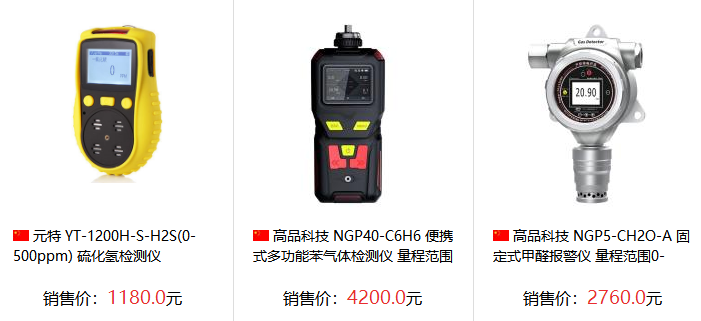
3 常见有毒有害气体报警器的使用维护
3.1 检定和定期校验
有毒有害气体报警器在初装之后应及时向国家授权的有资质的技术检定机构申请检定,在检定合格后才能投入使用。石化企业的有毒有害气体报警器除按计量法要求实施检定外,定期进行使用中检验也是所需的,以便及时掌握报警器的运行情况,一般规定检定周期不应超过1a,每3 个月检查标定一次零点和量程。
3.2 使用与维护
(1)有毒有害气体报警器的安装需要在符合国家和行业有关法律和规范下选择安装点,检测器无论室内室外安装都必须安装防雨罩。检测器一般情况下应垂直安装,使传感器向下,避开热源安装在可能发生泄漏点附近,选择无振动、无阳光直射的地方,并避免溅水、溅油和机械损伤等外部的不良影响。
现场传感器探头一定要加装防雨防尘罩,并且变送器部分不得进水,如意外进水,则要立即停止使用。
(2)使用前要将零点调整到位,检查一下报警系统Is it normal. If it is a suction alarm, first check whether the pipeline is leaking . High-low temperature gases should be buffered to within the working temperature range of the sensor before detection. The filter in the pipeline cannot be omitted arbitrarily. If the suction flow drops significantly, the filter (or membrane) should be replaced in time. Once liquid enters the probe rod, it can dried with a drying box or a large-flow air pump, and the oil stains can be wiped off with a clean rag. It is better to use floats for sampling in areas with liquid such as sewage wells, so that the sampling port is always above the liquid surface.
(3) Press the test button once a week to check whether the indication and alarm system are normal. If you suspect that the instrument is abnormal, you can press the test button at any time.
(4) Always check whether firm and reliable.
references
[1] Wang Sen, Fu Qingling. Test Questions Collection for Instrument Workers - On-line Analytical Instrument Volume [M]. Beijing: Chemical Industry Press, 2006.