1. Uneven film making
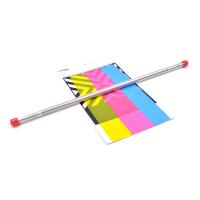
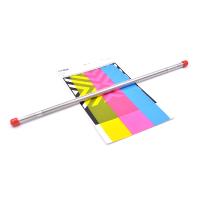
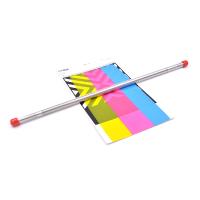
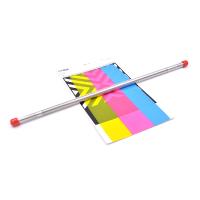
Please check whether it is caused by the rough or uneven surface of the coating substrate, and rule out the uneven force on both sides caused by manual operation. If possible, please use an embossing bed or even a vacuum plate for proofing. The last possible problem is the straightness of the wire rod, whether it is due to the uneven coating caused by bending. Usually, there will be no similar problems with the wire rod, because once the wire is bent, the tightness of the steel wire will be displayed immediately. The RDS forming rods are made of specially developed transparent tubes from factory to packaging and long-distance transportation, which are moderate in hardness and different from other inferior packaging materials. In terms of straightness, there have been no problems with other brands.
2. There are scratches on the film
Before making the film, ensure that the coated ink or paint is fully stirred evenly. First, eliminate the cause of scratches caused by sample impurities or excessive particles; then observe whether the scratches are a few or evenly distributed. The caused grooves are partially blocked, especially as "deep first and then shallow". If it still appears after careful cleaning, please use a magnifying glass to observe with the naked eye whether the steel wire/groove is deformed due to bumping; if the scratches are evenly distributed, please judge first whether it is The problem of leveling is caused by too high consistency. In general, the wire rods produced by RDS are wound with precise steel wires, and the circular cross section of the steel wires is an important part of the process. The flatness and consistency of the groove flow channel is an important part of the process, and we are also confident that it will not be caused by this. This may appear on some low-end or rough-crafted wire rods, but we regard this problem as a problem on RDS products. A very good competitive advantage over other coating sticks. Please trust RDS products.
3. The shape of the scraped film is weird
This situation is most likely caused by the superimposition of two reasons: the uneven amount of the scraped sample when it is first applied to the bottom of the wire rod and the non-linear scraping of the manual coating film. Please scrape the sample again.
4. The difference between wire winding rod and forming rod
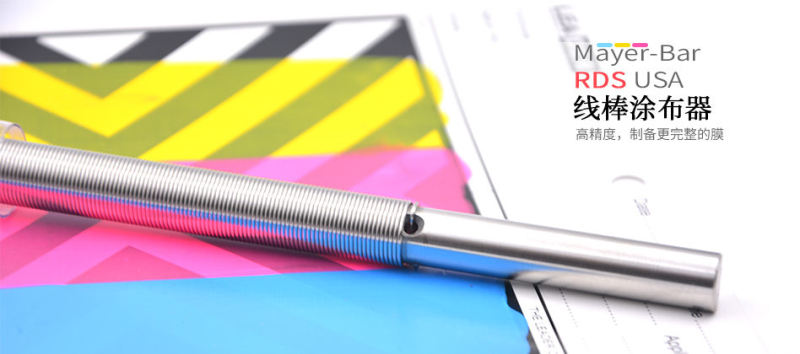
Theoretically, there is no difference between the wire-wound rod and the forming rod for scraping samples, but because the shapes of the grooves formed by the two are different, the amount of sample coating required for the film coating is different. The winding rod better follows the Mayer-Bar principle, and the forming rod is easier to clean. In the case that there is a requirement for the amount of coating, we do not recommend replacing each other, on the contrary, they can be replaced. For the advantages and disadvantages of wire-wound rods and forming rods, please refer to the article " Should I choose wire-wound or extrusion for coating rods?" "
5. Which diameter of RDS rod should I choose?
RDS provides RDS coating rods with three different specifications according to the diameter of the main rod, namely 1/4 inch, 3/8 inch and 1/2 inch. At the same time, in addition to the wire winding process, RDS provides 1/4 inch The diameter of the extrusion (die-casting) process coating rod, the coating effect of the three diameters is the same, in CHINA, more than 96% of users use 3/8 inch diameter. The effect of different diameters is that it is more convenient to apply to automatic coating machines that require wire rod diameters. The effect of manual scraping is the same.
6. Which type of RDS rod should I choose?
Please first calculate the wet film thickness according to the wet film thickness calculator professionally developed by NBCHAO Mall, address https://tool.nbchao.com/mohou/ , and then select the wire rod model corresponding to the wet film thickness according to the RDS model matching table. This calculator is for reference only, and may vary depending on factors such as product elongation, viscosity, coating wire rod type, substrate, etc. If you cannot know the coating amount, density and solid content per square meter of a specific sample, you can use the North-South Moisture Dry Wet Film Converter to make a rough estimate. The address is https://tool.nbchao.com/ganmo/ . It is generally believed that the relationship between the dry film and the wet film of most coatings is as follows: dry film = wet film × coating solids%
Due to the complex drying and film forming process of the coating film, this tool is more suitable for volatile coatings or two-component coatings with high solid content, but the accuracy is poor for volatile coatings and inorganic zinc-rich coatings with low solid content. Practical application should be based on test results. The calculation results of this tool are for user reference only.
The source of this article: NBCHAO Mall, reprinting is strictly prohibited, and infringement must be investigated.