1. Particles: Particles refer to tiny objects, which are the basic units of powder and can exist independently. Generally from several millimeters to several nanometers. For example, the mist and smoke in the air, the sand and bubbles in the water, the cement used in construction and the red blood cells in the blood can all be considered as particles.
2. Particle size: The size of particles is called particle size, which generally refers to the diameter of an equivalent sphere.
3. Equivalent particle size: When a certain physical property of a particle is the same or similar to that of a homogeneous spherical particle, the diameter of the spherical particle is called the equivalent particle size of the particle. Common equivalent particle sizes include equivalent volume diameter (particle size measured by laser method), equivalent area diameter (particle size measured by microscope method), equivalent sedimentation velocity diameter (also known as Stokes diameter, measured by sedimentation method) Particle size, equivalent sieving diameter (particle size measured by sieving method), etc. Due to different equivalent methods, a particle may also have multiple different equivalent particle sizes. This is the result of different particle size test methods The results are often different for the main reason.
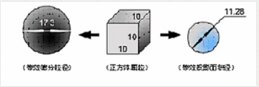
The equivalent particle size obtained by different equivalent methods
Equivalent volume particle diameter: The diameter of a spherical particle of the same substance that has the same volume as the actual particle is called the equivalent volume diameter.
Equivalent area diameter: The diameter of a spherical particle of the same substance that has the same projected area as the actual particle is called the equivalent area diameter.
Equivalent sedimentation velocity (Stokes) diameter: the diameter equivalent sedimentation velocity (Stokes) diameter of spherical particles .
Equivalent sieving diameter: Under the same sieving conditions, the diameter that passes through the same sieve hole as spherical particles of the same substance is called the equivalent sieving particle size.
4. Particle size distribution: The expression method of particle size after mathematical statistics is generally expressed according to the percentage of weight or volume of particles with different particle sizes in the total powder.
5. Median diameter D50: refers to the corresponding particle size value when the cumulative distribution content reaches 50%, which can also be expressed as D (v, 0.5) or D (v, 50). That is: D50 of a sample = 5 μm, indicating that the volume of particles larger than 5 μm accounts for 50% of the total volume, and particles smaller than 5 μm also account for 50%.
6. D10: Particles smaller than this particle size account for 10% of the total weight (volume) of the particles, also known as D (v, 0.1) or D (v, 10). Similarly, D16, D25, D90, D97, etc. are also the same concept.
7. D (3, 2): average surface area diameter or Sauter average diameter. Is one of the average particle diameters, and its meaning is the diameter of a sphere with the same surface area as the actual particle. The calculation formula of D(m,n) is as follows:

8. D(4,3): Volume average diameter, the diameter of a sphere having the same volume as the actual particle.
9. Specific surface area: refers to the ratio of the total surface area of the particle to its volume, and can be expressed as SSA. The calculation formula is:

10. Shading rate: It is the maximum value of the instrument testing the scattered light produced by the tested sample in the laser beam. It is related to the parameters such as the refractive index of the measured particle size. The shading rate of the HYL-1076 laser particle size analyzer is controlled at 20-60 However, for samples of the same material with similar specifications, the change value of the shading rate should be controlled within 10, such as within the range of 30 to 40, which can help improve the accuracy of sample testing.
