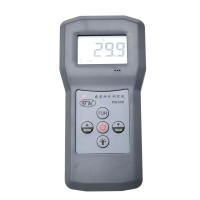
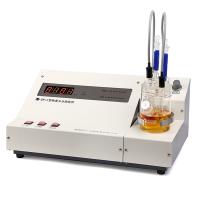
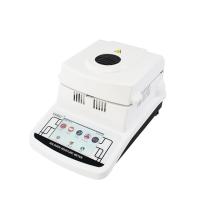
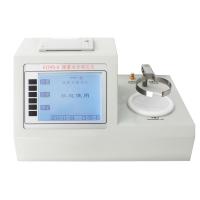
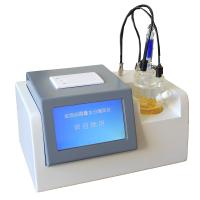
Trace Moisture Meter computer automatic control technology, large-screen LCD display, full Chinese menu prompt operation, rich calculation, printing experiment results function, is the petroleum, chemical, electric power, medicine, pesticide industry and scientific research institutions to test the moisture content heartfelt instrument. The Karl Fischer method, referred to as the Fischer method, is a capacity-splitting method for the determination of moisture proposed by Karl Fischer in 1935. The Fischer method is the most specific and accurate method for water among various chemical methods for determining the moisture content of substances.
The classic method has been improved in recent years to improve the accuracy and expand the measurement range, and has been listed as a standard method for the determination of moisture in many substances. The Fischer method is an iodometric method, and its basic principle is that when using iodine to oxidize sulfur dioxide, a certain amount of water is required to participate in the reaction: I2SO22H2O-2HIH2SO4 The above reaction is reversible. When the * concentration reaches above 0.05%, the reverse reaction can occur. If we let the reaction proceed in a positive direction, we need to add an appropriate alkaline substance to neutralize the acid generated during the reaction. It has been proved by experiments that adding pyridine to the system can make the reaction proceed to the right.
It is especially suitable for samples that are easily destroyed by heat. Not only can free water be measured, but also bound water can be measured. It is often used as a standard analysis method for moisture, especially trace moisture. But it is not suitable for samples containing strong reducing substances such as VC. Karl Fischer reagent is a reagent used to determine trace moisture in certain substances, and its ingredients are: methanol, pyridine, iodine, and sulfur dioxide. There are two methods for determining the end point: the visual method and the potentiometric method.