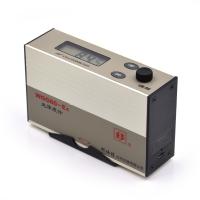
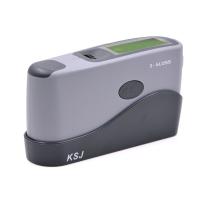
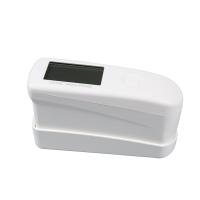
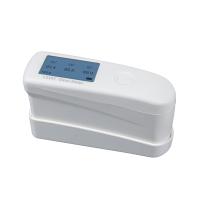
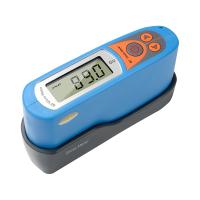
The so-called mirror gloss is the relative reflectivity of the sample in the reflection direction of the mirror, and the reflectivity refers to the ratio of the reflected light flux of the sample to the incident ray luminous flux within a fixed solid angle.
GB1743 stipulates that a fixed-angle photoelectric gloss meter is used, and the percentage of the ratio of the positive reflected light amount from the surface of the standard plate is expressed, and the incident angle of the light is a 45 ° angle.
The current paint supply technical conditions have always used 60 ° angular gloss as a control index.
GB9754, ISO2873 and ASTM D523 are all measures of 20 °, 60 ° and 85 ° mirror gloss of coatings. These three standards are first and foremost clearly not applicable to the determination of the gloss of coatings containing metallic pigments.
At the same time, these standards also make the following provisions:
1. The 60 ° method is suitable for the coating film of all paints, but for paints with high gloss or paints close to matte, the 20 ° and 85 ° methods are more suitable.
2. The coating film of high-gloss paint by the 20 ° method can improve the identification ability, and is suitable for pigments with a gloss of 60 ° higher than 70 units;
The 85 ° method can improve the identification ability for the coating film of low-gloss paints, and is suitable for paints with a gloss of less than 30 units at 60 °.
Generally speaking, the value measured by the 60 ° gloss meter is slightly larger than the value measured by the 45 ° gloss meter.