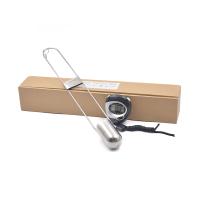
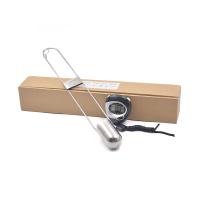
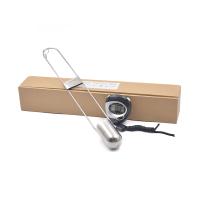
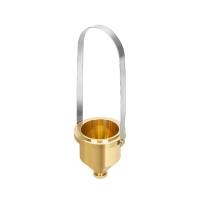
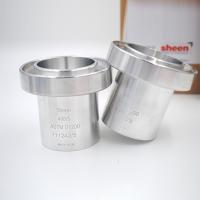
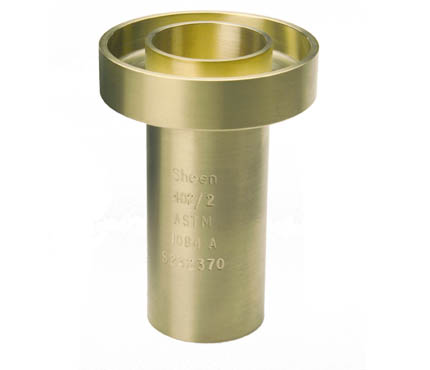
The first known industry attempt to correlate the results of various types of Viscosity Cups and relate each Viscosity Cup to a mathematical formula based on the measurements was ASTM Committee D-1 on Paints, Varnishes, Lacquers and Related Product Subcommittee. The results of this work were published in ASTM Bulletin No. 169, October 1950.

The above references include mathematical formulations to accommodate nonlinearity in the lower range of each cup due to eddy turbulence at the orifice. This allows comparing the results of the 17 different types of cups listed above the specified time minimum.
The above work also includes the results of an industry survey of preferences for viscosity measurement devices. Where cup-type instruments are applicable, the preference is very heavy in favor of the Ford Viscosity Cup series.
Based on the above work and the stated preference for the Ford series of Viscosity Cups, the ASTM Standard Method for Testing the Viscosity of Paints, Varnishes, and Lacquers was adopted in 1954 according to ASTM Designation D 1200, ASTM Designation D 1200. This method was reapproved in 1965 in 1958.
In D 1200-58 (1965), the dimensions of the cup and orifice are shown. In lieu of the flow formulation developed in earlier work, a graph is included showing the Stokes viscosity vs. outflow time (seconds) for Ford Viscosity Cups 2, 3, and 4. The lines in the charts for cup numbers 3 and 4 are very close to earlier work, except around the lower usable range. Cup 2 is not compared as it was not included in the original.
In 1970, the ASTM method was changed and published as D 1200-70 in the following standard. The dimensions of the series have been changed to metric, but there is no expected actual magnitude change. A change that could be particularly impactful is the reduction of the "Standard Viscosity Curve for Ford Cup" graph to a quarter size. This is apparently the first time that flow equations for each of the three have been included in the Methods appendix. mugs of this series.
It appears that the flow formula contained in the appendix of D 1200-70 is designed to match the curve in the graph of D 1200-58. In this attempt, however, there are even greater differences compared to the work published in 1950. The suspicion is that the format of the mathematical formula, which is not the same for each of the three cups in the series, was not developed in the early days. published works.

Most Ford #3 and #4 Viscosity Cups in use today are considered to be in good agreement with the definitions of these cups contained in ASTM Bulletin No. 169, October 1950. But there are other cups, including the Ford #2 cup, which are designed to comply with ASTM Method D 1200-58 or ASTM Method D 1200-70. As long as these results are within the stated outflow time limits, there should be no serious problem comparing the results from any of these different cups. The results for these different cups are theoretically within 5%, the outflow limit should be between 40 and 100 seconds for cup #2, 22 to 120 seconds for cup #3, and 25 to 100 seconds for cup #4 between.