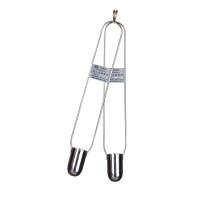
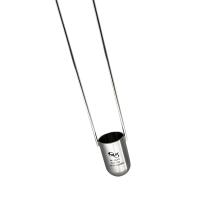
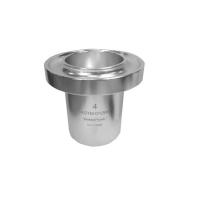
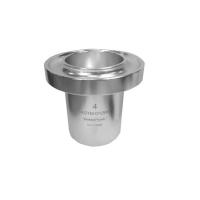
Most materials change viscosity based on temperature. Those typically measured by Viscosity Cups vary in the range of 3% to 8% per degree Celsius temperature change. In general, the higher the viscosity, the greater the change. In order to obtain acceptable accuracy, it is necessary to measure the temperature at the same time as the Viscosity Cup reading is obtained. When multiple determinations are made on similar products in the same viscosity range, it may be helpful to generate a graph for converting measured temperature and Viscosity Cup outflow time seconds to seconds at a specified temperature (typically 25°C).
Three variables need to be considered: viscosity, efflux time seconds and temperature. All three can be displayed on a graph with a series of curves, as shown in the following example. Viscosity levels are represented by diagonal lines, increasing from lower left to upper right. Such a graph can be prepared for a given material by taking readings with a Gardco/DIN cup over a limited temperature range, as shown in the Examples. Within this limited range, plots of the data obtained will generally yield straight lines, such as thick diagonal lines. Parallel lines are drawn across the experimental data line as shown, representing different viscosity levels. Enter the material represented and the Gardco/DIN 4mm designation on the chart
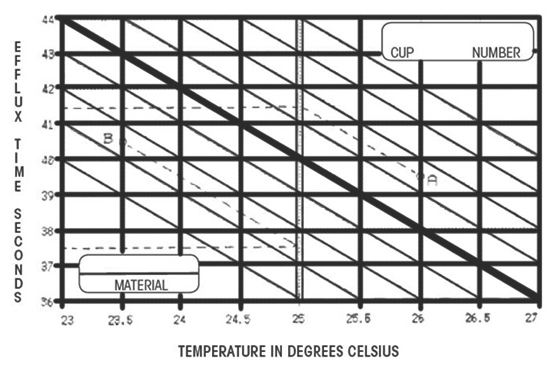
Use the prepared graph by plotting the measured temperature and efflux time seconds. At "A" in the example, these values are 26.0°C and 39.5 seconds. Parallel to the diagonal read the intersection with the heavy vertical line, which is 25.0°C (target temperature).
Then, reading horizontally to the left, the correct efflux time at 25°C was found to be 41.5 seconds. Similarly, at "B" in this example, the reading taken at 23.5°C was found to vary from 40.5 to 37.5 seconds when corrected to 25°C. Compensating for temperatures approaching but not reaching the specified temperature requires caution. Even over a limited range of ±2.0°C, the change in viscosity with temperature may not be linear, and any diluting material used to adjust viscosity may alter the rate of this change.