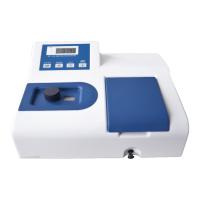
1. Diffuse light assay
1)(Apparatus and materials See Figure 1-5 for the turbidimeter. The instrument is equipped with standard test tubes and standard turbidity tubes (one for high and one for medium turbidity ).
(2) Measurement method
First, according to the color of the solution to be tested, turn the wheel equipped with white (colorless), red, green and blue color filters to correspond .
Insert the standard test tube filled with distilled water (as a zero calibration test tube) into the measuring hole of the probe, and cover the metal light shield, adjust the knob on the panel of the main unit, and the distilled water will be completely transparent, and the calibration indicator will be zero.
Take out the standard test tube of distilled water, replace it with a frosted plexiglass rod (as a high turbidity calibration test tube), cover the metal light shield, adjust the knob on the main panel, and set the indication to 100 or the calibrated turbidity value.

Insert the test tube containing the solution to be tested into the measurement hole of the probe, and cover the metal light shield. At this time, the reading indicated by the instrument on the panel of the host is the turbidity value of the solution to be tested.
When measuring turbidity, it should be noted that there should be no air bubbles in the tested solution, the liquid level should be flush with the scale line on the test tube wall, and there should be no sediment at the bottom of the test tube. If there are air bubbles or a small amount of sediment, shake the test tube first, and then measure after the bubbles or sediment disappear.
2. Transmitted light assay
(1) Instruments and materials
Transparency Tester, TMD type, see Figure 16, -transparency grade 20-100, measurement accuracy ±2%; copper mesh, 80-100 mesh.
(2) Test principle
If the solution to be measured is completely transparent, when a beam of directional incident light I passes through the solution, the light intensity of the directional transmitted light le can be detected; if the solution is turbid to varying degrees, when the directional incident light Diffusion of light occurs, thereby reducing the light intensity of the directional transmission light le, so as long as the light intensity of the directional transmission light le is accurately measured, the degree of transparency of the solution can be quantitatively reflected.
(3) Measurement method
First turn on the instrument to preheat, then cover the upper measuring port cover of the instrument, and adjust the calibration knob so that the display value of the instrument is 100. @ Filter the solution to be tested with 80-mesh or 100-mesh copper mesh to remove mechanical impurities, then pour the filtered solution into a dry and clean liquid tank, the liquid height is not less than 4/5 of the tank depth.
Insert the liquid tank into the measuring port, close the cover, and read the value displayed by the instrument, which is the transparency level of the measured solution. @Parallel measurement twice, if the difference between the two measurement results is less than 2. Take the average of the two measurement results.