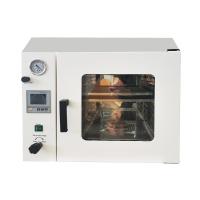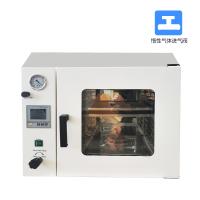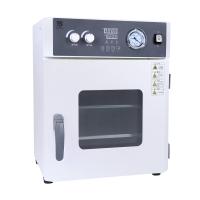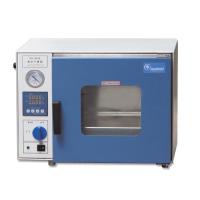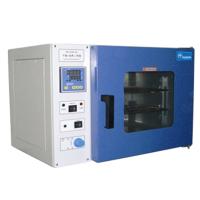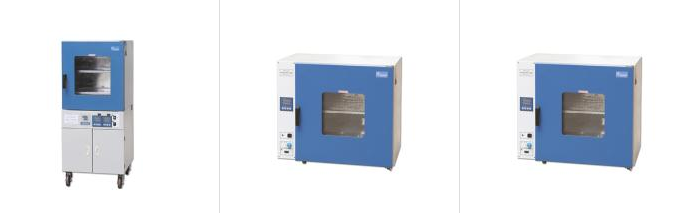
The structure of the vacuum Drying Oven
The vacuum Drying Oven is specially designed for drying heat-sensitive, easily decomposed and easily oxidized substances. It can flush inert gas into the interior, especially some items with complex components can also be dried quickly. Widely used in research and application fields such as environmental protection, for powder drying, biochemistry, chemical and pharmaceutical, medical and health, agricultural research, baking, and disinfection and sterilization of various glass containers. It is especially suitable for fast and effective drying of heat-sensitive, easily decomposed, easily oxidized substances and complex composition items.
The outer casing of the vacuum Drying Oven is stamped, folded and welded by steel plates. The surface of the outer casing is treated with high-strength electrostatic spray coating, and the paint film is smooth and firm. The studio is made of carbon steel plate or stainless steel plate, folded and welded, and the space between the studio and the shell is filled with thermal insulation cotton. There is a sample shelf inside the working room, which is used to place various test items. Mica controls are installed around the outer wall of the working room. The electrical box is on the left or lower part of the box. The front panel of the electrical box is equipped with a vacuum gauge, Temperature control instruments and control switches, etc., and electrical components are installed in the electrical box.
The vacuum Drying Oven can maintain a certain degree of vacuum in the working room and use an intelligent digital temperature regulator to display, set and control the temperature. The temperature regulator adopts computer technology to collect and process the temperature signal in the working room, so that the temperature in the working room can be kept at a constant temperature automatically. The temperature control system is PID intelligent temperature control, reliable performance, easy to use.
Precautions for the use of vacuum Drying Oven
1. The vacuum box should be used in an environment with a relative humidity of 85%RH, no corrosive gas around, no strong vibration source and strong electromagnetic field.
2. The shell of the vacuum Drying Oven needs to be effectively grounded to ensure safe use.
3. If the dry item is wet, it is better to add a filter between the vacuum box and the Vacuum Pump to prevent the wet gas from entering the Vacuum Pump and causing the Vacuum Pump to malfunction.
4. The Vacuum Pump cannot work for a long time, so when the vacuum degree meets the requirements of dry goods, the vacuum valve should be closed first, and then the power of the Vacuum Pump should be turned off. This prolongs the service life of the Vacuum Pump.
5. There is no explosion-proof and anti-corrosion treatment in the vacuum box studio, and items that are flammable, explosive, and corrosive gases are not allowed to be dried.
6. After the vacuum Drying Oven has been used for many times, it will cause the phenomenon that it cannot be vacuumed. At this time, the door seal should be replaced or the extension distance of the door buckle on the box body should be adjusted to solve the problem. When the drying temperature of the vacuum box is higher than 200°C, slow air leakage will occur (except 6050). At this time, remove the back cover of the box and use the hexagonal wrench to loosen the heater base, replace the sealing ring or tighten the heater base. to solve.
7. If the dried items are changed to light weight and small size (small particles) after drying, a barrier net should be added to the vacuum port in the working room to prevent the Vacuum Pump (or solenoid valve) from being inhaled by dry items.
8. If the rubber plug of the air release valve is difficult to rotate, it can be lubricated with an appropriate amount of grease inside. (such as Vaseline)
9. The vacuum Drying Oven should always be kept clean. Do not wipe the door glass with a reactive chemical solution, but with a soft cotton cloth.