The thickness of the locking layer can be calculated through the electrodeposition parameters, and can be obtained from the current efficiency formula:
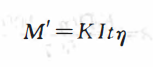
At the same time, the weight of the resulting metal lock layer can also be calculated using the volume of the metal and its density:
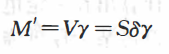
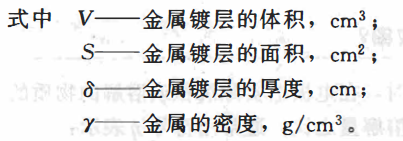
Since the unit of measurement for the locking layer in actual scientific research and production is micron (µm)' and the unit of the locked area is square decimeter (dm 2 ) , so when we want to use the known parameters To calculate the thickness of the obtained lock layer, some conversions are required.
From 1dm 2 =100cm 2 , 1cm=10000µm can get:
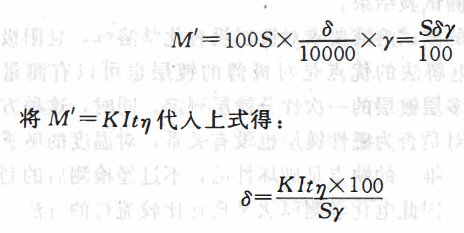
The electric lock process is based on the current density as a parameter, that is, the current value passing through the unit area. For the convenience of calculation, according to the concept of current density, D=I/S, I/S in the above formula can be replaced by current density D. The unit of current density is A/dm 2 . Considering that the electric lock measures the time in minutes, after substituting it, we get:
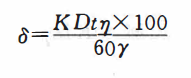
This is the formula for calculating the thickness of the locked layer based on the electrochemical properties of the locked species (electrochemical equivalent and current efficiency) and the current density and time used.
According to this formula, it is possible to calculate the locking layer thickness for a certain period of time under a certain current density, and also calculate how long it takes to lock a certain thickness.