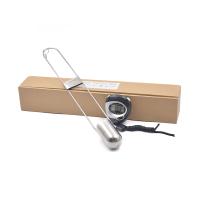
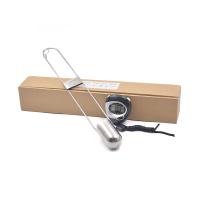
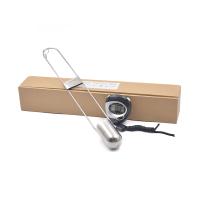
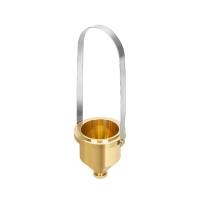
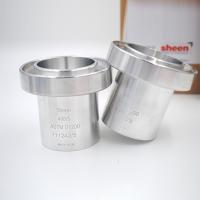
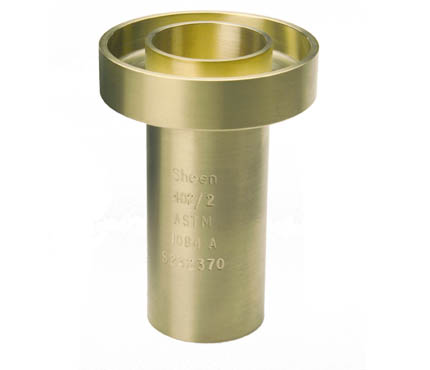
福特(FORD)粘度杯适用于测定牛顿型或近似牛顿型的色漆、清漆、喷漆以及类似流体的粘度。它是将待测定的流体装满福特粘度杯,然后测定流体从标准孔流出的时间。福特粘度杯测定法对许多色漆和其它涂料以及这些物料兑稀粘度的测定非常有用,但限于牛顿型流体或近似牛顿型流体的粘度测定。要获得满意且重现性好的测量结果,应当正确选择符合规定测量粘度范围的福特粘度杯型号。福特粘度杯不适合测量高粘度以及膏状体的物料粘度。
福特粘度杯是用于对化工原料进行粘度测定的,用户在使用前应当按相关规定建立适当的安全和卫生防护措施并确定规章制度。与化工原料接触有关的安全问题应当由用户予以确立,不属本说明书的说明范围。
结构及规格
福特粘度杯是基于ASTM D1200标准制造的,阳极氧化铝杯体,黄铜漏嘴,具有良好的耐腐蚀和耐溶剂性能,轻巧且能经受使用和清洗过程中的磨损。杯体外形采用了不同于ASTM D1200建议的样式,而是采用了类似于ISO粘度杯的样式,清洗和放置更稳便。粘度杯在出厂前均经过标准油校正。如果在使用中因某种原因松动过漏嘴或将漏嘴从杯中取出,应按ASTM D1200规定重新校正后才能继续使用。
型号 | 测量范围(厘斯) | 流出时间(秒) |
福特2号杯 | 20~120 | 40~100 |
福特3号杯 | 49~220 | 20~100 |
福特4号杯 | 70~370 | 20~100 |
福特5号杯 | 200~1200 | 20~100 |
运动粘度V(厘斯)与测量秒数t(秒)的换算公式:
福特2号杯 V=1.44(t-18)
福特3号杯 V=2.31(t-6.58)
福特4号杯 V=3.85(t-4.49)
福特5号杯 V=12.1(t-2)
(厘斯×比重=厘泊)

操作步骤
1. 测定应在不通风、无急剧温度变化的室内进行,室温应控制在22~28℃之间。
2. 用福特粘度杯进行测定时,样品温度应为25℃或采用客户间协商温度。试验过程中温度漂移应保持最小,且不可超过±0.2℃。
3. The sample of the test material should be visually homogeneous without any foreign matter or air bubbles.
4. Make the sample temperature slightly lower than the required measurement temperature, then fill the 1 pint jar with 2/3 of the sample and stir vigorously on a reciprocating shaker for 10 minutes. After stirring the sample is allowed to stand undisturbed and the sample temperature is further adjusted to the desired temperature. The viscosity measurement was started after 10 minutes.
5. Use a suitable stand to keep the mouth of the Viscosity Cup in a horizontal position.
6. Block the leak with your hand or a rubber stopper, and fill the cup with the test sample.
7. Use a clean and flat piece of glass to move inward from the edge of the cup along the mouth of the cup, scrape the excess sample into the outer groove, and seal the mouth of the cup. If you don't use a glass piece, you can use a ruler to scrape off the excess sample along the mouth of the cup.
8. First open the leak (remove the hand or the rubber stopper), then move the glass piece horizontally and start timing at the same time, and use a thermometer to measure the temperature of the sample stream. If the glass sheet is not used, timing is performed while opening the spout.
9. Stop timing when the flow line is cut off for the first time and read the counting seconds (accurate to 0.2 seconds), and confirm that the temperature drift meets the regulations (not exceeding ±0.2°C).
10. Repeat the determination three times, each time using a new sample of the same material. The average value of three determinations is used as the outflow time of the sample, and the viscosity is calculated according to the aforementioned formula.
11. After each measurement, clean the cup with a suitable solvent and a soft brush. Under no circumstances should metal cleaning tools come into contact with the cup. Cleaning of the leak hole requires special care to avoid any film deposits on or scratches to the inner wall.
12. To measure in an environment where the room temperature changes, the Ford Viscosity Cup needs to use a thermostatic control sleeve.
Precautions
1. The reproducibility of a test method depends on:
Dimensional accuracy of F Flow Cup
F Temperature at the time of measurement
F Newtonian properties of fluid
2. In order to maintain the accuracy of the Ford Viscosity Cup , it must be cleaned in a timely manner, and it should be handled and stored with care to avoid bumping and falling. After using for a certain period of time, the cup should be calibrated according to ASTM D1200. The frequency of calibration checks depends on how often the cup is used and how well the user protects the cup. It is recommended that the user send it to the manufacturer or relevant organization for calibration once a year.
3. ASTM D 1200 has the following instructions on the precision of the Ford Cup:
F Repeatability: Two results measured by the same operator at different times, if their difference is greater than 8%, it is considered suspicious.
F Reproducibility: Two results measured by different operators in different laboratories, if their difference is greater than 20%, it is considered suspicious.