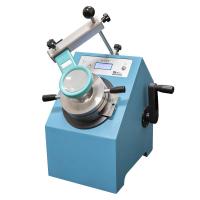
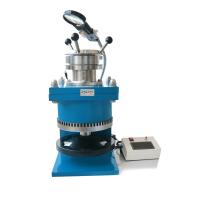
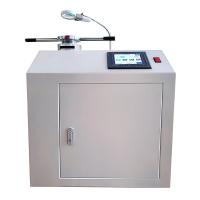
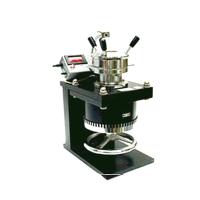
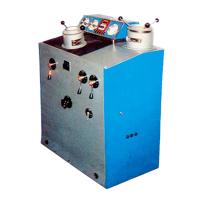
1. Test board preparation:
Dry the coated test panel (the coating can only be sprayed on one side, and the back side needs to be conductive. After polishing it with 0# sandpaper, clean it), dry it according to the drying conditions and drying time specified in the sample standard, and then At a temperature of 23±2°C and a relative humidity of (50±5)%, it can be put into the test after conditioning for at least 16 hours (except for special regulations).
2. Ambient temperature:
The test should be carried out in an environment with a temperature of 23±5°C and a relative humidity of (50±5)% (unless otherwise specified).
3. How to use:
(1) Turn the handwheel of the cupping instrument to the bottom in the "down" direction (clockwise), unscrew the clamping head of the test plate on the upper part of the testing machine, insert the test plate with the coating side up into the gap, and connect the punching head and Align the center of the test plate, tighten the clamping head of the test plate, and firmly fix the test plate on the stamping die.
(2) Turn on the power switch on the rear panel of the device, and the display should display 00.00.
(3) Rotate the hand wheel in the direction of "up" (counterclockwise) to raise the stamping head. When the rotation is close to 3 laps, you should slow down and rotate at a speed of about 3 seconds. When the stamping head just touches the template, the counter conducts electricity and starts counting, and the counter reading machine is the indentation depth.
(4) Continue to rotate the handwheel to reach the specified depth, observe the test plate to judge whether the sample is qualified; or gradually increase the indentation depth to determine the minimum depth when the coating just cracks or begins to separate from the bottom material.
4. Matters needing attention in the test:
(1) During the indentation process, it is irreversible to rotate, otherwise the counting will be inaccurate.
(2) With corrected normal vision or a magnifying glass as agreed, check whether the coating of the test panel is cracked or separated from the substrate. If a magnifying glass is used, it shall be stated in the test report so as not to cause misunderstanding with the visual results.
(3) When determining the minimum depth of damage, when the coating surface cracks or separates from the substrate for the first time, stop rotating the handwheel and read the indentation depth (accurate to 0.1mm), and the experiment should be repeated Experiment to verify the results until the results agree.