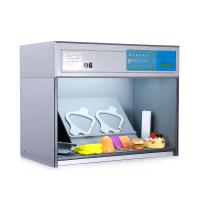
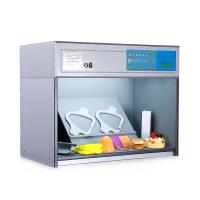
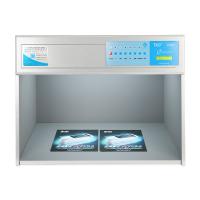
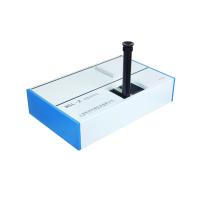
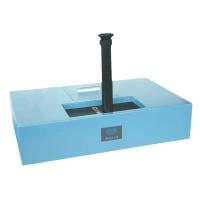
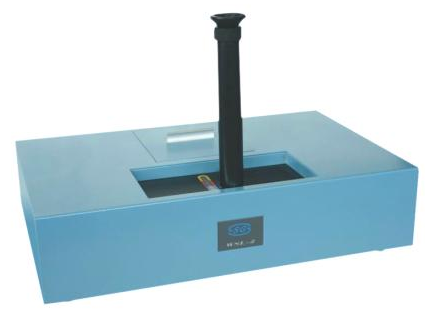
WSL-2 Comparative Color Meter (Color Meter) is a visual color Measurement Instrument, which uses the internationally recognized special color standard - Lovibond color scale to measure the color of various liquids, colloids, solids and powder samples. Spend.
Measuring principle
The method of adjusting the color visual effects of two parts in a field of view to be the same or equal is called color matching, and the WSL-2A comparative Colorimeter applies this principle. The color of the object to be measured and the color of the color filter appear in the left and right fields of view of the eyepiece respectively through the optical path. Adjust the color filter to make the colors of the two parts of the field of view completely consistent. At this time, the Lovibond color scale indicated by the instrument is determined Measure the color of the object.
Install
The instrument should try to avoid placing it in front of a window or a place exposed to direct sunlight. It is better to face a white or neutral-colored wall without a window. The height of the seat should be suitable for observing the field of view directly on the eyepiece tube. Open the accessory box, and there is a lens tube, a set of cuvettes, and two spare bulbs in the accessory box. Take out the lens barrel and screw it into the host interface screw (unscrew the protective cover), and then measure the sample after checking the power supply voltage and the light bulb contact.
Sample Preparation
Since there are two kinds of samples, transparent and non-transparent, the measurement methods are divided into transmission method and reflection method.
When measuring the color of a transparent liquid, you only need to inject the liquid into the cuvette, and then put the cuvette into the groove of the color box to start the measurement (make the cuvette close to the window of the color box).
Please note that the color depth of the measured transparent liquid is related to the length of the cuvette used, therefore, before measurement, the length of the cuvette specified in the test standard must be checked, and special attention should be paid: the color depth is not necessarily directly proportional to the length It is completely wrong to replace the result obtained by the 10mm cuvette with one-half of the measured result of the 20mm cuvette. Likewise, it would be a mistake to assume that doubling a liquid will give you half the color depth of that liquid.
In the absence of specific standards, care should be taken to ensure that the color scale of the sample does not exceed 20 Lovibond units when selecting cuvette specifications, because the color resolution between 3 and 10 Lovibond units is better. If it exceeds this value, The resolution gradually decreases.
When measuring the color of non-transparent objects such as jam, colloid, powder, paper pattern, cloth, plastic, etc., you can choose the sample container ordered separately. After the sample is installed, replace the lower reflective plate close to the back of the instrument with the container to be tested, and measure its color scale by observing the reflected light beam on the sample without using a cuvette. Paper patterns and fabric samples should be cut into circular pieces with a diameter of 28mm.
Colorimetric method
Turn on the power, observe the field of view, the left half shows the color of the sample, and the right half shows the color of the calibration filter, adjust the yellow, red and blue filter sets respectively until the colors of the left and right parts are exactly the same. At this time, the value displayed in the display window of the instrument slot plate is the chromaticity of the sample to be tested (add the values of the same color). In order to reduce the measurement time, it is better to estimate the results of the measurement in advance.
When one or two primary color filters are adjusted to be closer to the color of the sample, if the color is darker than the color of the sample, the brightness of the sample can be weakened by using the neutral gray film transferred into the light path of the sample, and its value is the value of the sample. Brightness data. It should be noted here that when the three primary colors are used for color comparison, the neutral gray film can no longer be used, and only the method of adjusting the color filter with the smallest indication value can be used to achieve color matching.
When measuring the color of yellow liquid, it is recommended to fix the chromaticity of yellow Lovibon first, and then use red and blue to match, so that the position of the color chip can be determined more quickly.
In addition, when observing, the eyes should be centered. At the same time, the staring time should not be too long, because the resolution will decrease after eye fatigue. In other words, it is better to observe step by step than to observe continuously for a long time.
color naming
At present, it is common to use one primary color to describe a certain color, but some departments use six color description methods for more convenience or for certain specific needs. Here is a brief introduction to these six colors:
1. Red: Lovibond red
2. Orange: A combination of red and yellow. If yellow is in the majority, it is yellow-orange; if red is in the majority, it is red-orange.
3. Yellow: Lovibon yellow
4. Green: A combination of yellow and blue. If yellow is the majority, it is yellow-green; if blue is the majority, it is blue-green.
5. Blue: Lovibond blue
6. Purple: The combination of red and blue, if red is the majority, it is red-purple; if blue is the majority, it is blue-purple. Each color has the concept of "bright" and "dark". When all three primary colors are used for colorimetry, the sample is called "dark* color", and the weakest primary color value is called the darkness value. When a neutral gray chip is used in the measurement, the sample is called "bright color", and the color scale value of the neutral gray chip is the brightness value.
Example: The result of a certain colorimetric measurement is: red 10.5; yellow 7.2; blue 3.1, all three primary colors are used, and the lowest indication value blue 3.1 is the darkness (red 3.1, yellow 3.1, blue 3.1), Since the remaining red 7.4 and yellow 4.1 contain equal 4.1. Therefore, the value of orange is 4.1, and the value of red is 3.3, so the sample is called "dark red orange". So on and so forth. Table 1 is the recorded results of several samples. Users can refer to the format of this table to make a test manual for data recording and long-term preservation.