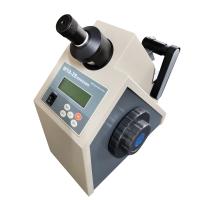
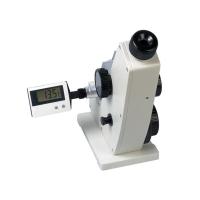
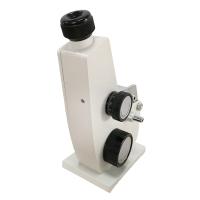
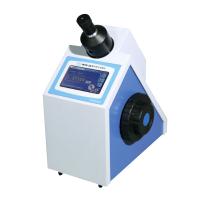
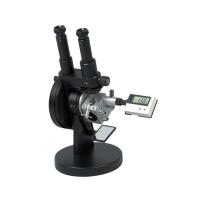
How to use and operate
(1) Preparatory work:
(1) Before starting the measurement, it is necessary to check the reading with a standard sample. Add 1 to 2 drops of brominated naphthalene to the polished surface of the refracting prism, and then paste the polished surface of the standard sample. When the reading field of view indicates the value on the standard sample, observe whether the dividing line between light and dark in the telescope is in the middle of the cross line , if there is deviation, use a screwdriver to slightly rotate the screw in the small hole (16) in Figure 7. This screw drives the objective lens to deflect, so that the image of the dividing line is displaced to the center of the cross line. Through repeated observation and correction, the initial error of the indication is minimized (including the operator's aiming error). After the calibration is completed, it is not allowed to move this part arbitrarily in the subsequent measurement process. If there is any doubt about the measured refractive index value in the daily measurement work, it can be checked with the standard sample according to the above method to check whether there is an initial error and correct it.
(2) Before each measurement work and when calibrating the indication value, it is necessary to clean the rough surface of the light-incoming prism, the polished surface of the refracting prism and the polished surface of the standard sample with a mixture of absolute alcohol and ether (1:4) Gently wipe clean with absorbent cotton, so as not to leave other substances, which will affect the imaging clarity and measurement accuracy.
(2) Measurement work:
(1) Determination of transparent and translucent liquids: Add the liquid to be measured on the surface of the refracting prism with a clean dropper, cover the light-incoming prism, and lock it with the handwheel (10). bubble. Open to take the (-) sign. Shade (3), close the reflector (1), adjust the diopter of the eyepiece to make the image of the reticle clear, at this time turn the reading handwheel (15) and find the position of the dividing line between light and dark in the field of view of the eyepiece, and then rotate Use the achromatic handwheel (6) to make the dividing line without any color, and fine-tune the reading handwheel (15) so that the dividing line is in the center of the crosshairs, and then turn the condenser (12) properly. is the refractive index of the measured liquid.
(2) Determination of transparent solids: There must be a flat polished surface on the object to be measured. Open the light entrance prism, add 1 to 2 drops of bromonaphthalene on the polished surface of the refracting prism, wipe the polished surface of the object to be measured and put it on to make it in good contact, then you can find it in the field of view of the eyepiece Demarcation, aiming and readouts operate as before.
(3) Determination of translucent solids: The translucent solids to be measured also need to have a flat polished surface. When measuring, stick the polished surface of the solid on the refracting prism with bromonaphthalene, open the reflector (1) and adjust the angle to measure with the reflected beam. The specific operation method is the same as above.
(4) Measuring the sugar concentration in sucrose: The operation is the same as when measuring the liquid refractive index. At this time, the reading can be read directly from the upper half of the indication in the field of view, which is the percentage of the sugar concentration in the sucrose solution.
(5) Measuring the average dispersion value: The basic operation method is the same as that of measuring the refractive index, except that when the dispersion adjustment handwheel (6) is turned in two different directions, the boundary line between light and dark in the field of view becomes colorless. At this time, it is necessary to write down Take the average value of the scale value Z indicated on the dispersion value scale circle (7) each time, and record its refractive index nD. According to the value of the refractive index nD, find the A and B values in the same row of the Abbe refractometer dispersion table (if nD is in the middle of the two values in the table, use interpolation method to obtain). Then find out the corresponding δσ value in the table according to the Z value. When Z>30, the δ value takes a negative value. When Z<30, δ takes a positive value, and the average dispersion value can be obtained by substituting the calculated A, B, and δ values into the dispersion formula nF-nC=A+B δ (see page 7 for examples)
(6) If it is necessary to measure the refractive index at different temperatures, screw the thermometer into the thermometer seat (13), connect the water pipe of the thermostat, adjust the temperature of the thermostat to the required measurement temperature, connect the circulating water, After the temperature has stabilized for ten minutes, it can be measured.
Repair and Maintenance
In order to ensure the accuracy of the instrument and prevent damage, users are requested to pay attention to maintenance and the following points are put forward for reference:
(1) The instrument should be placed in a dry, well-ventilated room to prevent the optical parts from becoming moldy after being damp.
(2) When testing corrosive liquids, cleaning should be done in time (including optical parts, metal parts and painted surfaces) to prevent erosion and damage. A desiccant (color-changing silica gel) is present to absorb moisture.
(3) There should be no hard impurities in the sample to be tested. When testing solid samples, the surface of the refracting prism should be prevented from being roughened or indented.
(4) Always keep the instrument clean. It is strictly forbidden to touch the optical parts with oily or sweaty hands. If there is dust on the surface of the optical parts, it can be wiped lightly with high-grade suede or long-fiber absorbent cotton, and then blown away with a leather blower. If the surface of the optical parts is stained with grease, it should be wiped clean with alcohol ether mixture in time.
(5) The instrument should avoid strong vibration or impact to prevent damage to optical parts and affect accuracy.