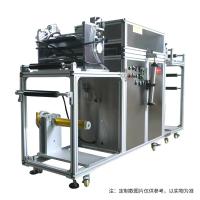
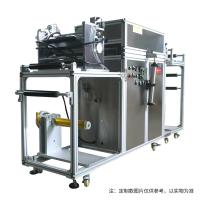
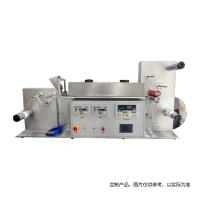
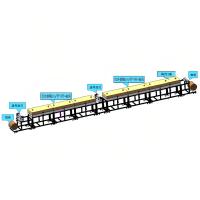
When coating with a roller coater, when the paint is separated between the rollers, due to the effect of surface tension, the paint forms a thin film layer like a duck web, and the film between the rollers is stretched and thinned with the rotation of the two rollers, and finally Cracks, forming a transient stalagmite intermediate, and finally reverts to its original surface. Due to the uneven distribution of the surface tension of the coating on the coating after splitting, moiré and pitting patterns may be formed on the coating surface.
1 After the paper product is coated, it can improve the printability, special performance and decorative effect of the paper product.
2 Coating equipment is mainly composed of four parts: unwinder, coating head, dryer and winder, among which the coating head is the main equipment for coating the coating on the paper surface.
3 When the coating head completes the coating operation, it has two functions at the same time: measuring the coating amount and finishing the coating quality.
4 The coating method of paper can be divided into internal coating and external coating according to the position of the applicator; single-sided coating and double-sided coating according to the coating surface; one-time coating according to the coating Cloth and multiple coats. 5 The components of mineral coatings include pigments, adhesives and auxiliary additives.
6 Factors affecting the mixing effect of the pigment disperser include mixing intensity, mixing time, solid content of the mixture and shearing speed.
7 The coating screening equipment mainly includes vibrating screens and filters.
8 The brush in a brush applicator consists of bristles, a brush holder and a moving device.
9 The structure of the air knife coater includes correction rolls, threading rolls, pressure rolls, coating rolls, backing rolls, air knives, crawler vacuum boxes and return systems, etc.
10 The double-flow coater is composed of a nozzle-type feeding device, a scraper metering device, a back roller and a paint collecting tray.
11 The inverted knife coater is the predecessor of the overflow contact knife coater, which is one of the most widely used coating devices in the paper industry in the world today.
12 Coating scraper can be divided into soft scraper (non-inclined scraper) and hard scraper (inclined scraper). The thickness of the scraper is 0.25~0.63 mm, the width is 70~105 mm, and the length depends on the width of various coating machines. 13 The roll coater can be divided into press roll coater, reverse roll coater, transfer roll coater and gravure roll coater according to the coater head.
14 The severity of the formed pattern is affected by factors such as the rheology, viscosity, coating speed and coating amount of the coating, and the hardness of the roller.
15 Disadvantages of electrostatic coating technology are: explosiveness, safe use at high voltage, high cost. 16 There are batch, semi-batch and continuous vacuum coating methods.
17 The types of unwinding racks are: load belt, sandwich type, pneumatic controller, power regeneration system, compressed air tensioning device.
18 The drying of coated paper is the same as the drying of paper machine paper, which is also a process of heat and mass transfer (that is, the transfer of energy and mass).
19 At the beginning of drying, evaporation occurs on the surface of the coating, so that the partial pressure of the vapor appears, and the evaporation migrates to the interior of the coating. Evaporation depends on capillary pressure difference and vapor pressure difference. 20 The coating drying process includes surface drying and internal drying.
21 There are many types of coating dryers, such as drying cylinder dryers, bridge hot air dryers, air cushion dryers, sinusoidal air flotation dryers and infrared dryers.
Glossary
1 Coating equipment : refers to equipment suitable for coating processes with different purposes and different structures.
2. Air-knife coating machine : After the feeding roller transfers the coating to the paper surface, use the compressed air from the air knife to blow off the excess coating and spray the coating evenly.
3. Scraper coater : Use a scraper to scrape off excess paint and smooth the coating surface. 4-Roll Coater: The degree of contact between the two rollers is used to measure the coating and homogenize the coating.
5. Curtain coater : It is a new coating method. The liquid coating is free-falling before it touches the moving pre-coated paper sheet. It is non-contact coating.
6 In-machine coating : The coater is set between the two dryers of the paper machine, combining papermaking and coating into one process. 7 Coating outside the machine: coating and papermaking are separated, and the base paper is placed on a special coating machine.
8 Pattern : 9 Reverse Roll Blade Coater: It is a profile coating machine that can apply a very uniform thin layer of coating on the surface of the paper web.
10 gravure coating machine : also known as gravure offset coating machine. It uses gravure feeding and offset paint transfer two process principles, uses a gravure roller to measure the amount of coating, uses mechanical and chemical methods to engrave different patterns on the surface of the roller, and then chrome-plates the surface.
11 Curtain Coater : It uses a slit nozzle to spray paint to form a liquid film, and coat the liquid film on the paper web.
12 " Teapot Effect ": When the curtain coater is coating, the paint flows out of a continuous film from the nozzle of the paint dispenser, starting from the gap, and the freely falling curtain is in a short distance (about 100~300mm) Gained expansive flow. Gravity, inertia, adhesive and capillary forces control the stretching behavior of the curtain as it flows towards the base paper. The forces at the stationary contact line cause an uneven distribution of stress near the opening of the slit, causing the curtain to sometimes deflect towards the lower end of the opening. As a result, the line of contact moves away from the gap, causing the "teapot effect" to occur. 14 Spray coating: It is a non-contact coating method, which can be used for single-sided or double-sided coating (sizing) of paper or cardboard by using controllable high-pressure spray technology.
15 Cast coating : when the paint is in a plasticized state (flowable state), first stick the paint surface on a highly polished non-adhesive surface, in essence to make the coating have a high gloss, and then make the paint The layer becomes non-plastic and the coated paper is eventually removed from this non-adhesive surface. 16 Pre-cast coating: Another form of cast coating, which differs from general cast coating in that it first casts the paint on a polished metal surface to dry, and then transfers this paint layer to paper, which has Binders facilitate bonding of paint layers after cast coating. Generally used for cardboard coating.
17 Intermittent vacuum coating : In the intermittent method, each component is mounted on a guide rail and sent to a vacuum chamber for coating. After coating, it is picked out and then replaced with another component.
18 Continuous Vacuum Coating : In the continuous process, the substrate is fed in from one side of the vacuum chamber, metallized and then exited from the other side. The vacuum chamber can maintain a certain degree of vacuum for a long period of time.
19 Paper threading roller : It is a device that smoothly guides the paper web on the unwinding frame to the coating machine for coating.
20 " Railway track ": The density and composition of each point on the same plane in the coating are inconsistent, as well as the unevenness of the surface, causing some components to flow in the horizontal direction, which is likely to cause paper defects in the "railway track".
21 " Drying cylinder mark " phenomenon: it is caused by the migration of paint, which is a unique phenomenon of high-speed hot air dryer, and is caused by the irregular migration of paint when it is dried by high-speed hot air. In high-speed hot air drying, in order to keep the paper in close contact with the drying cylinder, irregular cylinder sticking occurs.
common problem
1 What are the advantages and disadvantages of using in-machine coating for paper coating?
Answer: Advantages: Compared with the coating outside the machine, the coating inside the machine does not need a separate paper unwinding, threading and transmission adjustment system, etc., so it has the advantages of compact equipment, low equipment investment and low unit cost. It is the current foreign production coating A basic coating method for cloth paper. Disadvantages: The drying capacity of the paper machine is limited, the coating speed is low, and the output of the paper machine is affected. At the same time, the two parts of papermaking and coating will affect each other to reduce production efficiency, and it is also not conducive to the adjustment of product varieties. Considering that our country mainly uses grass raw materials, the strength of paper is low, and the paper pages are easy to break, etc., in-machine coating is seldom used in my country at present.
2 Preparation process of mineral coating?
Answer: The importance of the preparation of mineral pigment coatings goes without saying. The processing methods include: transportation and crushing of pigments, cooking, cooling and screening of adhesives, addition of additives and uniform mixing, re-screening and adjustment of viscosity and solid content .
3 What are the factors that affect the mixing effect of the pigment disperser? How do the factors affect it?
Answer: (1) Mixing intensity (the main factor), for a given mixing intensity, the dispersion can be completed in a short time, if it cannot be completed, the additional effect of extending the time is very small; therefore, all particles should be made to pass through the maximum shear strength between the small areas. (2) Mixing time (secondary factor), it is necessary to ensure that all materials have sufficient time to flow through the dispersion zone with high mixing intensity.
(3) The higher the solid content of the mixture, the greater the flow resistance and the higher the energy transfer rate.
(4) The increase of the shear speed increases the shear resistance, not only improves the degree of dispersion, but also shortens the dispersion time.
4 How does the air knife coater work?
Answer: The paint from the paint tank is transferred to the surface of the base paper through the feeding and feeding system, and then when the paper web passes between the back roller and the air knife, the air flow at a certain angle to the paper web is ejected from the air knife spray slot Blow off the excess paint to achieve the required coating weight, while blowing the coating evenly.
The excess paint on the paper surface is blown down into the air material separator by the air knife located at the center line of the back roller, and the separated paint is returned to the paint tank through the air material separator for reuse.
5 What are the factors that affect the coating amount of the air knife coater? Typical air knife coating process parameters?
Answer: The coating amount of the air knife coater is related to the pressure of the air knife, and also related to the installation angle of the air knife, the distance between the knife and the paper, and the width of the knife slit.
Typical air knife coating process parameters: knife distance 6~10mm, knife angle 40~45 degrees, knife slit width 0.4~1.5mm, wind pressure 9~20kPa
6 How to control the coating amount of the air knife coater? Answer: The method to reduce the coating amount of the paper surface:
(1) increase air pressure (2) reduce vehicle speed
(3) Reduce the solid content of the paint (4) Reduce the viscosity of the paint
(5) Reduce the nozzle gap of the air knife
(6) The method of shortening the distance between the nozzle opening of the air knife and the paper web on the back roller to increase the amount of coating on the paper surface, and vice versa.
7 Working principle of knife coater
Answer: The excess paint is coated on the paper web by the feeding roller, and then the excess paint is scraped off with a scraper. It has the characteristics of flat coating that fills up the depressions on the surface of the base paper, making the coating plane quite smooth. It has good printing effect and is suitable for high-concentration paint and high-speed coating.
8 What are the basic types of knife coaters?
A: Drag blade, flexible blade, inverted blade, Bill blade, dual blade, dual flow, overflow contact, jet blade coater.
9 How does the Bill Blade Coater work?
Answer: The paper web runs down through the coating groove formed by a flexible scraper and a soft rubber backing roller. The backing roller runs 3~5% faster than the paper sheet. This speed difference and the draft angle when leaving the roller can provide Loads evenly and eliminates scratches. The Biel knife coater operates on the principle of a soft knife, increasing the coating weight by increasing the knife pressure.
10 How does the double blade coater work?
Answer: The paper web is coated on both sides by two flexible scrapers at the same time. The coating is sprayed from the slit-shaped coating tanks on both sides to the vertical paper surface, and then it is metered and leveled by the two opposite scrapers. The paint returns to the paint collection pan, where it is filtered and recycled.
11 双流涂布器的工作原理?
答:涂料由纸幅两侧的喷嘴式上料器涂覆于纸面,上料量主要由流送泵、喷嘴式上料器与纸幅的夹角和距离大小来控制,过量的涂料溢流返回涂料收集盘。涂布后的纸幅由刮刀或者计量棒进行计量和整饰。对于相同涂料,靠近背辊一侧的纸面涂布量会稍高于刮刀一侧的纸面涂布量,因此要达到两面涂布量一致的话,需要使用不同浓度的涂料,靠背辊一侧的涂料固含量低一些,所以涂料循环系统也需单独分开。
12 溢流接触式刮刀涂布器的工作原理?
答:在充满溢流的涂料槽盘内,包覆有橡胶的上料辊将涂料覆盖在表面,在与纸幅和背辊运行的相同方向旋转,同时将涂料转移到纸面上。上料辊与背辊之间的间隙一般为0.44mm加上纸页厚度。纸幅位于上料辊与背辊接触点的中间,该点充满涂料。由楔状的线压力及剪切逐渐增加的曲线结构可消除涂料中的气泡以及防止脉动涂布效果。然后纸幅上的涂料可经过软刮刀或硬刮刀以及计量棒的计量和整饰,刮下的涂料与涂料盘溢流的涂料一起返回涂料循环系统。
13 三辊压榨涂布头的结构形式?
答:中间辊保持固定的位置,而顶辊和底辊可以移动或往中间辊上加压;另一种形式可以将底辊固定,并且通过一组共同的载荷装置转移中间辊和顶辊,带有机械制动的连杆,把一顶辊和中间辊连接在一起,并且保持顶辊辊隙的间隙。
其他的三辊式装置的辊子排列,其辊轴并不在一条直线上,辊子排列有时是倾斜的,呈“L”形或“狗腿”形;According to涂布工艺、成品要求以及进入干燥部的引纸方式,决定最后辊子的排列。
14 三辊压榨涂布机的工作原理?
答:三辊式压榨涂布头工作时,上料辊从涂料槽内将涂料带到转移辊上,刮刀将转移辊上的涂料计量至要求的厚度后涂敷到原纸的表面。通常中间辊保持固定,通过顶辊和底辊向中间辊加压,从而调整涂布机的工作参数。
15 传递式涂布机的工作原理?
答:涂布头每面使用3个辊筒,分布辊将涂料转移给涂布辊。然后由涂布辊将涂料涂于纸面。这种涂布头中的所有辊的线速度均相近,According to涂布工艺的要求可能略有差别,但一般不超过5%。
涂布量由分布辊和计量辊间的间隙及调整计量辊与相邻辊筒的相对速度来控制的。由于涂料是通过各辊转移传递的,所以各辊间的线压力不能太大,以免涂料被挤出。辊筒的直径应According to涂布机的车速、涂布宽度和产品的性质来决定。
16凹辊式涂布机的工作原理?
答:凹辊式涂布时上料辊从涂料盘中带入过量的涂料,将之转移到凹辊并用刮刀强制刮送使之充满凹辊上的每一个凹纹,多余的涂料同时被刮刀刮去。凹纹中的涂料可直接转涂到纸面上,也可以转移到涂布辊后再涂敷于纸面。
17 影响凹辊式涂布机涂布量的因素?
答:有很多因素影响涂布量,如辊筒的网点形状和密度、涂料粘度、固含量、纸的吸收性、平滑度、辊间的线压力和涂布速度等。当原纸和涂料已经选定时,辊筒的线压力和辊面网点形状起着决定性的影响。
18 添加表面活性剂提高幕帘稳定性的作用效率的影响因素?
答:化学组成,链的长度,表面活性剂分子的浓度; 幕帘液体的黏度;
幕帘流动领域的局部速率; 幕帘液的使用期限; 新幕帘表面的生成速率。
19 帘式涂布过程中,哪些因素容易导致帘式涂布失败的?
答:流速低,幕帘破裂;
流速与涂布速度均低,出现拽拉膜现象; 涂布速度高,流速相对低,出现夹杂空气; 流速高,涂布速度低,形成踵部。
20 喷雾涂布机的工作原理?
答:涂料用高压泵加压(压力高达150kg/㎡)进行雾化。在雾化过程中,液体从喷嘴高速喷出后,薄雾状的涂料和大气相撞,然后突然失去速度形成小液滴,液滴的直径约为20~40(60)μm。小液滴飞落到纸张表面,撞击纸张表面并形成连续的液体薄膜。
21 铸涂涂布方法?
答:通常的铸涂方法是:把含有颜料和粘合剂(如干酪素)的涂料混合物涂布在纸幅的一面,然后把湿的涂层表面紧压在一个热的、高度抛光的表面上(即镀铬的烘缸表面),直到涂层干燥为止。然后纸幅就自然地从这个烘缸表面上剥离下来,涂层表面用肉眼看实际上像抛光金属表面的镜象。
An alternate method is to apply the paint to a dry surface first, rather than the altered method of applying it to paper. Two methods are used to transfer the coating to the paper: (1) the paper web is in close contact with the wet coating before the coating is completely dry; (2) after the coating is dried on the cast coating surface, the paper is then cemented with the dried coating together. The latter method can be applied to the paper web with an adhesive,