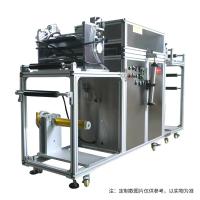
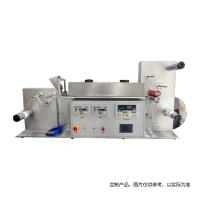
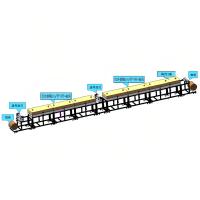
Fitter part
1 Debugging of the parallelism of the passing rollers of the equipment, refer to the assembly process card for debugging,
2 gas circuit connection and debugging,
Connect the gas circuit according to the schematic diagram of the gas circuit, start debugging after the equipment is powered on, adjust the air pressure gauge of each part of the equipment to the minimum state, open the total air pressure gauge, and follow the sequence (1 unwinding, 2 head, 3 machine Tail, 4 rewinding) Open the air pressure gauges to be debugged one by one, the air pressure value is about 0.1mpa, and then adjust the action direction and running speed of each cylinder. During the debugging process, pay attention to check whether there is any air leakage in the air circuit. It needs to be dealt with in time. After completing the above debugging, set the pressure value of each part of the cylinder. The range of pressure value is as follows:
Intercoat cylinder 0.25Mpa
Scraper rotary cylinder 0.4Mpa
Scraper lifting cylinder 0.4Mpa
Pressure roller cylinder 0.4Mpa
Coating swing roller cylinder 0.2Mpa
Discharge swing roller proportional valve F1=0.001 F2=0.4
Total barometer 0.6Mpa
3 Debugging of manual function of equipment
Electricians and fitters cooperate with each other to debug,
unwinding part
1 Whether the button and position of the pressing belt are correct, and whether it is consistent with the state on the touch screen. If not, the air pipe needs to be replaced, and the speed of opening and closing of the pressing belt cylinder and the synchronous speed
2 Check whether the running direction of the rewinding and unwinding air shaft is consistent with the path on the touch screen. If it is not consistent, the electrician needs to change the wiring. If it is double rewinding, it is necessary to check whether the conversion of the upper and lower air shafts is consistent with the mark. If not, replace the clutch. Air pipe or wiring, check whether the synchronous belt is worn during the operation of the motor, and if necessary, adjust the parallelism of the synchronous wheel. 3 Check the direction of movement, speed, manual and automatic functions of the correction part, the sound during the correction operation, whether the limit device meets the requirements, and check whether the correction direction is correct during automatic operation
nose part
1 Before ventilation, when the rotary scraper is at the cleaning position, the distance between the adjustment screw of the scraper and the coating roller must be >30mm to prevent damage to the coating roller. If it does not meet the requirements, adjust the angle between the spline on the rotary cylinder and the scraper.
2 Manually run the coating roller, back roller, and reference roller to see if the running speed and direction are consistent with the set parameters, if not, change the parameters of the servo motor. Note that the scraper and the backing roller cannot be in contact with the coating roller when the coating roller is running
3 Back roller zero return debugging, when back to zero, the back roller moves backward, after sensing the rear limit sensor, it changes direction and moves forward for a certain distance, then stops, and the zero return is completed. At this time, the position of the backing roller is at zero position. At zero position, the distance between the backing roller and the coating roller should be between 3-4 mm, which should not be too small or too large. To prevent accidents when starting debugging, the distance between the motor and the screw rod should be adjusted. The coupling needs to be loosened, and then press the zero button, the motor starts to run, at this time, touch the rear limit sensor with a screwdriver and remove it, the motor starts to change direction, after a period of time, the motor stops, and then manually adjust the screw Make the distance between the back roller and the coating roller 3-4mm, lock the coupling, and return to zero again to see if the position meets the requirements. If it does not meet the position, adjust the position of the limit sensor until it is qualified. If there is an abnormality in the action, the electrician needs to check the line or check the parameters. After the zero return action is qualified, check the zero return positioning accuracy of the back roller push, kneading and loosening positioning accuracy, and the synchronous speed of the two servo motors. The number of times is not less than 5 times, and the position Accuracy error <0.01mm. If not, please check the assembly accuracy of the screw part and the wiring of the electrical appliance.
4 刮刀的零位标定,在标定零位之前需把硬限位调至最高,以防止刮刀下降时碰伤涂辊,调整好刮刀的升降和同步的速度,速度调慢一些,以免对位移传感器的精度造成影响,然后检查位移传感器数据显示的方向是否正确,用手轻轻往下压针头,数值变小,说明方向正确, 按住向上按钮,调节滑块往电机方向走,说明电机运转方向正确。然后开始回零标定,刮刀零位标定时,刮刀下降,位移传感器数值变小,当刮刀硬限位后不再下降,位移传感器数值没有变化时,伺服电机再继续运转一定距离然后停止,零点标定完成。刮刀的硬限位高度大约为40-50um,实际值要与设定值一致,两边硬限位的高度误差<5um. 5,调整好刮刀的角度和斜滑块的压印,刮刀的角度调整至下刀口位置与刮刀座上的轴承位的中心垂线重合,然后再往背辊方向旋转0.5-1mm左右的距离。斜滑块的压印按装配工序卡要求进行调整, 6刮刀,涂辊,背辊的检查和调整,检测钢辊的圆跳动<1um,背辊圆跳动<10um,刮刀直线度<2um,背辊还需要检查圆柱度,准备一块50*200的铜箔或铝箔,放在背辊和涂辊中间,捏合背辊,通过调整坐标,用一定的力度能把箔拉出来为止,把背辊左右两边调整成一样的状态,然后逐渐从两边往中间检测其捏合程度,如果有过紧或者过松现象,通过调整捏合坐标(调整量位0.01mm)能达到之前的捏合成度的视为合格,如果超过0.01的调整量则不合格,需更换背辊。 机尾的调整, 检查出料纠偏,压辊,与按钮是否一致,设定好出料摆辊的比例阀的参数
4 张力标定和摆辊的标定,和电工配合一起标定张力和摆辊,
5 烘箱加热调试, 打开风机,检查风机的转动方向是否正确,检查完毕后把进风,循环风,排风风闸打开至最大,烘箱门打开,把风机频率设定在50Hz,开启风机吹30分钟,调整好防干烧装置的温度上限,调整至150-180,然后开始单节烘箱加热,
6. The equipment is automatically run and debugged. After setting all the parameters, start to wear the belt for test machine. Start at a speed of 1000mm/min to see if the equipment is running normally. If there is any abnormality, cooperate with the electrician in time. After the equipment is running normally, Start debugging the deviation correction actions one by one, and speed up the subsequent test machine work after completing the above work.
7 Requirements for running test machine
1. The belt running of the equipment runs smoothly as a whole, the pendulum roller has no obvious swing, and the transmission part has no abnormal noise. Check the running status of each motor and there is no obvious heating.
2. When the belt is running, the tension on both sides of the rollers such as the head and the tail is consistent, no twill, no wrinkles, and the rollers run flexibly.
3. A series of actions such as single-sided intercoating (single-stage and multi-stage), double-sided intercoating, continuous coating, steel roller, and back roller speed change are required when running the tape.