As a spraying tool, the Spray Gun consists of a spray head and a gun body. Its operating principle is to use extremely high air pressure to quickly break the paint passing through the paint channel into extremely fine particles, and then spray it out from the nozzle and adhere to the surface of the workpiece. In addition to the precise structure and performance of the Spray Gun itself, the correct operation of the Spray Gun can also make the spraying effect more effective. In order to have a good spraying effect, it is also very important to master the skills of using the Spray Gun. This article will explain in detail the correct operation method of the Spray Gun .
Before using the Spray Gun, you must first understand the functions of its various parts. For professional painters, the three spray width adjustment knobs (Figure 1).
The spray width adjustment knob is used to adjust the size , and can be used to check whether the Spray Gun is in good working condition. Turning the regulator counterclockwise increases the spray pattern, while turning the regulator clockwise decreases the spray pattern. Below the spray width adjustment knob is the paint flow adjustment knob, which is used to adjust the amount of paint sprayed from the nozzle. Rotating the spray width adjustment knob counterclockwise can increase the needle stroke, thereby increasing the paint flow; turning it clockwise can decrease the needle stroke, thereby reducing the paint flow. The last one connected to the air intake pipe hole at the bottom of the Spray Gun is the air pressure adjustment knob. If the air intake pressure is too high, you can turn the air pressure adjustment valve clockwise to reduce the air intake air pressure of the Spray Gun to the standard value recommended by the manufacturer . If the air pressure is too small, adjust in the opposite direction. The spraying operation is to cooperate with each other through these three knobs to make the Spray Gun reach a good working state, so as to carry out the spraying operation.
Also, a word about the gun trigger. The trigger of the Spray Gun has two gears, touch it lightly to reach the first gear, which is mainly used for pre-spraying air for blowing dust, and continue to pull to reach the second gear, which is used to atomize the paint flowing through the paint channel.
After you are familiar with the Spray Gun, you can start the operation preparation before spraying . The painting operation is a delicate operation, which should be strictly carried out in 7 steps.
1. Load paint. Generally, the volume of the universal upper pot of the Spray Gun is 600ml. After the sprayer mixes the paint according to the requirements of the paint product, pour the paint into the gun pot. The depth of the paint should not exceed 11cm.
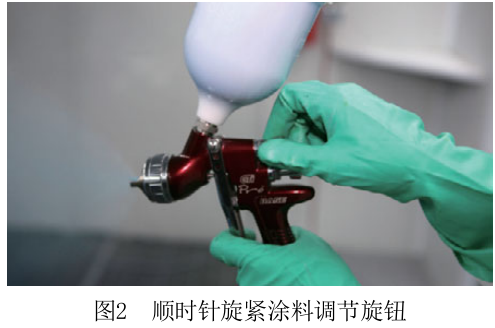
2. Spray gun initial adjustment. This step is to keep the Spray Gun in the initial spraying state, which requires 4 steps to operate: (1) Tighten the paint adjustment knob clockwise (Figure 2) until the gun needle is completely closed; (2) Rotate the spray width adjustment knob counterclockwise , fully open it ; (3) pull the trigger to gear 1, adjust the intake pressure to 2.0bar (1bar=10 5 Pa, according to actual equipment requirements ); (4) turn the paint flow adjustment knob counterclockwise, loosen Two and a half to three laps.
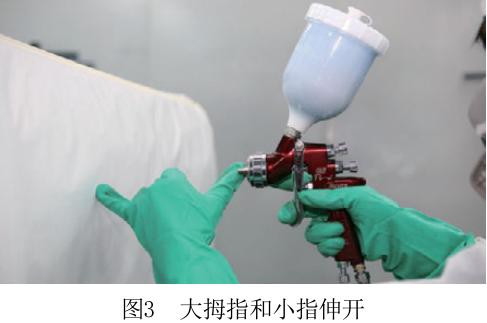
3. Determine the proper spraying distance. The sprayer stretches the thumb and little finger (Figure 3) in a "six-shaped" shape . The best spraying distance of the Spray Gun is 15cm, too close or too far may affect the actual spraying effect.
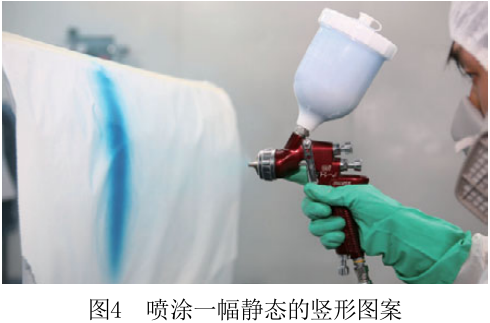
4. Test spray pattern. Spray a static vertical pattern on white paper (Figure 4), and determine whether the size and shape of the pattern are standard. If there is any abnormality it should be corrected in time.
5. Test material flow. First, rotate the air to spray a horizontal pattern, and stop immediately after spraying until the pattern has a vertical flow phenomenon, and then observe the shape of the vertical flow pattern, and make corresponding adjustments if there is any problem.
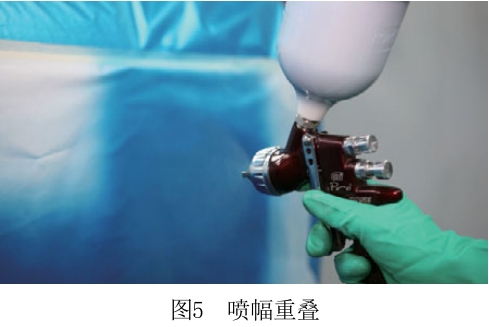
6. Determine a certain spray width overlap (Figure 5). In actual spraying, 50% of each spray pattern needs to overlap with each other. The purpose of this is to ensure that there will be no gaps in the painted surface .
7. Maintain a certain "shooting" speed. The moving speed of the Spray Gun is related to the drying speed of the paint, the ambient temperature and the viscosity of the paint. Generally, the speed should be kept at 30~50cm/s for uniform movement. "Moving the gun" quickly will make the paint too dry, which will easily cause surface roughness and orange peel; while "moving the gun" too slowly will easily cause sagging , and it will easily cause silver accumulation and clouding when spraying metallic paint.
The above is the common use method of the Spray Gun. There are still many small skills in daily spraying operations, which need to be learned and summarized by the sprayers themselves, and gradually improved to become a skilled and excellent spraying technician.
