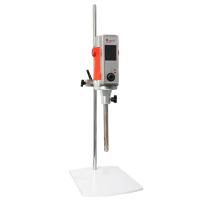
Use and Maintenance
1. This machine adopts single-phase three-wire system, and the required power socket is 220V, 10A three-hole socket.
2. Before using the machine, a professional inspection of the operation of the driving host should be carried out. Please do not install the dispersing and homogenizing working head during the test.
3. The dispersing and homogenizing working head of this machine is strictly forbidden to run away from the liquid medium. Avoid damage to mechanical parts without liquid medium protection during high-speed operation, resulting in mechanical failure.
The disassembly and assembly steps of the working head of this machine:
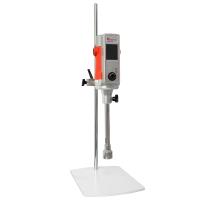
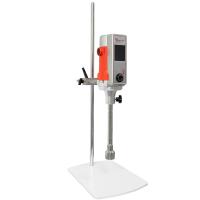
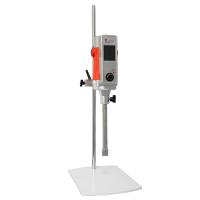
1. When installing, please put the feed port of the working head (4) downward, grasp the middle with your palm, align it with the installation hole of the working head connection seat (3) on the main engine, and insert it in place, and turn the handle to fix it.
2. When disassembling, please hold the middle part of the working head with your hand, turn the fixed handle of the connecting seat of the working head to loosen it, and then remove it from the mounting hole on the connecting seat. But do not use too much force to make the head of the working head hit the flat plate of the machine base, causing deformation and damage to the feed inlet.
Drive speed of this unit
It can be adjusted arbitrarily according to the requirements of dispersion and homogeneity, and the speed range is 13000-34000 rpm.
The markings on the speed control dial 1~6 indicate the corresponding speed of each gear:
1 ... 13000 rpm 4 ... 27000 rpm
2 ... 18000 rpm 5 ... 30500 rpm
3 ... 23000 rpm 6 ... 34000 rpm
Note: The speed of each gear should be selected according to the characteristics and requirements of the material. When the load continues to increase, the speed regulating device will automatically adjust and reduce the speed. Extraordinary electronic disturbances from outside can occasionally cause brief speed instability.
Attention should be paid to the operation of the dispersion homogenization experiment of this machine:
1. Before starting the machine, be sure to pull the speed control dial to the initial position (mark [ 1 ]), then pull the power switch, start the drive motor, and then slowly turn the speed control dial according to the requirements of dispersion and homogeneity, so that The speed increases gradually.
2. When the machine is running at a high speed, it will generate axial suction force. The stator end of the working head should be 2 mm from the bottom of the vessel
The distance above is to avoid collision between the working head and the container.
3. In order to prevent or reduce air entry and pulse fluctuations in dispersed homogeneous materials, the working head should be placed slightly away from the center of the container.
4. If the material with higher viscosity is dispersed homogeneously, there will be a vacuum in the functional area of the working head, which will cause the main drive to stall and affect the homogenization effect. When the viscosity of the material is high, the material should be diluted appropriately or the capacity of the material should be reduced.
5. For the homogeneous operation of liquid/solid mixture (adding and mixing), it is necessary to add solid powder and non-materials after the main drive reaches a higher speed, but the addition speed should be controlled to avoid the phenomenon of main engine stalling due to excessive solid materials entering Occurs to prevent local failures. When the coarser solid material is used for homogenization, it must be pulverized before proceeding.
6. It only takes 30 seconds to 5 minutes to complete the general dispersion and homogenization operation, and the prolongation of the processing time has no great influence on the result.
If the process of dispersion and homogenization contains some complex processes such as reactions, the processing time is about 30 minutes.
7. After the dispersing and homogenizing operation is completed, please pull the speed control dial to the initial position, turn off the power switch, and pull the power cord plug out of the socket. Remove the working head and clean it in time for the next use.
With moderate maintenance of the equipment, it will provide you with zero failure use cases.
1. After the machine has been used for a period of time or stopped for a long time, maintenance and inspection should be carried out before it is used again. Especially in terms of electrical safety performance, a megohmmeter can be used to test the insulation resistance. If it is found to be damp, it should be dried.
2. The brushes on the drive host of this machine and the sliding bearings on the working head are all vulnerable parts. When the main engine is in no-load operation, when there is an obvious stall phenomenon, professional maintenance personnel should be asked to replace the brushes; when the working head is disassembled, assembled, and cleaned, it is found that the gap between the sliding bearing and the transmission shaft is too large, and the wear When it is obvious, the sliding bearing should be replaced.
3. The working head of the machine must be cleaned in time after each operation. If conditions permit, it should be carried out in a timely manner.
4. For the experimental materials that are easy to clean, add an appropriate amount of cleaning agent to the container for dispersing and homogenizing, start the machine and let the working head run in the container at a medium speed for 1 to 5 minutes, then wash it with clean water and wipe it with a soft cloth. dry off.
5. For experimental materials that are difficult to clean, it is recommended to use solvents for cleaning. If the solvent is highly corrosive, please try to finish cleaning in a short time, and do not soak for a long time.
6. For high-demand cleaning, special disassembly tools should be used to remove the rotor, transmission shaft and other parts of the working head for cleaning, so as to ensure that the cleaning effect meets the requirements.
Troubleshooting for this machine
1. Overload protection: the speed is slightly reduced when the load is running, and the equipment is overloaded! Please reduce the load before continuing to operate.
2. Over-temperature protection: When the load is running, the speed drops significantly, and the temperature of the equipment is too high! Please change the speed to the starting gear and run at idle speed until it cools down.
3. Automatic safety shutdown: If the conversion rate is too high (suddenly stuck) when the device is running at high speed, the machine will automatically shut down.
4. Restart protection: If the power plug is plugged in when the device is turned on, or the power supply is restored after an accidental interruption, the device cannot be started. Please turn off the device and turn on the power switch again to start.