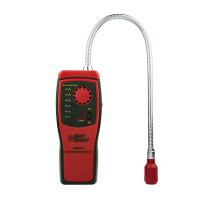
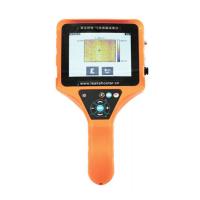
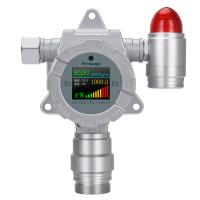
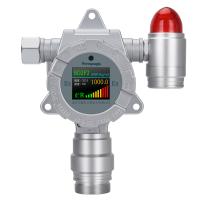
A Gas Detector is an instrumentation tool for gas leakage concentration detection, mainly referring to a portable/handheld Gas Detector. Gas sensors are mainly used to detect the types of gases existing in the environment. Gas sensors are sensors used to detect the composition and content of gases. It is generally believed that the definition of gas sensors is based on the classification of detection targets, that is to say, any sensor used to detect gas composition and concentration is called a gas sensor, regardless of whether it uses physical methods or chemical methods. For example, sensors that detect gas flow are not considered gas sensors, but thermal conductivity Gas Analyzers are important gas sensors, although they sometimes use roughly the same detection principle.
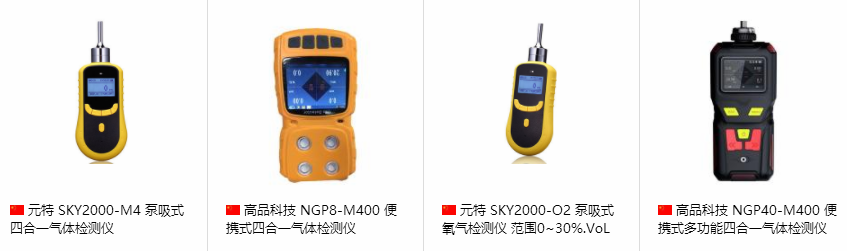
Precautions for purchasing Gas Detectors: Have you paid attention to the choice of Gas Detectors? How to choose according to the environment? How to choose according to space? How to choose according to gas? No matter what the reason for our choice is, we need to pay attention to the following points:
1. Reliability
The longer the life of the Gas Detector sensor, the better. Generally speaking, the life of the sensor is 2-3 years, and the life of the flammable gas sensor is 3 years. The longer the mean time to error, the better. What is the accuracy and precision, the smaller the error value, the better. The product warranty period is generally 1 year.
2. Correction requirements
Correction method, duration, and ease. There are two calibration methods - laboratory and on-site calibration. On-site calibration is to exhale the oxygen sensor, the oxygen reading value of the instrument needs to drop and an alarm occurs.
3. Stability
What is the value of zero point offset and full scale offset of the Detector, the smaller the better.
4. Applicability
Enterprise professionals and experienced job supervisors or employees should identify and evaluate the hazardous gases in the limited space operation site to determine whether the sensor of the selected Detector meets the use requirements.
5. Convenience
Light weight, small size, easy and comfortable to wear, easy maintenance.
6. Legibility
Numeric or pointer Gas Detector. Generally speaking, the numerical type has the advantages of easy readability and less misjudgment. Is the display area large enough with backlighting and large fonts for easy reading and comprehension. Whether the siren is loud enough to be distinguished from the background noise. Generally, the efficiency above 90dB(A) is applicable. Whether the warning flashing light can be recognized from various angles. Can the signal be displayed continuously with the change of the measured gas concentration, and the alarm will be stopped after confirmation or countermeasures are taken.
7. According to the measurement object and measurement environment
Determine the type of sensor according to the measurement object and measurement environment. To carry out a specific measurement work, we must first consider what kind of sensor is used, which needs to be determined after analyzing various factors.
8. Response characteristics (reaction time)
The frequency response characteristics of the sensor determine the frequency range to be measured, and it is necessary to maintain undistorted measurement conditions within the allowable frequency range. In fact, the response of the sensor always has a certain delay. It is hoped that the delay time should be as short as possible.
9. Linear range
The linear range of a sensor is the range over which the output is proportional to the input. In theory, within this range, the sensitivity remains constant. The wider the linear range of the sensor, the larger its range and can guarantee a certain measurement accuracy.
Notes on the use of Gas Detectors:
1) Pay attention to the life of various sensors: all kinds of gas sensors have a certain service life, that is, life. Generally speaking, in portable instruments, LEL sensors have a longer service life, which can generally be used for about three years; photoionization Detectors have a service life of four years or longer; In one to two years; the life of the oxygen sensor is the shortest, about one year.
2) Pay attention to the concentration measurement range of the detection instrument: various toxic and harmful Gas Detectors such as ammonia Detectors and total phosphorus Detectors have their fixed detection ranges. Only when the measurement is completed within its measurement range can the instrument be accurately determined. If the measurement is carried out beyond the measurement range for a long time, it may cause permanent damage to the sensor.
3) Pay attention to the detection interference between various sensors: Generally speaking, each sensor corresponds to a specific detection gas, but any Gas Detector cannot be absolutely special. Therefore, when selecting a gas sensor, it is necessary to understand as much as possible the interference of other gases to the sensor, so as to ensure its accurate detection of a specific gas.
4) Pay attention to regular calibration and testing: the toxic and harmful Gas Detector is the same as other analytical and testing instruments, and is measured by relative comparison method: first use a zero gas and a standard concentration gas to calibrate the instrument , the standard curve is obtained and stored in the instrument. When measuring, the instrument compares the electrical signal generated by the gas concentration to be measured with the electrical signal of the standard concentration, and calculates the accurate gas concentration value. Therefore, zeroing the instrument at any time and frequently calibrating the instrument are necessary tasks to ensure accurate measurement of the instrument.
Semiconductor gas sensor
It is manufactured by using some metal oxide semiconductor materials, and at a certain temperature, the electrical conductivity changes with the change of the ambient gas composition. For example, the alcohol sensor is prepared by using the principle that the resistance of tin dioxide will decrease sharply when it encounters alcohol gas at high temperature.
advantage
Semiconductor gas sensors can be effectively used for the detection of many gases such as methane, ethane, propane, butane, alcohol, formaldehyde, carbon monoxide, carbon dioxide, ethylene, acetylene, vinyl chloride, styrene, acrylic acid, etc. In particular, the sensor has low cost and is suitable for the needs of civilian gas detection. The following semiconductor gas sensors are successful: methane (natural gas, biogas), alcohol, carbon monoxide (city gas), hydrogen sulfide, ammonia (including amines, hydrazines). High-quality sensors can meet the needs of industrial detection.
shortcoming
The stability is poor, and it is greatly affected by the environment; especially, the selectivity of each sensor is not perfect, and the output parameters cannot be determined. Therefore, it is not suitable for use in places where accurate measurement is required.
Catalytic combustion gas sensor
This sensor prepares a high temperature resistant catalyst layer on the surface of the platinum resistor. At a certain temperature, the combustible gas is catalyzed and burned on its surface. The combustion is the temperature rise of the platinum resistor, and the resistance changes. The change value is the concentration of the combustible gas. function.
advantage
Catalytic combustion gas sensors selectively detect combustible gases: the sensor does not respond to anything that is not combustible. The catalytic combustion gas sensor has accurate measurement, fast response and long service life. The output of the sensor is directly related to the explosion hazard of the environment, and it is a dominant type of sensor in the field of safety detection.
shortcoming
In the range of flammable gases, there is no selectivity. There is a danger of ignition and explosion when working with dark fire. Most elemental organic vapors are toxic to sensors.
Thermal conductivity cell gas sensor
Each gas has its own specific thermal conductivity. When the thermal conductivity of two or more gases is quite different, the thermal conductivity element can be used to distinguish the content of one of the components. This sensor has been used sensorily for the detection of hydrogen, the detection of carbon dioxide, and the detection of high-concentration methane. This kind of gas sensor can be applied in a narrow range and has many limiting factors.
Electrochemical Gas Sensor
A considerable part of its flammable, toxic and harmful gases are electrochemically active and can be electrochemically oxidized or reduced. Using these reactions, gas components can be distinguished and gas concentrations can be detected. There are many subcategories of electrochemical gas sensors:
(1)、原电池型气体传感器(也称:加伏尼电池型气体传感器,也有称燃料电池型气体传感器,也有称自发电池型气体传感器),他们的原理行同我们用的干电池,只是,电池的碳锰电极被气体电极替代了。以氧气传感器为例,氧在阴极被还原,电子通过电流表流到阳极,在那里铅金属被氧化。电流的大小与氧气的浓度直接相关。这种传感器可以有效地检测氧气、二氧化硫、氯气等。
(2)、恒定电位电解池型气体传感器,这种传感器用于检测还原性气体非常有效,它的原理与原电池型传感器不一样,它的电化学反应是在电流强制下发生的,是一种真正的库仑分析的传感器。这种传感器已经成功地用于:一氧化碳、硫化氢、氢气、氨气、肼、等气体的检测之中,是目前有毒有害气体检测的主流传感器。
(3)、浓差电池型气体传感器,具有电化学活性的气体在电化学电池的两侧,会自发形成浓差电动势,电动势的大小与气体的浓度有关,这种传感器的成功实例就是汽车用氧气传感器、固体电解质型二氧化碳传感器。
(4)、极限电流型气体传感器,有一种测量氧气浓度的传感器利用电化池中的极限电流与载流子浓度相关的原理制备氧(气)浓度传感器,用于汽车的氧气检测,和钢水中氧浓度检测。
红外线气体传感器
大部分的气体在中红外区都有特征吸收峰,检测特征吸收峰位置的吸收情况,就可以确定某气体的浓度。
这种传感器过去都是大型的分析仪器,但是近些年,随着以MEMS技术为基础的传感器工业的发展,这种传感器的体积已经由10升,45公斤的巨无霸,减小到2毫升(拇指大小)左右。使用无需调制光源的红外探测器使得仪器完全没有机械运动部件,完全实现免维护化。红外线气体传感器可以有效地分辨气体的种类,准确测定气体浓度。
这种传感器成功的用于:二氧化碳、甲烷的检测。
磁性氧气检测仪
这是磁性氧气分析仪的核心,但是目前也已经实现了“传感器化”进程。
它是利用空气中的氧气可以被强磁场吸引的原理制备的。
This sensor can only be used for the detection of oxygen and has excellent selectivity. Only nitrogen oxides in the atmospheric environment can have a slight impact, but because the content of these interfering gases is often very small, the selectivity of the magnetic oxygen analysis technique is almost perfect!