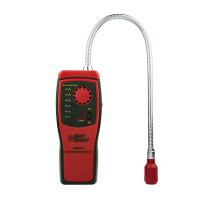
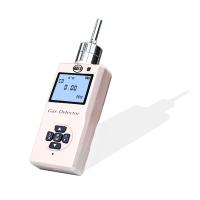
The combustible Gas Detector adopts a new generation of low power consumption and high anti-interference carrier catalytic sensor. It forms a detection bridge with two fixed resistors. When the flammable gas in the air diffuses to the surface of the detection sensor, it will rapidly burn without flame under the action of the catalyst on the surface of the sensor, and generate reaction heat to increase the resistance value of the platinum wire of the sensor, and the detection bridge will output a differential pressure signal. The magnitude of this voltage signal is proportional to the concentration of combustible gas. After it is amplified, it performs voltage and current conversion and converts the percentage content (%LEL) within the lower limit of the flammable gas explosion into a 4-20mA standard signal output.

The oxygen Detector applies the principle of Galvanic primary battery. Its structure is to install the anode (lead) and cathode (silver) in the primary battery, and separate it from the outside with a thin film. When the oxygen-containing gas in the air passes through the film to reach the cathode , a redox reaction occurs. At this time, the sensor will have a mV-level voltage output that is proportional to the oxygen concentration. After the voltage signal is amplified, the voltage-current conversion is performed and the oxygen content within the percentage (0-30%) is converted into a 4-20mA standard signal output. .
The poisonous and harmful Gas Detector adopts the world's professional imported electrochemical sensor. It applies the principle of controlled potential electrolysis. Different poisonous and harmful gases can be measured by replacing the sensors of different gases and changing the value of the polarization voltage.
The gas to be measured reaches the working electrode through the thin film, and a redox reaction occurs. The sensor will output a small current at this time, which is proportional to the concentration of toxic and harmful gases. The current signal is converted into a voltage after sampling processing, and the voltage signal is amplified. Afterwards, the voltage and current are converted, and the content (ppm value) within the detection range of toxic and harmful gases is converted into a 4-20mA standard signal output.
Organic volatiles adopt the world-leading photoion gas sensor (PID), which uses the principle of photoion ionization gas for gas detection. Specifically, the target gas is irradiated/bombarded by the ultraviolet light generated by the ion lamp. The target gas will be ionized after absorbing enough ultraviolet light energy, and the target can be detected by detecting the tiny current generated after the ionization of the gas. concentration of the gas.
The carbon dioxide Detector adopts the world's professional infrared principle sensor, which is a sensor that uses the physical properties of infrared rays to measure, and it includes an optical system, a detection element and a photoelectric detection element. Optical systems can be divided into two types: transmissive and reflective according to their structure. The detection element can be divided into thermal detection element and photoelectric detection element according to the working principle. Thermistors are the most widely used thermal components. When the thermistor is exposed to infrared radiation, the temperature rises, the resistance changes, and the electrical signal is output through the conversion circuit.