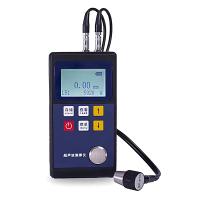
Ultrasonic Thickness Theory of Operation
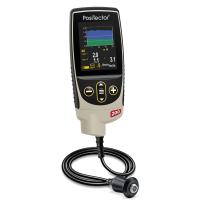
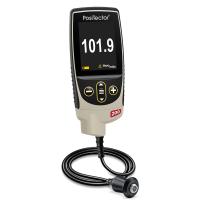
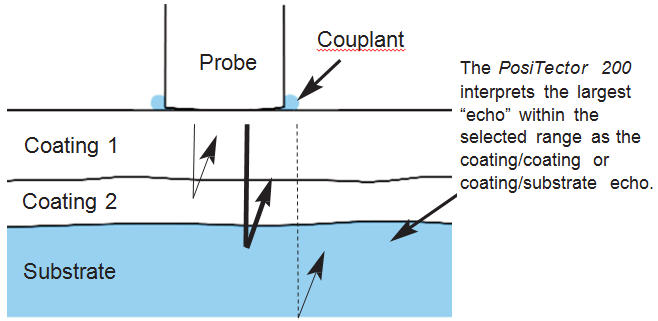
The PosiTector 200 probe emits high frequency sound pulses which travel through the coupling gel to the coating and reflect from any surface density differences. Coating thickness readings are obtained by measuring the time it takes for an ultrasonic signal to travel from the probe to the coating/substrate interface and back. Divide the travel time by 2 and multiply by the speed of sound in the coating to obtain the thickness of the coating.
how to measure
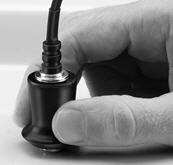
Remove the protective rubber cover from the probe.
Press the center navigation button to launch Gage.

Apply couplant to the surface of the part.
Lift the probe when you hear double BEEP, or - leave the probe on the surface in the same position for continuous measurements.
When finished, wipe the probe clean of couplant, and return the Gage to the protective pouch. There is no need to disconnect the probe from the PosiTector during storage.

Calibration, Verification and Adjustment
Three steps ensure great accuracy...
Calibration - usually done by the manufacturer. All probes include a calibration certificate.
Verifying Accuracy - Typically done by the user against a known reference standard such as a plastic shim or coating thickness standard.
Adjustment - known thickness
calibration
Calibration is the advanced, controlled and documented process of measuring a traceable calibration standard over the entire operating range of the probe and verifying that the results are within the probe's stated accuracy. Calibration is performed by the manufacturer, its authorized agent, or an accredited calibration laboratory using documented procedures in a controlled environment.
verify
Validation is an accuracy check performed by the user against a known reference standard. Successful verification requires the Gage to read within the combined accuracy of the probe and reference standard.
Adjustment
Adjustment or Calibration Adjustment is the physical act of aligning a probe's thickness reading with that of a sample of known thickness (to remove bias) in order to improve the probe's accuracy on a particular coating. see thickness