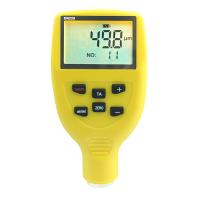
Coating thickness refers to the thickness of the final hot-dip galvanized coating, while coating weight refers to the zinc content of a given surface area. There are two different methods that can be used to measure coating thickness on hot-dip galvanized steel - magnetic Thickness Gauges and optical microscopy.
The first method utilizing a magnetic Thickness Gauge is a non-destructive and simple method. There are three types of magnetometers, any of which can be easily used in a galvanizing facility or in the field.
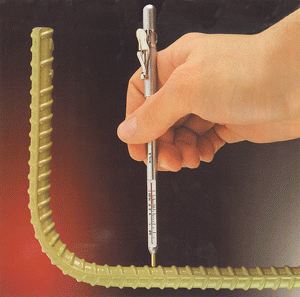
The first type of magnetic Thickness Gauge, the pencil gauge (Figure 14), is pocket-sized and uses a spring-loaded magnet housed in a pencil-shaped container. The tip of the gauge is placed on the steel surface and pulled out slowly in a continuous motion. When the tip of the gauge is pulled away from the steel's surface, a magnet near the tip is attracted to the steel. The scale indicates the coating thickness immediately before the magnet is pulled from the steel surface.
The accuracy of a pencil gauge requires that it be used in a true vertical plane, as measurements taken on a horizontal or top position will have more error due to gravity. Measurements should be taken multiple times as the absolute accuracy of this type of gauge is below average and it is difficult to determine the true coating thickness when only one reading is taken.
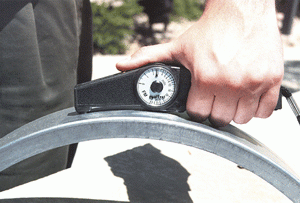
A banana gauge (Figure 15) is the second type of Thickness Gauge. With this gauge, coating thickness measurements are taken by placing a rubber magnet housing on the surface of the product and holding the gauge parallel to the surface. Turn the scale ring clockwise to bring the tip of the instrument into contact with the coated surface and turn counterclockwise until contact break can be heard and felt. When the magnetic tip breaks away from the coated surface, the position of the graduated ring shows the coating thickness. The advantage of a banana gauge is the ability to measure coating thickness in any position without recalibration or gravitational interference.
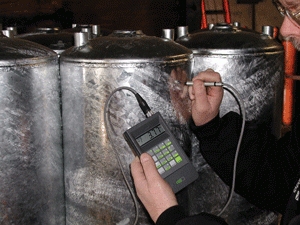
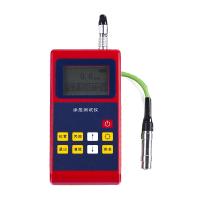
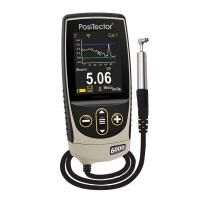
Electronic or digital gauges (Figure 16) are accurate and arguably the easiest to operate Thickness Gauges. The electronic Thickness Gauge is operated by simply placing the magnetic probe on the coated surface, and the digital readout shows the coating thickness. The advantage of electronic gauges is that they do not require recalibration with the probe orientation, but they do need to be calibrated with shims of different thicknesses to verify gauge accuracy when in use. These shims are measured and the gage is calibrated to the thickness of the shim, then the process is repeated for different thicknesses of shims until the gage produces accurate readings in all thickness ranges. One benefit of electronic or digital meters is the ability to store data and perform averaging calculations, which facilitates the entire process.
ASTM E 376
The ASTM E376 specification contains information on measuring coating thickness using a magnet or electromagnetic current. It provides some tips for obtaining measurement results with the highest accuracy and describes how physical properties, structures and coatings can interfere with measurement methods. It also contains some general guidelines on how to reduce errors. Some key requirements and guidelines include:
Measurement readings should be spread as widely as possible
Measurements for large products should be at least 4 inches from the edge
The reading should be in the "regular area" of the coating
Readings should not be taken near edges, holes or inside corners
Avoid taking readings on curved surfaces if possible
At least five readings should be taken to obtain a good "true" value representative of the sample
Recalibrate frequently, using non-magnetic thin film standards or shims above and below expected thickness values
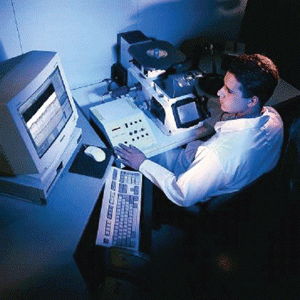
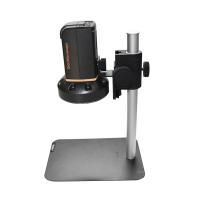
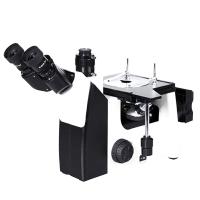
Another method of measuring coating thickness is optical microscopy (Figure 17), which is a destructive technique that exposes the edge of the coating under an optical microscope. Samples will need to be sectioned, then mounted and polished to reveal the exposed edges of the hot-dip galvanized coating. The calibrated eyepiece of the light microscope can then determine the thickness of the coating. Because this is a destructive technique, it is generally only used to examine single specimen samples to resolve measurement disputes or for research purposes. The accuracy of light microscopy is highly dependent on the expertise of the operator.