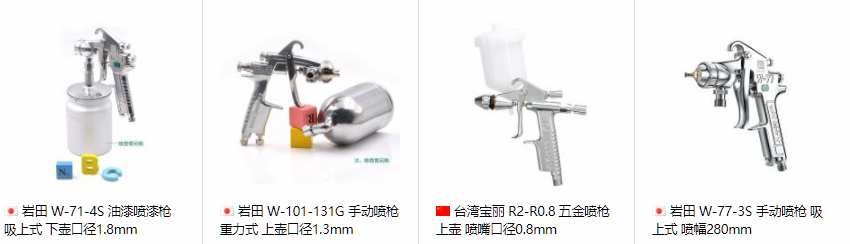
1.1 Correct gun posture and Spray Gun operation mode
The first skill you need to master when using an air Spray Gun is the correct way to hold the Spray Gun. The first thing to do when operating the Spray Gun is to keep the Spray Gun as vertical as possible to the workpiece to be sprayed, and the trajectory of the Spray Gun should be kept parallel to the sprayed surface during the movement process , that is, to maintain the same distance to stabilize Move in parallel or pass the spraying surface at a consistent speed. The spraying trajectory of the Spray Gun should follow the shape of the surface to be coated as much as possible. When moving the Spray Gun, avoid arc swinging with the elbow or wrist as the center.
1.2 Shooting speed
When using an air Spray Gun for spraying operations, the Spray Gun can move up, down, left, and right , and it is better to run evenly at a speed of 15-20 cm/s. The nozzle should be sprayed straight to the spraying surface, and the inclined spraying should be minimized as far as possible. If the Spray Gun is inclined, the running speed is variable, and the width of the overlap is variable, the coating film with uniform thickness cannot be obtained, and it is easy to produce streaks and spots. defect. If the speed of the Spray Gun is too slow, it is easy to cause sagging or falling; if the speed is too fast or the spray pattern is not overlapped enough, it is difficult to obtain a smooth coating film. When running to both ends of the spraying surface, the hand that pulls the trigger of the Spray Gun should be loosened quickly to reduce the paint mist . The hanging parts need special attention.
1.3 Control of spraying distance
The distance between the nozzle and the surface to be sprayed should be properly adjusted according to the type of paint , the construction viscosity and the atomizing pressure of the Spray Gun. The control principle is: for the slow-drying paint, the spraying distance should be farther, and the quick-drying paint can be closer ; the construction viscosity can be farther, and the construction viscosity can be closer; the air pressure can be farther, and the air pressure can be closer. A little bit (the so-called a little farther and a little closer refer to small-scale adjustments with an adjustable range of 10 to 50 mm ). Since the deposition amount of the sprayed paint mist on the working surface decreases proportionally with the extension of the spraying distance, it is better to control the spraying distance at 15 to 25 cm when spraying the two-component acrylic polyurethane topcoat with an air Spray Gun, so that It can make the paint particles falling on the surface of the workpiece evenly distributed and in a wet state. If the spraying distance is too far, the paint film will be thin and rough ; if the spraying distance is too short, the paint film will be too thick and prone to flow and sagging defects, and the phenomenon of orange peel .
1.4 Adjustment of spraying air pressure
在调节喷涂气压时应掌握的原则的是,通过提高压缩空气的压力可使涂料的喷出量增加,最终喷枪口处的雾化压力不应超过 0.5 MPa 为佳,一般控制在 0.3~0.4 MPa,喷涂气压更好不要超过 0.6 ~ 0.7 MPa 的界限。实践证明,超过 0.6 ~ 0.7 MPa,涂料的喷出量反而减少。而且喷涂气压过高易流挂,由于漆雾过大而造成粗膜、干喷、橘皮等漆膜弊病,造成涂料过度雾化和过度喷涂,所以虽然涂料喷出量增加,但涂料的实际利用率反而降低,而且涂料在没有到达被喷涂表面之前溶剂就大量挥发,会造成涂膜的流平性不好;喷涂气压过低会造成雾化不良,喷幅减少,喷雾图样中心部位变厚、溶剂挥发迟缓、表面会形成麻点等弊病。
1.5 施工黏度的控制
The application viscosity of the paint will not only affect the paint output, but also greatly affect the atomization effect. If the coating viscosity is too high, the atomization effect of spraying will be poor, and the surface of the paint film will be rough ; Big waste. Therefore, the spraying viscosity of the coating should not be too high or too low. When spraying two-component acrylic polyurethane topcoat, it is generally better to control it at room temperature for 18-26 s (coating -4 cups), and it is appropriate if the ambient temperature is high. Reduce the construction viscosity and control it at 18-21 s, and conversely increase the construction viscosity and control it at 22-26 s. If the -4 cup is not painted at the construction site , it can also be estimated by visual inspection, as follows: Stir the paint evenly with a wooden or iron rod , stir it up to a height of 20 mm and stop to observe. If the line does not break within a few seconds, it is too thick; if the line breaks as soon as it leaves the liquid surface, it is too thin; it is better to control when it stops at a height of , the paint liquid forms a straight line, and the flow becomes instantaneous. If it drips down, then such a construction viscosity is more appropriate.
1.6 Adjustment of spray pattern
By adjusting , the adjustment in the clockwise direction will increase the width of the graphic, changing from a circle to an ellipse. When the Spray Gun is spraying, it will form a pattern perpendicular to the workpiece to be coated. Fan-shaped spray in the same direction, and the larger the graphic width, the larger the area . Therefore, in the case of a certain paint flow rate, the larger , the thinner the obtained coating film, and the more spraying times required to achieve a certain thickness. Therefore, it is necessary to adjust the spraying graphics in time according to the construction needs , so that Improve the efficiency of painting work.
1.7 Overlap control during spraying
There is less paint at both ends of the spray pattern and more in the middle, so if overlapping spraying is not carried out, the paint film thickness will be uneven. In order to obtain a coating with uniform paint film thickness, the painted surface of the next spraying stroke must There is 1/4~1/2 overlap with the coating surface of the last spraying stroke. When the spray pattern is circular, there should be 1/2 overlap; when the spray pattern is oval, there should be 1/2 overlap. 4~1/3 overlap, which can ensure uniform . Too little overlap will cause defects such as "false spray" or "missing spray", and streaky color difference ; too much overlap will cause defects such as sagging. In addition, when there is "virtual spray" or "missing spray", be careful not to re-spray randomly. When there is a leak or uneven , you can only repeat the spraying once to avoid sagging or falling.
1.8 Spraying process operation skills
The standing position when spraying is that the shoulder on the side holding the Spray Gun is facing the middle of the part to be sprayed, the legs are separated slightly larger than the shoulder width (about 1.5 times), and the knees are slightly bent. If horizontal spraying is used, spray from left to right and from top to bottom ; if vertical spraying is used, start from the side close to the operator, "shoot" from bottom to top, and move forward one by one, keeping the atomization at all times The paint flies forward, and does not start and stop the gun within the surface of the sprayed part. The sprayed atomized paint flow should be about 100 mm more than the edge, so as not to cause the paint mist to fall on the sprayed surface and lose its gloss. The spraying sequence is carried out according to the principle of "difficult first and then easy, first inside and then outside, first high and then low, first small area and then large area", and pay attention to the spraying of complex-shaped surfaces. The principle of spraying the simple surface after the corner, the complex shape surface, and finally the plane . In this way, the sprayed paint mist will not be splashed on the already sprayed paint film, which will cause problems in the quality of the painting.
1.9 Adjustment of the atomization effect of the suction air Spray Gun
For the adjustment of the suction air Spray Gun, it is mainly the harmony between the pressure of the compressed air and the amount of paint output. When adjusting, gradually increase the pressure of compressed air while maintaining a certain amount of paint supply to find a good adjustment position. If the air supply pressure has reached the maximum and still can’t get the desired effect, it means that the amount of paint produced by the paint is too large, and the pressure of the compressed air cannot make it fully atomized The air supply pressure to achieve a better atomization effect. If the spraying speed of the paint from the nozzle is too high, or the pressure of the paint is too high, the flow rate of the paint will be too large to be well atomized. The principle of adjusting the appropriate paint outflow and air pressure is: under the premise of meeting the paint flow requirements required by the Spray Gun , use the lowest air pressure as much as possible. The specific operation method is: first adjust the atomization pressure of the compressed air to about 0.2 MPa, and then check the spray shape when the paint control button is fully opened. If the satisfactory , the atomization pressure can be increased again, but the atomization pressure at the final Spray Gun should not exceed 0.5 MPa. If the atomization effect , you can slightly close the paint control knob to reduce the paint flow , and then re-adjust the spray width. Repeat this process until the desired atomization effect is obtained with as little atomization pressure as possible . Sometimes it is also critical to reduce the viscosity of the paint by diluting it, improving the siphon effect of the paint, and achieving the atomization effect.
