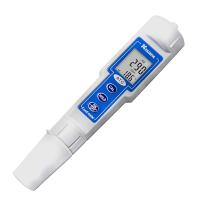
K-water Korea Water Resources Co., Ltd. monitors and researches hydropower stations through Onset's U20-001-03 water level Recorders, U24-001 and U24-002-C conductivity Recorders, and U22-001, U23-001 and other water temperature Recorders. Effects of Dams on the Coastal Environment.
Korea Water Corporation (K-water) is the main Korean government water resource management agency responsible for the comprehensive development of water resources and the provision of public and industrial water supplies. Established in 1967, K-water implements the National Water Resource Management Policy for multi-purpose dams, water supply dams and district water supply systems.
From 2013 to 2014, K-water conducted a first-of-its-kind study to assess the impact of water resource management on coastal ecosystems in southern Korea. Leading the principal investigators Nam-Il K-water, who obtained his Ph.D., the aim of the study was to examine the impact of hydropower discharges on the salinity and temperature of downstream and coastal waters. The study also investigated what changes in temperature that occur in tidal mudflat systems include, if any, and how these changes affect marine bivalves populations.
The project initiates complaints against fisheries management.
"Fisheries management is concerned about the release of freshwater from a small control dam downstream of the hydropower station causing low water temperature, salinity and changes in tidal tidal flat area, affecting bivalves production," Dr Win said.
The Ph.D.-winning team began measuring changes in temperature and electrical conductivity at 15 locations along the bay, including the Three Gorges Dam reservoir, estuaries, tidal flats, coastal waters, and three distinct watershed flow characteristics as urban, natural and control. For data collection, Ph.D. and his research colleagues relied on a variety of HOBO series data loggers, including water level loggers such as the U20-001-03, conductivity loggers U24-001 and U24-002-C, and U22- 001, U23-001 and other water temperature Recorder monitoring stations.
"To investigate the potential ecological impact of dam emissions, continuous and long-term data covering temporal and spatial variations in daily, weekly, seasonal, and annual time regimes are required," said Dr. Win. "The HOBO series of data loggers is a very cost-effective way to do this, they are easy and reliable and safe," he said.
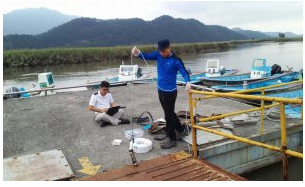
The monitoring instruments are submerged and they are deployed below the surface of the flowing water to a buoy tethered in place. In coastal areas, Onset data loggers are obtained in a similar manner to aquaculture facilities. Tidal flats, nylon cable ties are used to tie Onset Pro V2 data loggers U23-001, U23-002, U23-003, U23-004 boards, board buried and protection rods.
During the study period, deployment was mostly continuous, with downloads occurring every two months. Salinity was measured every 10 minutes at each site. Air, sea tide and exhaust temperature data are also collected. Onset's HOBOware graphing and analysis software is used for quick field evaluation and Microsoft Excel data export for further analysis.
The findings reveal that the temperature regimes vary naturally, with dam-dependent urbanization and dependence on ocean currents, with low temperature effects likely due to limited seasons. The researchers also concluded that discharges from hydropower plants had little effect on the temperature of seawater. The results of this study were used to negate the fishery's complaint.
"Freshwater input does not always lead to one-way effects, such as reducing stream temperature," said Dr. Win. "Seasonal variations and ocean conditions should also be considered important for coastal applications."
Dr. Gain said that for further study waters connecting coastal estuaries could be assessed in a similar way. "Possible environmental influences can be determined by detecting small changes in temperature and conductivity," he said. "Continuous data are very important for ecological impact assessment".
Obtained a Ph.D. published a paper in a domestic Korean scientific journal and presented his project and results at a recent conference. He will soon write another paper for publication in an international scientific journal.
The results of the project will be used in a 10-year study of the estuary by Chinese fisheries, which is currently planned. The project may also be replicated in other Korean K-water managed dams.