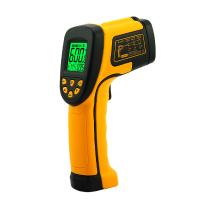
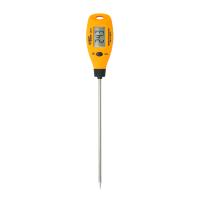
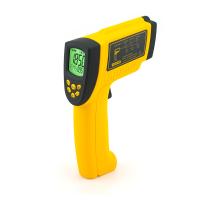
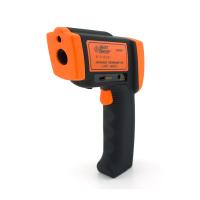
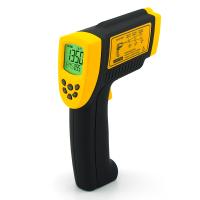
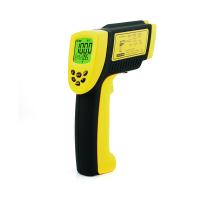
每当您使用测温仪测量读数时,可自选打开或关闭背照灯和激光;
较高发射率一般指发射率设置值在0.95附近;
较低发射率一般指发射率设置值在0.30附近;
当用户无法确认被测物体的发射率时,可在待测物体(温度小于150℃时)表面覆盖黑色电气胶带(发射率约为0.95),等待胶带与被测物体同温度后,测量并记录胶带温度。将测温仪对准待测物体,调节发射率大小,使温度值与胶带温度相同,则此时仪表设置的发射率与待测物体的实际发射率接近,可用于后续测量。

实例:检测接触器(起动器)
1、按SET键选择发射率。按▼/▲键设置较低发射率用于明亮的接触点,或设置约0.7的中等水平发射率用于阴暗的接触点。
2、按黄色键选择 MAX(最大值)。
3、不松开扳机,测量一个孔的线和负载侧。
4、一个孔的线和负载侧之间的温差表明某一点上的电阻增加,可能接触器发生了故障。
实例:检测封闭式继电器
1、按SET键,然后按▼/▲键将发射率设置为较低值用于不绝缘接头,或较高值用于塑料密封式继电器或用于胶木封闭式继电器或绝缘接头。
2、按黄色键选择 MAX(最大值)。
3、开始扫描。
4、测量继电器外壳以查找热点。
5、测量继电器终端上的电气接点以查找热点。
实例:检测保险丝和保险座接点
1.按SET键,然后按/△键将发射率设置为较高值用于用纸包覆的保险丝体或绝缘接头
2.按黄色键选择MA(最大值)
3.扫描保险丝用纸包覆的全长
4.不松开扳机扫措每根保险丝。保险丝之间的温度不均可能表明电压或安培度不平衡
5. Press the SET key, then press the M/ key to set the emissivity to a lower value for metal fuse seal covers and non-insulated fuse seat contacts
6. Press the yellow key to select MX (maximum
7. Scan each sealing cap on each fuse
NOTE: Uneven or high temperatures indicate a loose or corroded contact on the spring clip of the fuse holder.
Example: Detecting electrical contacts
1. Press the SET key, then press the V/△ key to set the emissivity to a lower value for non-insulated joints or fuse joints, and to set the emissivity to a higher value for insulated joints. Note: Conductors are usually smaller than the pyrometer spot size. If the light spot ruler is larger than the joint, the temperature reading is the average value of the light spot
2. Scan the conductor and move in the direction of the electrical contactor (quick connect with push line nut insurance seat contact or big D)
Example: Scanning walls for presence or insulation defects
Turn off heating and cooling systems and fans
2. Press SET key to select emissivity. Use the skill key M to set a higher emissivity
3. On the painted surface or window surface, press the yellow key and select MN ( minimum value , or select MAX ( maximum value) when the temperature on the opposite side of the wall is high
4. Measure the surface temperature of the inner partition wall. Do not release the trigger Record this temperature as a reference temperature for a good "insulated wall"
5. Facing the wall to be tested, stand at a distance of 12m from the wall and scan a 10cm point on the wall
6. People go up to scan the end wall horizontally, or scan the ceiling between the wall and the wall horizontally, find the maximum deviation of the reference temperature to , this can be like detecting the power supply of the machine after it is turned off no heating) and retest. When the fan is turned on , if the check result is different when the fan is turned off, it may indicate that there is a generational problem in the regulating seal wall. The air demand is caused by the low air duct that makes the acoustic pressure difference in the entire regulating seal space
Example: Testing Bearings
△Warning
To avoid injury when testing bearings
Never wear loose clothing, jewelry or collars when working around moving parts such as motors, belts, blowers and fans
・确保电气切点在伸手可及之处,并能正常地自由作不要单独工作
注释
将两个操作相似载荷的发动机互相比较的效果更好
1.按SET键,然后按V/△健将发射解设置为较高值
2.按黄色键选择MM(最大值
3.启动发动机并使它达到稳定状态工作温度
4.可能的话,关闭发动机
5.测量两个发动机的轴承温度
6.比较两个发动机的温度。温度不均等或高温可能表明存在由于太多摩擦所造成的润滑或其它轴承问题。
7.对风机轴承重复相同顺序
实例:检测皮带和滑轮
1.SET键,然后按M/▲键将发射率设置为较高值。
2.按黄色键选MAX(最大值)。
3.后动发动机并使它达到稳定状态工作温度。
4.将测温仪瞄准待测表面。
5.开始记录温度
6.慢地将测温顺着皮带向第二个滑轮移动。
・如果皮带正在滑动,滑轮会由于摩擦生热而温度升高
・如果皮带在滑动,滑轮之间的皮带温度将保持高温
・如果皮带没有在滑动,滑轮之间的皮带温度将会降温
・如果滑轮的内侧表面浅有星现真正的字形,这表明了皮带滑动,并且会共在高温下运转,直到更换滑轮。
・滑轮需要正确对准(包括“俯仰和摆”),皮带和滑轮才能在正常的温度下运转可使用正规或拥紧的铁丝来检查滑轮是否对准发动机滑轮应在与风机滑轮相当的温度下运转
・如果发动机转轴的滑轮的温度高于外園周的温·明皮带可能没有在滑动
・如果滑轮的外圆周的温度高于发动机转轴的滑轮的温度,那么皮带可能正在滑动,而且滑轮可能没有对准。
实例:检查液体循环辐射供暖应用
地面的辐射导热管的铺设方向通常与外墙平行。从地面与墙壁的接面开始,从墙壁向房间中央移动,同时平行扫描到墙壁。您会看到与外增平行的等温列表明地面下导热管的位置,您会看到与外墙垂直的高低温度列在相等的距离起起落落。高温表明您扫描地面下的导热管,下降的低温表明扫描到导热管之间的空间
1.按SET,然后按V/键将发射率设置为较高值
2.按黄色键选择MN(最小值)
3.要找出地面下的辐射导热管位置,暂时将回路温度升高,市生较热的点以便于识别管线途经
MAX(最大值)、DIF(差值)地面温度之间切換,并且记录温度以供后比较和预测类似情况下的趋势用。
实例:测量格、调温器或出风口排放温度
1.接SET健然后MM键将发射추设置为较高值
2.将测温仪代体排成格、温器或出风口
3.测量排放温度
4.松开反机以法结温度读数S秒钟并记录温度
5.格栅、调温器或出风口温度应与空气处理机的排放温度相等。
实例:检查空对空蒸发器或冷凝器是否存在阻塞
1.拆下面板以便触及螺管回转弯头或发夹弯。
2.按SET键,然后按V/▲键将发射率设置为较低值用
3.于铜管。
4.开始制冷系统。
5.将测温仪瞄准螺管回转弯头或/发夹弯
6开始记录温度
测量每个回转弯头或/发夹弯的温度。
・All evaporator return bends/hairpin bends should be equal to or slightly higher than the saturation temperature of the evaporators referenced to the pressure/temperature table .
・The temperature of all condenser return bends/hairpin bends should be equal to or slightly lower than the saturation temperature of the condenser.
・If a set of return bends/hairpins does not meet the expected temperature, it indicates that the splitter or splitter tube is blocked or restricted.