Peninsula College uses economical Recorders to measure and record temperature and light data, and complete statistical goals to enhance students' interest in oceanography.
overview
Introductory science courses are usually a mix of lectures and "quantities in paint" labs, where students go through a series of steps to a predefined conclusion. From the point of view of providing content and information, this approach has advantages. However, it does not reflect the actual research process, which involves asking questions and formulating opinions and hypotheses, and collecting and analyzing data UA-002-08.
challenge
challenge
An introductory oceanography course at Peninsula College, a community college in Port Los Angeles, Washington, with the goal of incorporating a healthy dose of survey-based data collection and analysis, using research-grade instrumentation, in order to achieve four goals: Keep the classroom engaging Students to increase motivation and improve overall grades. Students who seem particularly interested are encouraged to consider careers in marine science and technology. Expose students who will enter marine science or technology to potentially useful techniques and skills. In almost all professions, the problem-solving skills associated with field data collection facilitate the organization and analysis of data similar to those found in general software packages. To achieve these goals, one activity was developed for the class: Design, Build, Deploy, and Restoration of the Marine "Moorings," where every instrument "package" consists of data loggers designed to collect time-series data. Resources to acquire equipment at community colleges are often scarce, so faculty have taken creative and conservative approaches to exposing these entry-level students to research-grade measurement equipment. In fact, a small research project in Washington DC's Juan de Fuca Channel (Rubin, Miller et al., 2011) has recently begun utilizing the HOBO Predent® temperature/light data logger UA-002-08 from ONSET , UA-002-64, a Massachusetts corporation. As a result of this effort, the data logger proved to be robust and reliable for the community college
Solution UA-002-08, UA-002-64
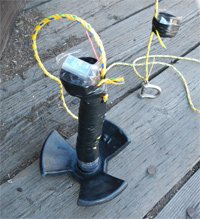
Ten HOBO data loggers UA-002-08, UA-002-64 can be obtained from a small peninsula of the local Sea Life Center. The class accumulated a few buoys, some thread, tape, old plastic bottles, rubber bands, assembled with tools, and got to work. Divided into three groups, students built moorings for shallow water (generally less than 20 ft) on community piers and deployed UA-002-08, UA-002-64 data loggers at the moorings to measure temperature and light at various depths. This HOBO UA-002-08, UA-002-64 gives students almost complete latitude in designing their UA-002-08, UA-002-64 loggers – something that wouldn't have been as rugged as a more expensive or precision gauge . Building the mooring method became an engineering challenge, introducing students to some ocean hugs, so enthusiastically sharing photos of the mooring with other classes. The mooring was deployed for two weeks in October 2012 with HOBO set to log temperature and light data every 30 minutes. After deployment, students find moorings, disassemble and clean the parts, and download and organize the data using accompanying Hoboware® Pro graphing and analysis software. Finally, the last homework assignment is an open-ended analysis of collected data. Students are asked to pose a simple question and hypothesis, and then explore relationships in the HOBO data, in a fundamental way, to test their hypothesis.
result
Clearly, this activity fits with many of the curriculum's goals and objectives. Class interests are clearly piqued as students engage in data collection in the ocean. It turned out that the data also included some interesting patterns to reinforce the concepts covered in the classroom. For example, suppose a student, might have a relationship between tide level and water temperature, and then visually explore the relationship with data from a nearby NOAA tide gauge station and water temperature from a mooring deployed at a HOBO UA-002-08 , UA-002-64. To examine the potential confounding effects of air temperature changes, she also pulled air temperature data from environmental monitoring buoys a kilometer away. Her investigations suggest that the possibility of the convergence of the highest high tide period of the day and the highest low tide period of the day, creating an additional long-term water condition in a mixed semi-diurnal tidal environment, may facilitate Extra water for warming water. The student's investigations, though inconclusive, clearly have her efforts related not only to data analysis but also to the role played by tides, mixing, and atmospheric heat exchange in shaping the ocean environment. Several elements of the introductory oceanography course make it particularly suited to this type of learning activity, including preparation to enter marine waters and the generosity of local funders. Still, this activity is highly transferrable to other classrooms. For example, in the case where marine data collection is the heart of this marine class, collecting data on a pond, lake, or even a campus fountain would still achieve the goal of having students solve engineering challenges as a group, collecting and analyzing time series of data . This, combined with the low cost of the data logger, means this type of activity is transferable to many teachers and many other classrooms. For more information, ITU Beijing North Dahe Instrument Co., Ltd. Peninsula's Introduction to Oceans certainly positively impacts students. Measurements at the end of the quarter showed that 76% of the data collection and analysis activities were viewed as a single high-impact and valuable process.
