Food waste is the largest component of the solid waste stream reaching landfills and incinerators in the United States (EPA 2011). As such, composting kitchen scraps is becoming increasingly popular as an environmentally friendly means of reducing solid waste while creating beneficial soil replenishment. Composting animal-based kitchen waste has long been discouraged for residential additions, and it attracts waste pickers for a reason. While plausible, this claim has surprisingly not been tested.
To determine whether adding animal-based kitchen waste really affects removal visitation, our biology department at Trinity College was in an experiment using three compost piles in a rural residential area in eastern Connecticut. One pile received cut vegetables and other vegetable and animal product residues, while one control pile did not receive any waste, but otherwise operated like the other 2 piles. Every visit to the pile is recorded with wildlife surveillance cameras. We are currently preparing to publish our findings from the Phase 1 study. So far, 29 species (13 species of birds, 16 species of mammals) have been recorded in the pile. The overall pattern generally showed higher visitation with piles of the mixture, but interesting seasonal variations in the main scavenging species.
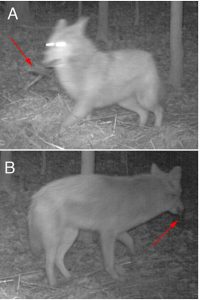
As we move beyond the original question, we are eager to see other environmental factors affecting the pickers. For example, we wish to determine whether temperature affects foraging behaviour. Food scraps were configured in piles on a six-day cycle. It can be predicted that in colder temperatures, when endothermic animals stress vigorously as they regulate body temperature, competition for kitchen scraps may be more severe, and access will focus shortly after the supply. This early-access mode can also occur under high temperature conditions, when competition for scavengers can intensify, and microbes break down waste materials animals need to utilize before they become overly coddled. However, at intermediate temperatures, one can predict a more drawn out pattern of access between supply events. To examine how temperature affects foraging behavior, we have been using ONSET data loggers (HOBO® UA-002-64) for several years to monitor the temperature near, inside the pile. Recording the air temperature near the UA-002-64 is simple. The logger is anchored to the north edge of a nearby tree by anchoring it with a plastic cable tied to a rope looped around the trunk. Deployment of loggers in a heap is a bit more challenging because the device needs to be secured to prevent its removal from foraging. To achieve this, we will record UA-002-64 in the center of a barbed wire envelope that is tethered to an iron reinforcement pole driven into the ground to mark the stake. This approach is generally fine. Recently, however, we had our first animal with a Recorder. The camera images showed that the culprit was an eastern coyote that managed to keep the wire rope (Figure 2). Fortunately, the wolves didn't find the HOBO tasty and dropped it not far from the pile, with no apparent harm.
