Classroom lights are on, while unused rooms waste energy. To overcome this problem, sensors are installed at the county campus to automatically turn off the lights after a room is vacated for a certain period of time. However, these sensors can malfunction and are often difficult to identify as broken. As a result, students and professors leave the lights on for periods of time, wasting electricity and wasting the university's money.
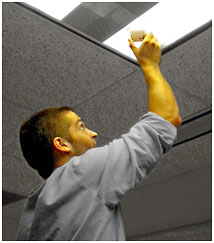
California State University Long Beach (CSULB) California State University Long Beach (Researchers) is one university affected by this issue. Aware of this energy problem, researchers energy-saving interns began a program to identify sensor failures. Interns Allie Bussjaeger and Felix Navarrete, the researchers, have tested about 25 percent of the classroom sensors so far. By identifying faulty occupancy sensors, they have the potential to save 31,000 kWh to date, which translates to $4,000 in cost savings for their campus
The researchers' average classroom contained 14 fixtures holding two 32-watt light bulbs each. Energy inefficiencies, and even overnight, one of these classrooms is still running fast. Bussjaeger, Navarrete, a member of the Consortium's Energy-Saving Green Campus Initiative, learned to use HOBO® data loggers to identify sensor failures at other campuses. Bussjaeger, Navarrete continues to work under the supervision of Paul Wingco, Energy and Sustainability Manager, on/off data loggers in classrooms on campus
On/off data logger UX90-002, UX90-002M (older model U9-002) measures 45 x 60 x 20 mm and a HOBO that records light status. Light threshold adjustment from 10 to 100 lumens/square meter. Additionally, these loggers can record up to 43,000 on/off changes. Employment time is one week for classroom installation. Then delete Downloads and Data Analysis. Using the light sensor and microprocessor Recorder UX90-002, UX90-002M (old model U9-002), record every minute when the lights are on. If the data light remains on for the entire week, then the occupancy sensor is considered non-working. If the data shows that the light is several hours after 10 point, then the sensor may be malfunctioning
With only 25 percent of the school completed, the intern estimates the researchers will save 125,000 kilowatt-hours per year thanks to sensors that identify bad occupancy across the campus. In dollar terms, researchers will potentially save $16,000 per year. "Because of the new state budget cuts, the department is encouraged to come up with cost-saving ideas," said Paul Wingco, researcher, energy and sustainability manager. "We often get calls letting us know there are lights in the building late at night. I'm delighted with the initiative of our interns to find a solution."
Bussjaeger, Navarrete intern with the Green Campus Project, projects funded by Pacific Gas and Electric, Southern California Edison, San Diego Gas and Electric, and Southern California Gas. The Green Campus Program is administered by the non-profit organization Conservation Energy, an alliance of industry, technology and energy companies. The Green Campus Program supports college students in pursuing careers in energy conservation.
