When your main worker is a 70-ton robot, you try your best to stay out of the way. Such is the case with RoboVault, in Fort Lauderdale, Florida, which uses the largest and tallest robotic crane in the U.S. to move exotic vehicles around the world, which houses customers and other valuables in an ultra-modern, high-tech storage facilities. Items are stored at least 30 feet above sea level in the warehouse in a no-person access area - no stairs or elevators to storage floors.
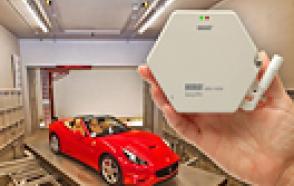
Because the facility also stores rare paintings, historical documents, prestigious wines, antiques, forensic exhibits, sports memorabilia and other climate-sensitive items, RoboVault carefully monitors the humidity and temperature within its hurricane-proof walls. However, when everyone enters the vault to check the environmental readings, the autonomous robot needs to stop its work to ensure safety.
To put an end to this disruptive practice, RoboVault recently installed the initial new wireless HOBO® ZW series data nodes ZW-001, ZW-003, ZW-005, ZW-006, ZW-007, ZW-008 to measure climate self-storage facility. With the new sensors, RoboVault employees can now see any changes in temperature or humidity in real time without having to enter the vault, because the remote network of data nodes wirelessly sends the climate information to the ZW-RCVR, ZW-ROUTER to the office computer.
"We need to maintain climate conditions that are conducive to the lifetime of those rare and valuable items," said Marvin Chaney, president and operating officer of RoboVault. “So we need to make sure there are no issues with our climate control system every day. Transmitting the data to our office is so much more convenient than sending people down to check the temperature and humidity manually every day.”
In addition to monitoring temperature and relative humidity, wireless data logger devices can accommodate sensors for measuring air conditioning voltage, amperage, kilowatts, kilowatt hours, gauge pressure, and more. A network can support up to 100 data nodes, creating a self-healing system that can monitor many different points. Therefore, this data node is desirable for storage facilities, museums and office buildings.
RoboVault places its data nodes throughout the 155,000-square-foot storage facility to monitor the environment for wine, cars and other items in special modules as well as safes. The data system allows RoboVault to ensure that the building maintains a museum-quality climate of 72ºF with approximately 50% humidity. In its wine storage unit, place a temperature of 55° with a humidity level between 68% and 70%.
The wireless data nodes ZW-001, ZW-003, ZW-005, ZW-006, ZW-007, ZW-008 work together in the wireless network to automatically send the recorded data to the remote computer on a regular basis. This offers greater convenience than conventional, stand-alone data loggers, which need to be retrieved so the collected environmental data can be manually offloaded to a computer.
The data nodes are equipped with specialized software for managing the sensor network, called HOBOnode™ Manager. The software allows RoboVault to look at the data and map it to analyze climate trends within.
As an additional level of assurance, RoboVault has configured alarm settings that will notify employees via email or text message if temperature or humidity levels fluctuate beyond company-specified levels for data nodes.
"The wireless data node is new, but works great so far. In our warehouse it's been interesting fluctuations from day to night – just a couple of degrees. I set the parameters to alarm. When a change in degree occurs, it's an alarm. It's Giving us another level of comfort, we have immediate alerts in the event of significant atmospheric changes in the warehouse,” said Matt Woodpecker, RoboVault Director of Business Development.
For safety and convenience, the facility keeps human entry to a minimum. Robotic cranes and a rail system provide out of property facilities. During the client activation process, first enter the personal password to enter the built-in professional security system, which uses biometrics, motion sensors, photoelectric beams, door magnets, networked CCTV and card access kiosks.
The plant was built to protect its contents not only from wily thieves, but also from category 5 hurricanes of 200 mph. "When there's a hurricane in Florida, this is a safe place for us and our family that we don't vacate, but stay here and keep things safe," Cheney said.
