Over the past decade, the Rocky Bay National Estuary Research Reserve (RBNERR) and the Conservancy of Southwest Florida have deployed temperature data loggers UA-001-08, UA-001-64 to monitor hatch temperatures on Keewaydin Island, Collier County, Florida. A total of 449 Onset HOBO temperature data logger loggerhead sea turtles have been deployed to study at the time of nesting on Keewaydin Island. Sea turtles are temperature-dependent sex determination (TSD) Sand temperature affects the sex of hatchlings. Incubation temperature can be used to predict artificial hatchability. Onset's HOBO® Temperature Logger starts recording hourly incubation temperatures and vacuum seals in plastic desiccant prior to deployment. As the turtle pulls the clutch, the lumberjack will deploy in the egg chamber. After the nest has hatched, the data logger is restored and downloaded using software based on the type of seizure the logger has. Data was exported to Excel for data analysis.
Figure 1 shows. Mean and standard deviation hatching temperatures for loggerhead turtles on Keewaydin Island in 2001-2009. The dotted line represents the critical temperature of 29 ˚C for male and female pups with the same ratio. Temperatures greater than 32°C produce females and temperatures less than 28°C produce male pups.
This study was initiated to examine whether clearing of exotic Australian pine (casuarina) trees and thus shade from Keewaydin Island would affect the sex ratio of captive hatchlings. In addition, the study documented the temperature of nests during active tropical storm seasons and recorded the effects of precipitation, tidal inundation on nest temperatures. Research efforts continue to examine long-term temperature trends and the role of environmental factors (rain, air temperature, storm events, climate change) in determining hatchability. An Onset HOBO® Rain Gauge Data Logger RG3-M, the RG3 was deployed on Keewaydin Island during the first record rainfall and temperature this summer for the duration of the sea turtle spawning season.
The results of the study showed that eliminating Australian pine did not affect the sex ratio in captive hatchlings. Nests on Keewaydin Island produced major admixture ratios and male-biased clutches predicted based on incubation temperature (Figure 1) and confirmed histologically (by the University of Alabama at Birmingham). Male pups are produced on Keewaydin Island which often make it the required nesting grounds. Nests on Florida's east coast primarily produce female-biased talons so Keewaydin provides much-needed males to South Florida's nesting populations. This is the longest and most intensive incubation temperature study by the professional community, resulting in significant data. Data is also used to educate the public about human and environmental factors affecting sea turtle nests.
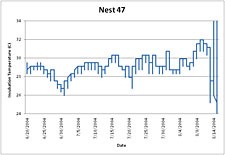
The research has had its share of excitement, such as the discovery that male pups are frequently being produced, and disappointing setbacks, such as the loss of more than half of sea turtle nests (along with temperature loggers) during storm events in 2001 and 2004. As we prepared for the 2010 turtle nesting season we found something that surprised us. An Onset HOBO® temperature data logger UA-001-08, UA-001-64 was found on the beach, we incorrectly assumed the logger was from a nest in 2009. Miraculously, the logger is still in good condition and data downloading. Based on temperature data, the nest was apparently submerged on August 13, 2004, the day Hurricane Charlier County was impacted. The logger was buried on the beach and continued to record data until May 2005. The minimum value for a logger to restore after deployment, is still functional and provides valuable data!



