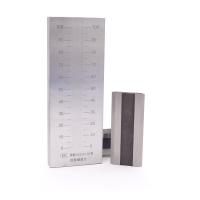
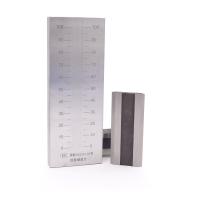
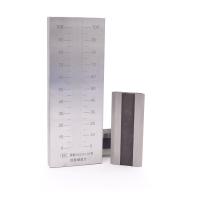
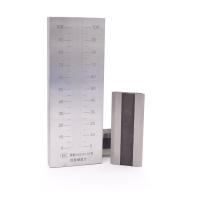
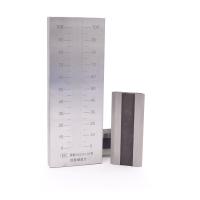
The finer the cement, the more complete its hydration reaction and the higher its strength. But if it is too thin, it will affect the output and cost, and at the same time, the moisture absorption capacity in the air will increase correspondingly, and it will easily deteriorate. Generally, the original fineness of domestic cement is to pass through a sieve of 4,900 holes/cm2, and the sieve residue shall not exceed 15%. However, since there is no unified standard for screen cloth in CHINA, steel wires of different diameters will affect the size of the screen mesh. Therefore, the new standard in 1977 was changed to a screen cloth with a square hole of 0.08 mm, and the screen residue should not exceed 15 mm. %.
It is generally believed that when the cement particles are smaller than 40μm (0.04mm), they have high activity, and when they are larger than 100μm (0.1mm), the activity is very small.
The test of fineness can be done by dry sieving method or water sieving method. When the two results are consistent, the result of water sieving method shall prevail. The method of operation and the instruments used should comply with the provisions of GB1345-7 7 Cement fineness test method (sieve folding method).
The gradation structure of cement particles has a great influence on the hydration and hardening speed, water demand, workability, heat release speed and especially the strength of cement. Under normal conditions, when the cement particle size is 0-10 microns, the hydration is the fastest. When the size is 3-30 microns, the activity of cement is the largest. When it is larger than 60 microns, the activity is small and the hydration is slow. It can carry out surface hydration and only play the role of micro-aggregate. Therefore, under general conditions, in order to better exert the gelling performance of cement and improve the early strength of cement, it is necessary to increase the fineness of cement and increase the gradation ratio of 3 to 30 microns.
Another way to express the fineness is the specific surface area, that is, the total area per unit weight of cement, and the unit is cm2/gram or m2/kg. Fineness is expressed by specific surface area. The specific surface area is the total surface area per unit mass of cement (㎡/kg). The national standard (GB175-2007) stipulates that the specific surface area of Portland cement should be greater than 300㎡/kg; the fineness of slag Portland cement, pozzolanic Portland cement, fly ash Portland cement and composite Portland cement The degree is represented by the sieve residue, and the sieve residue of the 80μm square hole sieve is not more than 10% or the sieve residue of the 45μm square hole sieve is not more than 30%.