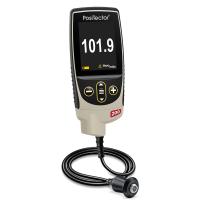
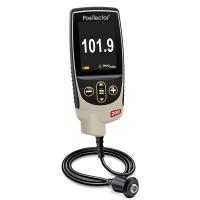
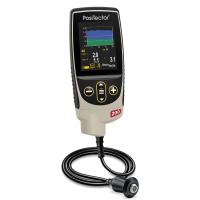
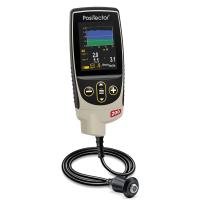
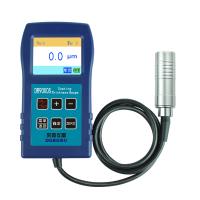
PosiTector®200 涂层测厚仪非破坏性测量涂层厚度超过非金属包括涂料在木材,混凝土,塑料,复合材料和更成熟的使用超声波技术。使用新的Max Thick Mode,PosiTector 200比以往任何时候都更容易使用。
测量原理
所述PosiTector 200探针发出的超声波的声音脉冲行进到涂层中,并反映从处于密度不同,例如衬底的任何界面/相呼应。它测量声音脉冲从探头传播到涂层/基板界面并返回的时间。通过将该行进时间乘以穿过涂层的声速(对于大多数聚合物涂层来说类似),可以计算涂层的厚度。
虽然PosiTector 200可以检测到涂层 - 基板界面上几乎总是存在密度变化,但也可以识别涂层之间的密度变化。PosiTector 200 Advanced型号通常可以检测不同或相同涂层的层之间的界面,只要在施加后续层之前允许初始层完全固化即可。通常,最响亮的超声回波代表涂层 - 基板界面,较小的回波代表单独的层厚度。
默认模式
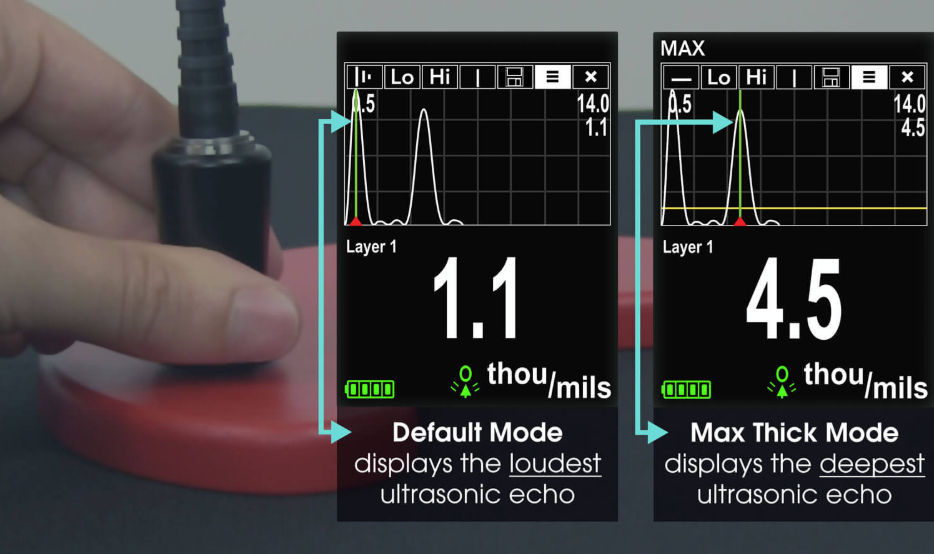
PosiTector 200的默认测量模式已成功应用数十年,可测量各种涂层和基材的涂层厚度。所述PosiTector 200搜索其测量范围内最响亮的超声回波,并将其报告为涂层厚度。在多层模式中,与最大回声相关的厚度(取决于所选择的层数)被报告为单独的层厚度。对于大多数测量应用,特别是在测量光滑的聚合物涂层时,该方法提供了总涂层厚度和单个层的准确读数,无需任何设置或调整。
有时使用PosiTector 200测量涂层表面附近表面粗糙度或许多响亮回波的应用是有挑战性的,因为这些条件会产生响亮的,不需要的回波,通常比涂层 - 基板界面上的所需回波更大且更响亮。虽然增加仪器的Lo范围会忽略这些不需要的回波,但是耗时并且有时难以进行调整以忽略不需要的表面回波,同时仍然测量涂层的较薄区域。
最大厚度模式
当增加Lo Range需要调整太接近预期的涂层厚度或者如果用户根本不想调整范围时,NEW Max Thick Mode是很好的的。
When Max Thick mode is enabled, the PosiTector 200 searches for the deepest significant echo, not the loudest echo. This means any loud echoes near the surface (usually caused by surface roughness or "noisy" coating systems) are ignored. This mode is generally more efficient at reporting the total coating thickness at the substrate interface and eliminates the need to adjust the instrument's preset Lo range. Since there are inevitably some small echoes within the substrate, only echoes above the preset loudness are reported. On PosiTector 200 Advanced models, this threshold can be adjusted from the graphic display mode.
When Max Thickness mode is enabled and multiple slices are selected (PosiTector 200 Advanced only), the slice thickness associated with the deepest ultrasound echo is reported.
Note: Maximum Thickness mode is not recommended for thin metal substrates or composite materials such as carbon fiber or fiberglass.
in conclusion
The PosiTector 200 Ultrasonic Coating Thickness Gauge measures coating thickness on non-metals including wood, concrete, plastics and more. For most applications, the NEW Max Thick Mode will provide accurate readings without having to adjust the Lo Range to ignore incoming surface reflections.