For many hygrometer users, the importance of time cannot be overstated. Restoration professionals need to know where hidden moisture is in a structure as soon as possible to minimize or prevent water damage. Lumber manufacturers need to know if all the lumber they are processing is ready for sale. Realtors may not have a lot of free time to test structures for moisture.
However, just as speed is important with moisture testing, so is accuracy. Many restoration professionals need to know exactly where moisture contamination begins and ends. Lumber manufacturers need to know the moisture content of the board's shell and core.
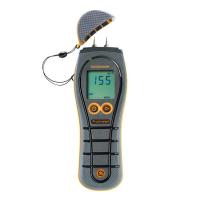
So, how can you save time and money on humidity testing while maintaining the accuracy of your hygrometer? One trick is to use a 2-in1 or 3-in-1 humidity testing tool, such as a TotalCheck hygrometer, to speed up the humidity testing process and get accurate humidity measurements.
Scan Large Areas Quickly with a Needle-Free Moisture Meter
When it comes to being able to quickly inspect large sections of structures, pinless hygrometers offer a distinct advantage over pin-type hygrometers. As long as the scanning plate at the bottom of the pinless hygrometer  is in solid contact with the surface being scanned, a reliable measurement of moisture content can be obtained.
Many restoration professionals and real estate professionals use pinless Moisture Meters so that they can spend less time testing different building materials. Lumber manufacturers can use pinless Moisture Meters to inspect large quantities of flat planks as well.
This provides a quick pass/fail check of moisture content even with a reference scale hygrometer. Because the TotalCheck 3-in-1 meter uses a reference scale in its needleless metering mode, it is often used to quickly determine if building materials are damaged.
Users just need to test a dry sample of any material they want to check first so they can know if the reference scale is reading high or low for that material. Once that's done, they can push the scan board over the material being tested, take a quick read, lift it up, and repeat until they've covered everything they need to check. It takes a while to check the same area using a needle hygrometer.
Use PIN Moisture Meter Mode for details
Although the Reference Ratio mode of TotalCheck's built-in pinless gauge can quickly pass or fail assess moisture in different materials, it does not provide a quantitative measurement of moisture content. To obtain quantitative data, the user needs to use a hygrometer, which is calibrated for the specific type of material being tested.
The TotalCheck 3-in-1 meter pin Moisture Meter model features drywall and wood moisture test scales to provide accurate, quantifiable moisture measurements in both materials, making it ideal for restoration, real estate and wood fabrication applications very valuable.
After figuring out where all the moisture pockets are in a structure or a pile of lumber, pins on the TotalCheck can be inserted into the moisture-damaged area to get an accurate reading of the moisture content. If insulated contact pins are used, the user can easily identify the exact depth of moisture pockets in the structure, or establish shell and core moisture content in planks.
Additionally, the pin hygrometer mode can be used to test moisture in materials with uneven surfaces that cannot be checked with a pinless hygrometer. With the extended length moisture probe, the TotalCheck can even be easily used to test for moisture in insulation. Hygrometer accuracy is ensured by calibrating the device to verifiable NIST standards and can be tested using Moisture Content Standards (MCS).
Check humidity conditions with a thermo-hygrometer
As mentioned, the TotalCheck is a 3-in-1 humidity testing device that combines a pin hygrometer, pinless hygrometer, and temperature hygrometer into one convenient tool. Thermo-hygrometers are valuable for restoration, real estate, and lumber fabrication for several different reasons.
Quickly identify moisture-compromised rooms in a structure. Real estate and restoration professionals can use the Thermo-Hygrometer mode to test the ambient relative humidity conditions of structural rooms on a room-by-room basis. Unusually high relative humidity (RH) levels in an area can be a strong indicator of moisture intrusion, helping restoration and real estate professionals focus their searches on rooms that are likely to be damaged.
Validation of wood acclimatization conditions. Relative humidity is a big problem for lumber manufacturers, especially in the spaces where they store and accommodate future lumber distribution. By checking the relative humidity of their storage areas, lumber manufacturers can thus ensure that the RH conditions there match those of the area the lumber will be shipped to, which helps prevent problems after the lumber has been shipped. This helps save time and money dealing with customer complaints about wood cracking or swelling.