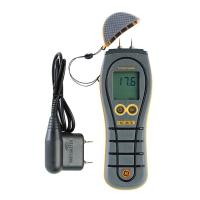
For plumbers, restoration professionals, and even home or business owners, the importance of quickly locating leaks cannot be overstated. When moisture intrusion in a structure is allowed to continue unabated, it can lead to a variety of structural problems and health hazards such as:
Collapsed walls, ceilings or floors;
mold growth;
Pests
Most of the time, when we discuss ways to find leaks in structures, we're referring to using a pin hygrometer to do the job. But can a needleless hygrometer also be used to locate leaks?
In some cases, needleless hygrometers are invaluable for quickly finding leaks in structures. With that in mind, here's how to use a needleless Moisture Meter to spot leaks:
Moisture Testing with Needleless Hygrometer vs. Needle Flow Meter
Needleless hygrometers work a bit differently than needle flow meters. Where pin hygrometers use a pair of electrodes to measure resistive current, pinless hygrometers use electromagnetic frequencies to "scan" a sample of material for the presence of moisture.
Because pin gauges only measure the moisture content of the material between the pins, they tend to be very accurate in identifying the precise boundaries of moisture-damaged areas. Also, if you use insulated pins, it's easy to determine exactly how deep the source of the leak or moisture pocket is.
Needleless Moisture Meters, on the other hand, scan a fairly large area. While this does sacrifice precision in determining the exact depth and boundaries of a leak or moisture pocket, it is much faster than pushing in a pin.
It's also important to note that a pinless hygrometer needs a flat, solid surface in order to work properly. As a result, the types of materials you'll be able to check are limited - for example, if you're checking insulation, you'll need a pin gauge with an extra long probe, not a pinless moisture gauge.
How to Find Leaks with an Anhydrous Hygrometer
Moisture testing with a pinless water meter is a relatively simple process once you get started, but first, there's a little homework to do.
Before you start tracking leaks in your structure, you will need to set your needleless hygrometer to its reference scale mode (if you have one). For example, Delmhorst's pinless ProScan digital hygrometer has this mode as an option, while the TechScan analog pinless hygrometer has a color-coded bar on the bottom.
Once the meter is in reference mode, it is important to take a dry sample reading of each building material that will be tested in the search to locate the point of origin of the leak. That way, you know what the drying instructions are for each material. For example, if you're testing a floor for leaks, you'll need to read the floor where you know it's going to be dry -- the same happens when you find a leak in a wall.
To track leaks on floors and ceilings, simply press the hygrometer against a flat surface and take a reading. Then, lift the gauge, place it in a different place, and take another look. You can start where you suspect a leak, or simply cover the entire floor. If you do find that the floor or ceiling material is wet, keep checking the surrounding area until you have a rough outline of the moisture-resistant material.
When finding a wall leak, it's important to remember two things:
If there is not enough thickness, the needleless gauge may scan the material behind the wall;
If the seepage is behind the wall, it may be much higher than where the wall becomes wet.
Why is the point at which a wall represents humidity much lower than the origin of the leak? Because water has the least resistance. If that path didn't send the water sideways to the wall, at the exact height where the leak occurred, it would instead flow into the building materials below the origin and then funnel outward as those materials become saturated.
Additionally, when testing for moisture in walls with a needle-free gauge, the gauge will provide an average of the moisture levels detected over its entire scan range. If this includes some empty space because the walls are thinner than the meter's scan depth, then this can produce false positives. Because of this, it is better to use a needle hygrometer when trying to find holes in the wall.
When to Use a Needleless Hygrometer to Look for Leaks
Many restoration professionals use needleless hygrometers early on to locate leaks in structures so they can completely cover large areas of the room as quickly as possible. Once they had a general feel for where the leak was in the structure, they switched to a pin-type Moisture Meter to get more accurate information.
Some people even use a 2-in-1 humidity testing device, like the TechCheck PLUS Hygrometer, to get the best of both worlds when testing humidity.