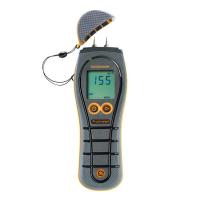
Hurricane season brings with it concerns about property damage and homeowners insurance. Specifically, questions such as "Will damages caused by high winds, floods, etc. be compensated?"
While there is no easy answer to this question - it depends on the type of property insurance, the amount of coverage, the insurance provider, documentation of the damage, local bylaws and many other variables - there is something about homeowners, business owners and water damage compensation. Compensation professionals can do to improve property damage insurance claims, making it more likely that lost expenses will be recovered. One of these is using a recovery hygrometer to check for water damage to property.
How Can Hygrometers Help with Property Damage Insurance Claims?
Here's a quick explanation:
Moisture Meter Helps Document Water Damage
The biggest way restoration hygrometers help with water damage insurance claims is that they help restoration professionals create the documentation needed to prove the extent of the damage.
This is because, using a recovery Moisture Meter, it is possible to quantitatively assess the moisture content in various building materials such as wood or drywall. By quantitatively reading out the moisture content of various building materials, restoration professionals can use objective data to demonstrate the extent of structural damage and the need for specific drying/tearing operations.
Documenting moisture measurements helps resolve disputes
If the insurance company objects to the need for some specific drying/tearing work, such as trashing building materials to remove excess moisture from the structure, it is absolutely essential that the moisture content of any scrap material be documented. This information can help demonstrate that the moisture content levels of these materials are at the point where the risk of mold intrusion or critical structural failure requires their removal.
This works wonders for resolving disputes between home/business owners or restoration companies and insurance companies. This in turn helps ensure that owners are compensated so that restoration contractors can get paid for their own work.
Restoration Moisture Meters Help Ensure Jobs Get Done the First Time
One problem that tends to arise in water damage repair/restoration is that a bag of water or source of moisture intrusion may be missed during the initial inspection. This leads to further damage after the "job is done". The problem is, the cost of such damage can be harder to justify to insurance companies.
A better way to deal with this problem is to prevent it from happening in the first place. A hygrometer helps with this.
By using a restoration hygrometer to check for excess moisture levels in various building materials, hidden sources of moisture pockets and moisture intrusion can be found that could become problematic later and during initial water damage repair. Eliminate them at work. This helps minimize the risk of additional injury, which is more difficult for insurers to clarify.
Picking the Right Moisture Meter for Restoration Jobs
Having the right hygrometer is necessary to quickly and efficiently find and document moisture in structures. With the right hygrometer, restoration work can be performed faster and more efficiently than without a hygrometer. Given the number of hygrometers currently on the market, it can be difficult to choose the right one. However, when choosing a recovery hygrometer, there are a few things to consider:
Instrument type. Moisture meters include needle and needleless varieties. Needle-free gauges are good at scanning larger areas, while needle gauges can check for uneven or soft materials and provide information on how deep moisture pockets are.
Optional electrode compatibility. Some special electrodes can greatly increase the versatility of the hygrometer. However, the meter needs to be compatible with the electrodes. Note: All pin-type DelMurthTM hygrometers are compatible with all Delmhorst electrodes.
Read the balance. Calibrate different hygrometers to obtain accurate moisture measurements in different materials. When inspecting a hygrometer for restoration work, it is important to note which moisture reading scale the meter is calibrated to, such as plaster (drywall), wood, or benchmark (a non-specific scale that provides qualitative moisture data).
Humidity reading range. In what range can the meter detect moisture? A wide reading range is usually desirable as it allows accurate measurements on heavily dampened materials.
Easy to operate. More sophisticated hygrometers tend to be more flexible, giving you a lot of additional options. However, it also means a steeper learning curve for being able to use the meter effectively. Some operators prefer simpler gauges that new users can easily pick up and use, while others prefer more robust equipment, even if it takes some getting used to all the features.
So, which Moisture Meter is right for your needs? It depends on what your needs are.
If you need a super capable, all-in-one device, something like Delmhorst's Navigator Pro Hygrometer is a good choice for professional restoration contractors. The versatile NavPro has three different moisture testing modes (pin, pinless, and thermo-hygrometer) and moisture scales (wood, drywall, and reference), making it the ideal tool for almost any moisture testing situation. Combined with the ability to store and export readings with location and time stamp, it is also ideal for documenting recovery efforts.
The J-Lite is a great and reliable moisture testing tool for restoration professionals who want an almost foolproof device. It features a simple light-up LED display that is easy to read even in the dark, and is easy to operate: just press the pins into the material and press the button.