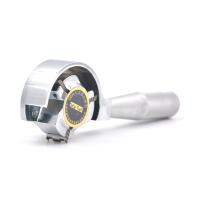
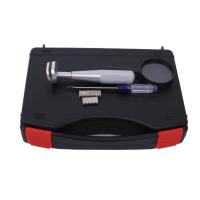
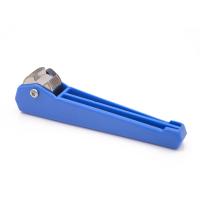
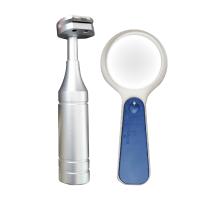
This is North-South Chaohua Instrument. In this issue, I will mainly share with you the points for attention in the selection of paint film cross-cutting device.
The paint cross-hatch is an instrument used to measure the adhesion properties of coatings. Generally, there are three main standards for paint film scratchers at home or abroad. One is GB/T9286. There are also three standards, ASTM D3359 and ISO2409. Generally, during the selection process of paint film cross-cutting device, the type can be selected according to two factors: whether the substrate is hard or soft, and the film thickness range. Generally, it can be divided into three types of film thickness. One is 0~60μm. This relatively thin coating. There is also a middle coating of 61~120 μm, and a post coating of 120~250 μm.
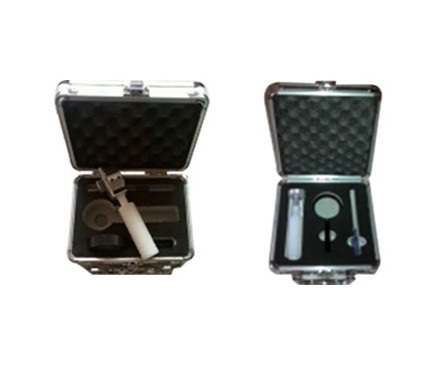
The paint film scratcher is produced according to the standards just mentioned. Therefore, their specifications also have some strict restrictions, which are generally divided into tooth spacing and the number of teeth. There are generally 4 types of tooth spacing, 1mm, 1.5mm, 2mm and 3mm. The number of teeth is mainly two, one is 6 Teeth, one is 11 teeth. Of course, the development of the paint film scratcher has also been divided into single-edged or multi-edged. Multi-blade, as the name suggests, it has a blade with multiple blades (generally 4 blades), so that the blade can be rotated at different angles when scribing, which is equivalent to using 4 different scribing devices for scribing experiments. One is also a way to reduce blade wear.
When choosing a paint film scratcher, the most important thing is the cutter head of the scratcher. The editor has seen some customers who would rather not buy a complete set of paint film crossers, but choose to buy an imported crosser blade. Why are scribe blades so important? Because a good cutter head largely determines the quality of the crossing effect. Just like a SLR, without a good lens, it is difficult to take good photos.
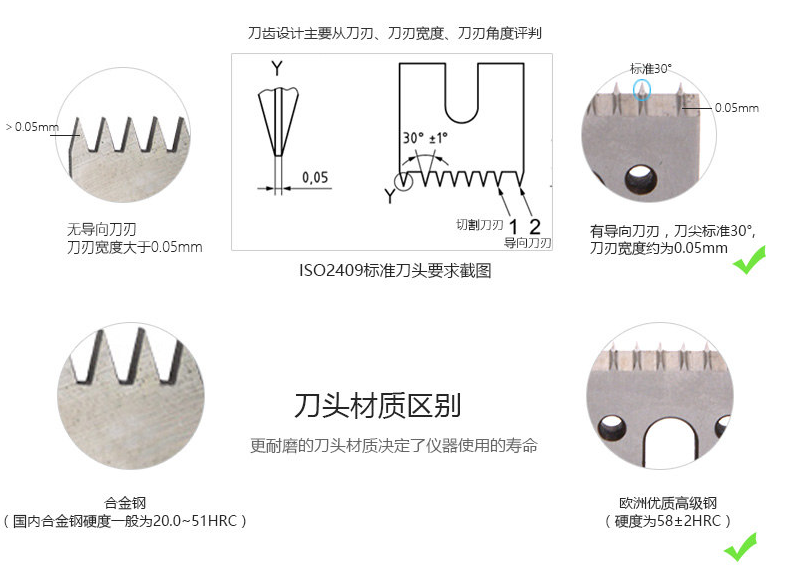
In fact, domestically produced cutter heads cost forty or fifty yuan. But an imported knife head costs at least a thousand dollars. The design of the cutter head actually has some strict regulations. The design of the knife head is mainly judged from the width of the blade and the angle of the blade. The low-end blade has no guide blade, and the blade width is relatively large. The imported cutter head with guide blade has a standard 30° tip and a blade width of about 0.05 mm.
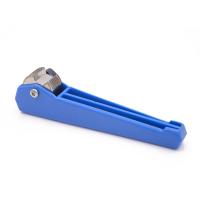
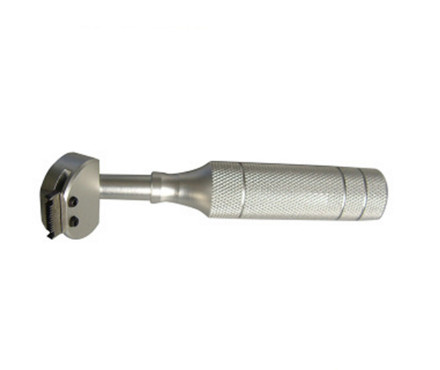
In terms of material, many low-end cutter heads in CHINA are made of alloy steel. The hardness of this alloy steel is average, and can only reach 20 to 50HRC. The imported cutter head, taking European TQC as an example, has a hardness of 58±2HRC. In addition to the selection of the knife head, the design of the handle is also a very important part. Before I talk about it, I will tell you a joke. This is what actually happened. After a customer bought an imported cross-cutting device at NBCHAO Mall, he found that the handle was loose and made a big fuss in NBCHAO, saying that your things are so expensive, why are they loose before they are used. Bring such a trick! How did this happen? In fact, this is by design. Because the handle turns left and right, it can better control the force of the grip part. Once you use uneven force, the handle will consume some of your unstable force through this rotation, so that your knife head can evenly draw a specific effect on your paint film.
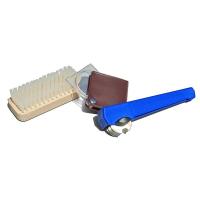
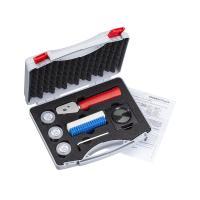
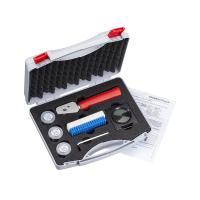
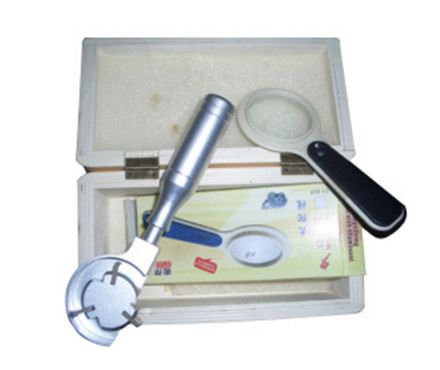
The general paint film scratcher is equipped with a magnifying glass during the experiment, which is about 2.5 times. There is also the nylon brush, which is stipulated in the standard operation, so I won't go into details. Furthermore, one of the more important consumables is tape. The general method of operation is also relatively simple, requiring only a series of different cutting methods on the dried coating on the substrate. If you choose a 6-tooth or 11-tooth blade, cut two parallel lines perpendicular to each other, you can get 25 or 100 squares, and then get the actual cutting effect according to the standard operation, corresponding to the adhesion rating standard Do an adhesion assessment.
When choosing a paint film crosser, if it is based on the ISO2409 standard, you can generally choose a 1mm spacing for solid substrates below 60 microns. If it is a soft substrate, then choose 2mm. For the specific selection, please refer to the selection of the paint film scratcher in the NBCHAO Mall. The main paint film scratchers here are different brands, imported and domestic. Different price points, some of their differences, and some details that need to be paid attention to during the selection process. A lot of information on other Internet will not be repeated here.